US author edition
Unpopular Science
Kernel Keys Press, 2026
The author’s edition in US English, typeset by the author in LaTeX.
- Format
- Paperback · 568 pages · full color · 7 × 10 in
- ISBN
- 979-8-9940-2871-1
- LCCN
- 2026902801
- License
- CC BY-NC 4.0
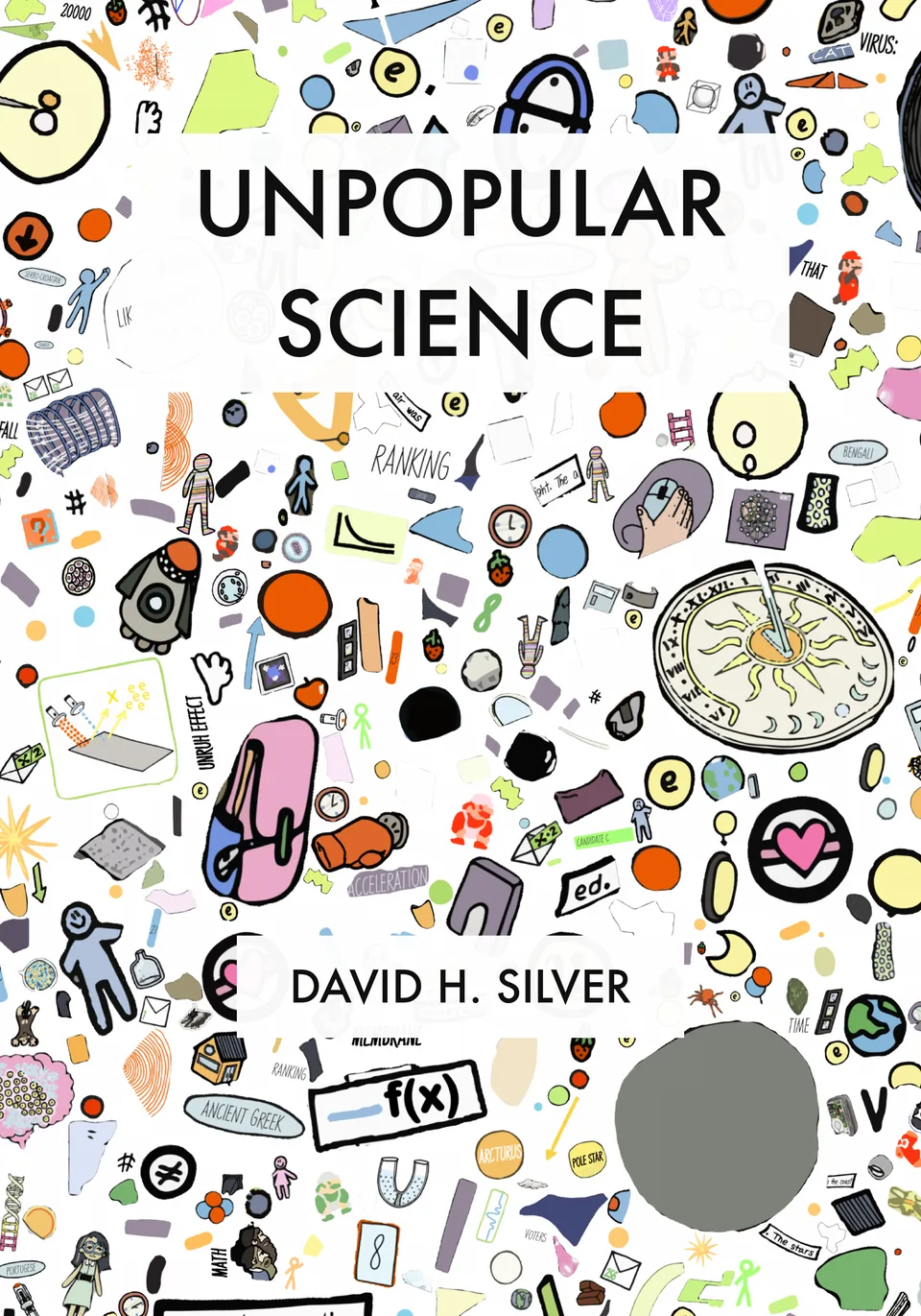
David H. Silver · Kernel Keys Press · 2026
Fifty explorations at the boundary of mainstream science.
Fifty phenomena from humanity’s exploration of nature. Each chapter moves from historical context through the main exposition to rigorous technical analysis.
From the prologue
Science doesn’t need exaggeration; its wonder is self-evident to those who explore it properly.
This book returns to the roots of scientific wonder, combining accessible explanations with rigorous mathematical foundations. Unlike contemporary science communication that oversimplifies or sensationalizes, it highlights the beauty of science as it truly is: both elegant and complex. The focus is understanding, not just exposure.
Too often, modern science communicators rely on a “laugh track” approach — telling readers how they should feel (“this is mind-blowing!”) instead of letting wonder arise naturally from the ideas.
Fifty stories, each structured to guide readers from the intuitive to the profound:
Concise background — the people, circumstances, and discoveries behind the phenomenon.
Described in straightforward terms, avoiding sensational language for clear, accurate explanations.
Rigorous academic analysis with equations, references, and derivations. Unapologetically tough — and not required to grasp the main ideas.
Every chapter also opens with a full-page illustrated sidenote by Jess DG Hayes, and an opening quotation traced, wherever possible, to its original source and language.
Read any chapter free
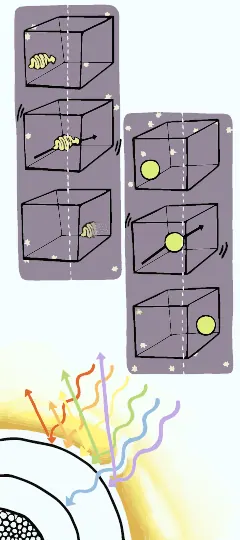 Chapter 01Relatively YellowThe yellow color of gold requires relativistic quantum mechanics to explain, unlike silver’s silvery appearance. Electrons in gold atoms reach 58% of light speed, causing changes in the 6s and 5d orbitals. This shifts absorption to blue wavelengths, resulting in the reflection of yellow-red light. Similar relativistic effects explain mercury’s liquid state and platinum’s white appearance. These everyday properties demonstrate how modern physics manifests in macroscopic observations.
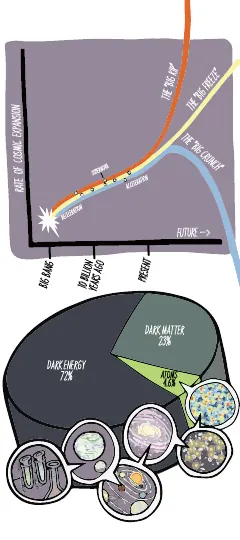 Chapter 02Dark Energies Are Pushing Us ApartObservations of distant supernovae in the 1990s revealed that the universe’s expansion is accelerating, contradicting earlier models that predicted gravity would slow cosmic expansion. This acceleration requires dark energy, an unknown component comprising about 70% of the universe’s energy density. Dark energy counteracts gravity at cosmological scales, manifesting as either a cosmological constant in Einstein’s equations or a dynamical field.
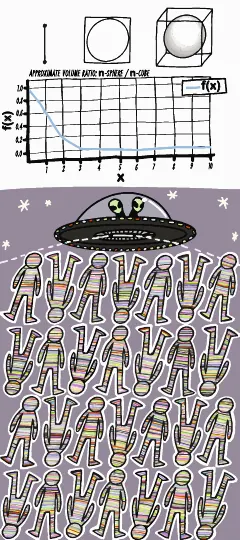
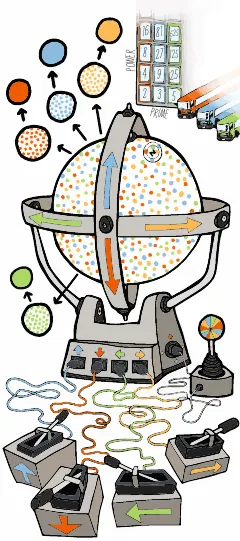 Chapter 03An Axiom of Your ChoiceThe Banach–Tarski paradox shows that a solid sphere can be partitioned into finitely many disjoint pieces and, using only rigid motions, reassembled into two spheres identical to the original. This construction depends on the Axiom of Choice and the existence of non-measurable sets, whose behavior diverges from intuitions about volume. While not physically realizable, the result illustrates how certain set-theoretic assumptions allow decompositions that defy standard notions of size and conservation.
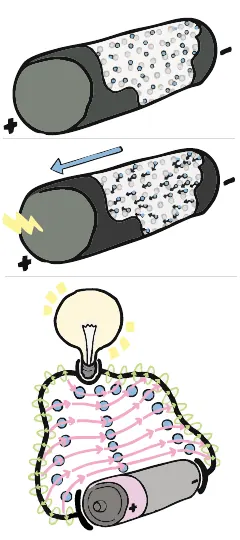 Chapter 04Think Outside the WireElectrical energy travels primarily through electromagnetic fields surrounding conductors, not through the movement of electrons in wires. While electrons drift at millimeters per second, energy transfer occurs near light speed through the Poynting vector (S = E × H), which describes energy flow perpendicular to both electric and magnetic fields. This field-based transmission explains why circuits respond almost instantly despite slow electron movement, as opposed to the common misconception that electricity flows like water through pipes.
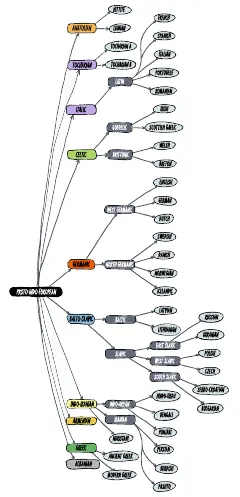 Chapter 05A Circle of PIEThe terms ‘wheel’ and ‘cycle’ (but not circle!) derive from Proto-Indo-European *kʷékʷlos despite their phonetic dissimilarity in modern languages. Regular sound shifts transformed this root differently in Germanic and Hellenic branches through documented phonological processes. These linguistic patterns preserve evidence of Bronze Age terminology and illustrate consistent patterns of language change. Comparative methods identify these transformations through sound correspondences across Indo-European languages.
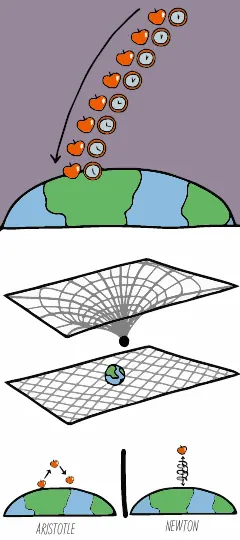 Chapter 06The Apple Falls the Slowest from the TreeGeneral relativity formulates gravity as spacetime curvature where time and space metrics are affected by mass and energy. Contrary to the depiction of gravity as bending space, as in the rubber sheet visualizations, in cases in which masses are small (the Earth, for example) it is the gradient in time’s rate that creates gravitational attraction, guiding objects towards regions of slower time. The reason an apple is falling is not because it is affected by force radiated by Earth, nor is it due to the curvature of space, but rather because it is following the shortest path through curved time.
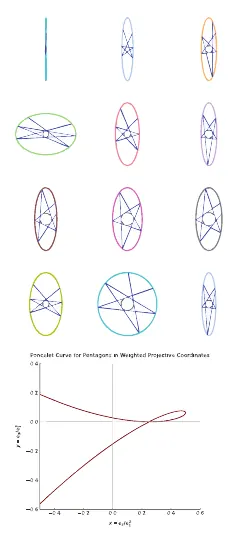 Chapter 07A Complex (Projective) Billiard GamePoncelet’s Porism describes an unexpected property of billiard trajectories between two nested ellipses: if one path returns to its starting point after a finite number of bounces, then all starting points generate periodic trajectories with the same number of bounces. This geometric result connects to elliptic curves and measure-preserving dynamical systems, exemplifying how problems in distinct fields reduce to the same equations through appropriate frameworks.
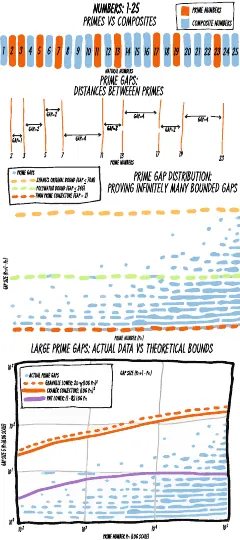 Chapter 08Mind the GapIn 2013, an unaffiliated Yitang Zhang proved there exists a finite bound B (initially 70,000,000) such that infinitely many prime pairs differ by at most B. While prime gaps can grow arbitrarily large, this breakthrough showed they cannot drift apart arbitrarily far. The Polymath8 collaboration subsequently reduced this bound to a few hundred. Zhang’s approach combined distribution properties of primes in arithmetic progressions with an advanced sieving technique, resolving a fundamental question about number patterns while falling short of proving the Twin Prime Conjecture that infinitely many primes differ by exactly 2.
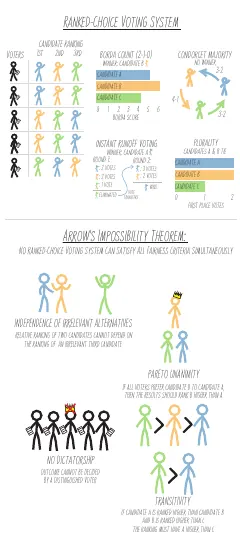 Chapter 09Real Democracy Has Never Been TriedArrow’s Impossibility Theorem shows that no voting rule can convert individual rankings into a collective decision without violating at least one basic principle of fairness. What seems like a straightforward requirement for democracy turns out to be mathematically impossible, leaving every voting system to sacrifice some aspect of fairness.
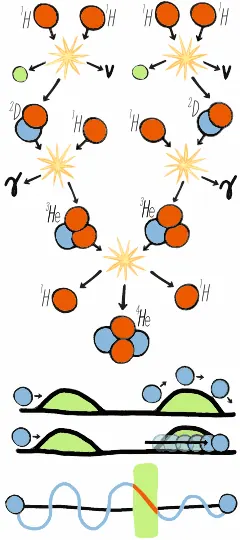 Chapter 10The Tunnel at the Beginning of LightSolar fusion proceeds despite temperatures insufficient for classical nuclear reactions because quantum tunneling enables protons to penetrate the Coulomb barrier with non-zero probability. At the Sun’s core temperature of 15 million Kelvin, the average proton possesses only about 1/20th of the energy classically required to overcome electromagnetic repulsion between positively charged nuclei. Quantum mechanics allows particles to “tunnel” through energy barriers they cannot surmount classically, with probability decreasing exponentially with barrier height and width. This tunneling effect, combined with the enormous number of interaction attempts in the solar plasma, sustains the fusion rate necessary for stellar stability over billions of years.
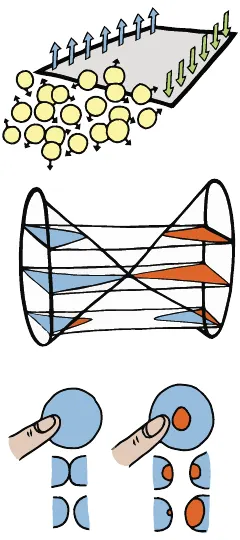 Chapter 11Edges of TomorrowTopological insulators exhibit an unusual combination of properties: insulating in their bulk yet conducting electricity perfectly along surfaces or edges. This behavior originates from the topology of the material’s electronic energy structure in momentum space, which guarantees protected conductive states resistant to scattering and imperfections. The mathematical concept of topology, concerning properties preserved under continuous deformation, manifests physically through the way electron wave functions ’twist’ as their momentum changes, leading to robust edge states and quantized conductance.
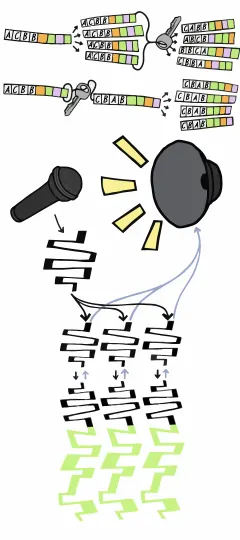 Chapter 12You Would Like to Order FirstGSM mobile communications used stream ciphers to protect call privacy, but protocol design left them vulnerable. Encryption was applied only after error correction and formatting, so fixed training sequences and redundant coding produced predictable ciphertext patterns. These leaks allowed attackers to recover session keys with modest effort, demonstrating that security depended less on theoretical cipher strength than on overall system design.
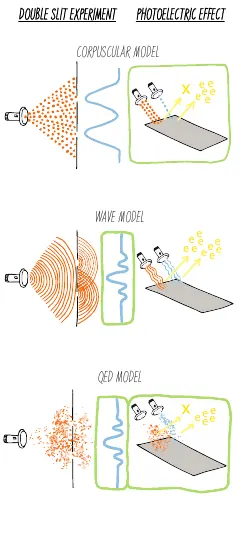 Chapter 13Right on SpotPoisson’s spot, also called the Arago spot, demonstrates wave diffraction through the unexpected appearance of a bright point at the center of a circular object’s shadow. When Augustin-Jean Fresnel proposed light as a wave phenomenon in 1818, Siméon Poisson derived this counterintuitive prediction in an attempt to disprove the theory. The effort backfired when François Arago experimentally confirmed the spot, which corpuscular optics could not explain, providing decisive support for the wave model of light.
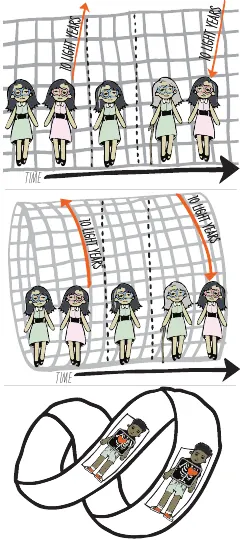 Chapter 14A Circle of TimeIn a cylindrical universe with compact spatial dimensions, twins can separate and reunite without acceleration, with one traveling around the circumference while the other remains stationary. Despite neither experiencing acceleration, they age differently upon reunion, creating a variant of the famous special relativistic paradox. In non-orientable topologies such as the Klein bottle universes, travelers can additionally experience reversal of chirality. Even a thoroughly non-dextrocardic explorer might come back from a cosmic stroll with his heart on the right side, no trauma needed.
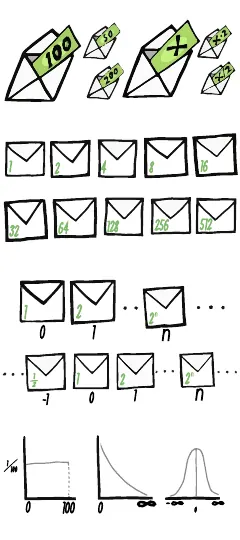 Chapter 15Envelope Trade-UpThe Envelope Paradox presents two envelopes where one contains twice the money of the other. After selecting one envelope, seemingly valid probabilistic reasoning suggests an expected gain by switching (averaging x/2 with 2x), regardless of which envelope was initially chosen. This symmetric conclusion creates a logical inconsistency since perpetual switching cannot be optimal. The paradox arises from improper application of expected value calculations to scenarios with unbounded distributions or when conditional probabilities are not properly accounted for. Resolving the paradox requires distinguishing between known values and variables, recognizing when probability distributions are ill-defined, and understanding the limitations of calculations with potentially infinite quantities.
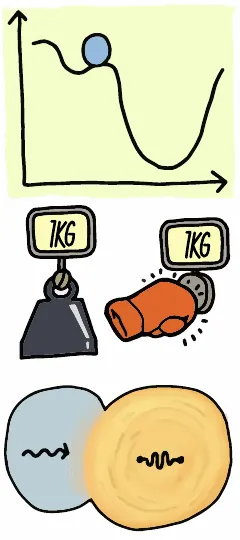 Chapter 16An Empty ThreatOur universe may exist in a false vacuum — a metastable state that could decay through quantum tunneling, producing a bubble of altered physics expanding at light speed. Current Higgs boson measurements suggest that while such decay is improbable for timescales far exceeding the age of the universe, the possibility remains that reality itself could undergo a phase transition that abolishes matter and forces — with the bonus side effect of no more spam.
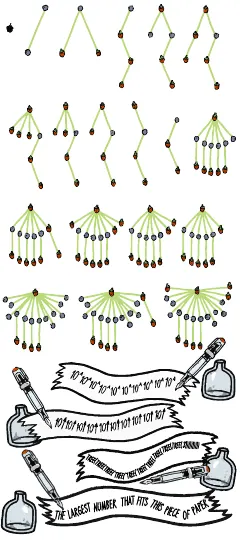 Chapter 17The Busy Beaver That Ate the TREEImagine you are given a pen with enough ink to write 20 centimeters and you are to write the biggest number you can think of. You can start by a tower of exponents , but it is not that big. In this chapter we explore the hierarchy from computable functions to TREE(3) — a number so immense that even if you built a tower of exponentials starting with a trillion raised to the power of a trillion, and then repeated that construction every attosecond for a trillion years, the result would still be vanishingly small in comparison. Yet even TREE(3) sits as close to infinity as the number eight, placing us in an infinity zoo where sizes exceed the categories brains evolved to handle.
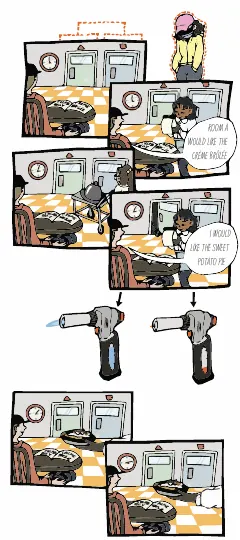 Chapter 18A Leaky Crystal BallSpeculative execution optimizes performance by executing instructions before knowing if they’re needed, leaving microarchitectural traces in cache memory even when results are discarded. Attacks such as Meltdown and Spectre exploit this, by constructing code sequences where a secret value determines which memory addresses are accessed during speculation. By measuring which addresses load quickly afterward (indicating they were cached), attackers can determine if specific bits were 0 or 1, allowing secrets to be extracted across privilege boundaries.
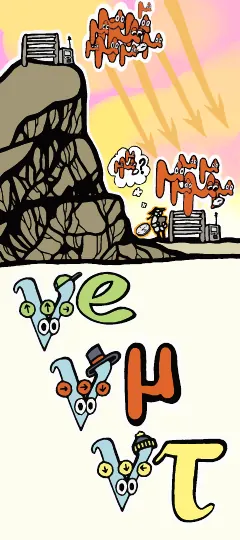 Chapter 19Consider the Muon’s PoVMuons created by cosmic rays colliding with the upper atmosphere provide direct evidence for time dilation. With a rest-frame lifetime of approximately 2.2 microseconds and traveling close to light speed, classical physics predicts these particles should decay before reaching Earth’s surface. Instead, detectors routinely observe muons at sea level. Special relativity explains this observation: from Earth’s reference frame, the muons’ time runs slower by a factor of γ (approximately 10–50 depending on energy), extending their lifetime enough to reach ground level. From the muon’s perspective, relativistic length contraction reduces the distance traveled.
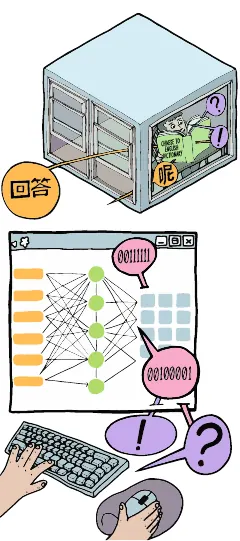 Chapter 20Capish, Comprehendes, Computes?Searle’s Chinese Room thought experiment challenges computational theories of mind: someone manipulates Chinese symbols according to rules without understanding the language. They produce appropriate responses, passing a linguistic Turing test, yet possess no comprehension. The argument distinguishes syntax (symbol manipulation) from semantics (understanding), suggesting that computers executing algorithms operate only at the syntactic level.
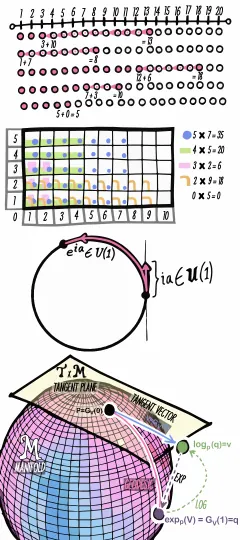 Chapter 21Exponentially GeneralizableThe exponential function extends far beyond calculus, appearing across mathematics as a bridge between local and global structure. From power series to Lie theory, from Riemannian geometry to sheaf cohomology, exponential maps carry additive or infinitesimal data into multiplicative, compositional, or curved settings. What began as a trick for quick computation has become a central map linking analysis, geometry, and algebra.
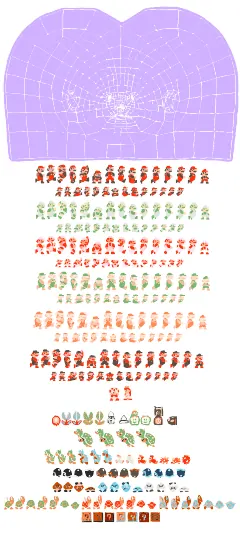 Chapter 22Creeping BugMinecraft’s Creeper began as a mistake. Markus Persson entered the pig’s dimensions backwards, producing a tall, thin figure that looked nothing like an animal. Instead of deleting it, he added a texture, a frown, and an explosive routine borrowed from the game’s block-destruction code. The result was a creature that crept silently, paused, and detonated. A simple modeling error became Minecraft’s most iconic enemy.
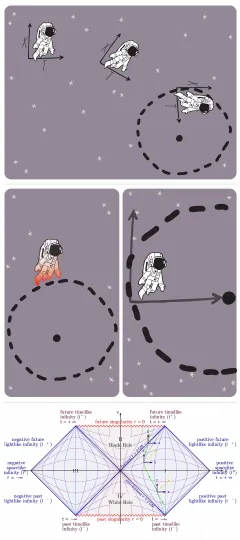 Chapter 23A Place at the End of TimeBlack holes create an observational paradox: external observers see infalling objects freeze at the event horizon with infinite redshift, while the falling objects cross in finite proper time experiencing nothing unusual. This contradiction arises from extreme spacetime curvature near the horizon (), where gravitational time dilation becomes unbounded. Inside the horizon, causality inverts — the radial coordinate becomes timelike, making the singularity not a place but a future moment that all trajectories must reach.
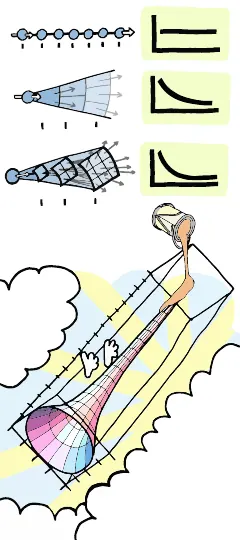 Chapter 24Put on Your 4D GlassesWhy does our universe have exactly three spatial dimensions plus time? Multiple independent constraints converge on : only in 3D space do inverse-square laws produce stable planetary orbits and bound atoms; only in 4D spacetime are fundamental forces renormalizable in quantum field theory; only in 4D do waves propagate cleanly without trailing echoes (Huygens’s principle). The arithmetic fact that creates unique mathematical properties — from quaternion algebra to self-dual gauge fields — that cascade through physics. Lower dimensions cannot support complex chemistry, while higher dimensions destabilize matter and causality.
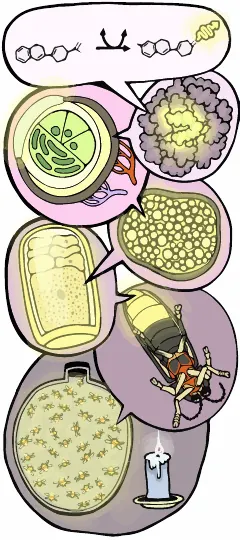 Chapter 25Let There Be BioluminescenceFirefly flashes demonstrate biology’s hierarchical organization from ecosystems to quantum mechanics. Species-specific flash patterns enable mate recognition and, in tropical swarms, synchronous displays visible across forests. Neural circuits generate these patterns by controlling oxygen flow through tracheal valves to specialized photocytes. Within these cells, luciferase catalyzes luciferin oxidation with extreme efficiency, converting chemical energy to light with minimal heat. The photons themselves arise when excited electrons in oxyluciferin transition between quantum energy states, emitting at 560–590 nm.
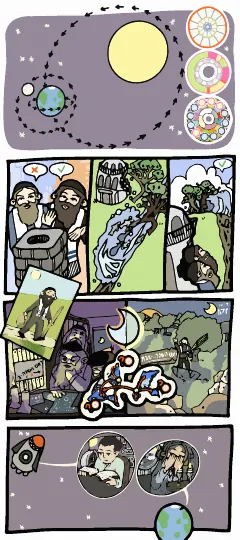 Chapter 26Once in a Jew MoonThe Jewish calendar was developed for witnesses observing the new Moon. So when witnesses claimed they saw the new Moon “in the morning east and evening west,” Rabban Gamliel accepted their impossible testimony, then ordered Rabbi Yehoshua to violate his own calculated Yom Kippur — establishing that communal unity is more important than astronomical accuracy. From Arctic whalers to orbital Shabbat, each generation learns that “it is not in heaven” — religious law belongs to human authorities grappling with reality, not perfect celestial mechanics.
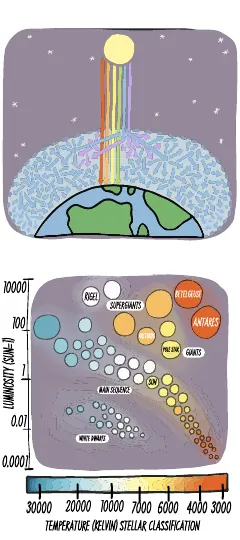 Chapter 27A Spectrum of SkiesSky colors are determined by light scattering and spectral signatures. Earth’s blue sky results from Rayleigh scattering, where nitrogen and oxygen molecules preferentially scatter shorter wavelengths by factors of 10–100 times more efficiently than longer ones. Mars’s butterscotch-orange haze results from suspended dust particles 1–10 micrometers across, scattering all wavelengths equally while absorbing blue light. Titan’s deep orange hue comes from photochemical hazes (tholins) produced by UV irradiation of methane, while Venus’s perpetual cloud deck creates brilliant white from sulfuric acid droplets.
 Chapter 28You’re So Hot, You Cool Me DownTemperature measures how entropy changes with energy (∂S/∂E), not merely kinetic activity. While unbounded systems such as ideal gases can only reach positive temperatures, quantum systems with finite energy spectra reveal different dynamics. When energy addition increases disorder, temperature is positive; when maximum entropy is reached, temperature becomes infinite; further energy addition creates more ordered states with negative temperatures. These negative temperature states are not colder than absolute zero but as hot as infinity — they transfer energy to any positive-temperature system when brought into contact.
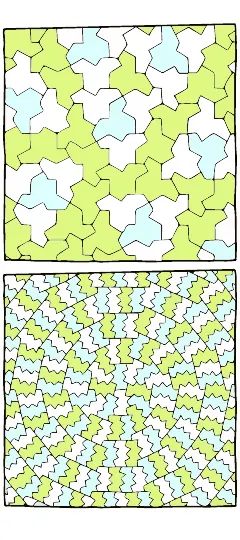 Chapter 29A Plane Hat TrickThe “Einstein problem”, named from German “ein Stein” (one stone), asks whether a monotile could tile the plane only aperiodically. In 2022, David Smith, a retired printer experimenting with shapes, discovered the thirteen-sided “hat” that solved this sixty-year puzzle. The hat tiles infinitely without ever repeating its pattern. The study of tilings previously revealed a connection between mathematics and physical quasicrystals, a discovery that won a Nobel Prize in 2011.
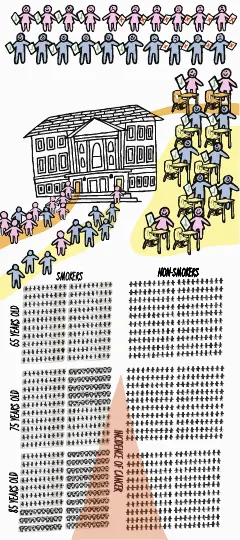 Chapter 30Divide and ConquerSimpson’s Paradox occurs when a statistical trend present in separate groups reverses when the groups are combined. This effect is a result of unequal group sizes or hidden confounding variables that distribute non-uniformly across the data. For example, a treatment might show positive effects in both male and female subgroups yet appear harmful in the aggregate population if the treatment is disproportionately given to patients with more severe conditions and males and females differ in average severity. The apparent paradox demonstrates that causal inference requires careful consideration of the causal relationship rather than relying solely on raw correlations.
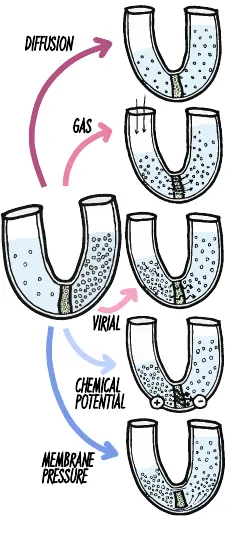 Chapter 31Concentrate on OsmosisStandard osmosis explanations based solely on water concentration gradients fail to account for measured flow rates that far exceed diffusion limits. The ratio of osmotic permeability to diffusive permeability (Pf/Pd) commonly exceeds 100 in biological systems with aquaporins, while purely diffusive transport would yield a ratio near 1. Mechanical explanations, notably Debye’s model, attribute osmosis to pressure gradients arising from solute-membrane interactions rather than simple diffusion. When solutes are excluded by a semipermeable membrane, their momentum cannot transfer across the boundary, creating a localized pressure drop that drives water movement.
 Chapter 32Timing Is EverythingTimekeeping has progressively moved toward smaller physical phenomena: from Earth’s rotation to pendulums, from crystal oscillations to atomic transitions, and now toward nuclear resonances. The SI second, defined by 9,192,631,770 periods of cesium-133’s hyperfine transition, relies on quantum interactions between nuclear and electronic magnetic moments. This shift to microscopic reference standards improves precision exponentially — hydrogen masers achieve stability of one part in , while optical lattice clocks using strontium reach one part in by probing transitions at Hz. The progression continues toward nuclear clocks using thorium-229, which promises precision of one part in by exploiting transitions in atomic nuclei rather than electron shells.
 Chapter 33The Center HoldsA geometric puzzle about Gaussian probability stumped mathematicians for over sixty years: prove that convex sets that are symmetric around the origin have enhanced overlap under Gaussian measure — that P(A ∩ B) ≥ P(A) · P(B). Despite partial results for boxes, ellipsoids, and slabs, the general case resisted all attempts. In 2014, Thomas Royen, a retired pharmaceutical statistician from a small German university, solved it using textbook methods: transforming to squared variables, applying Laplace transforms, and checking matrix determinants. His proof, published in an obscure journal, went unnoticed for years.
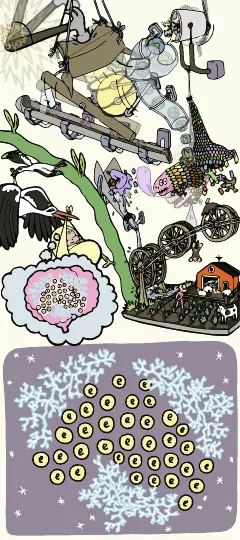 Chapter 34A Thought About NothingThe Boltzmann Brain paradox shows that statistical mechanics predicts a disturbing outcome: random fluctuations in a high-entropy universe would produce isolated conscious entities more frequently than entire ordered universes such as ours. A single brain with false memories requires orders of magnitude fewer unlikely coincidences than 13.8 billion years of cosmic evolution. These hypothetical observers would experience coherent thoughts and apparent histories, yet exist only as momentary statistical fluctuations. It is not easy to dismiss this preposterous theory based on scientific reasoning alone.
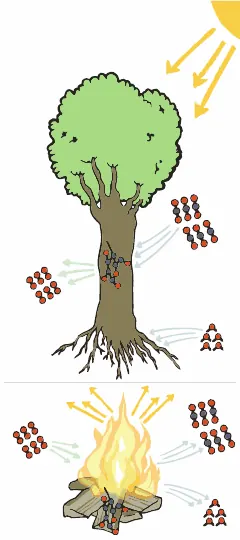 Chapter 35From Air to ArborAsk where a tree’s mass comes from and intuition points downward: soil, water, nutrients drawn up through roots. This is almost entirely wrong. Trees are made of air — 95% of their dry mass comes from atmospheric CO₂. Through photosynthesis, plants build themselves from carbon dioxide, converting invisible gas into solid wood, cellulose, and lignin using sunlight. Van Helmont’s 1640s willow experiment demonstrated this: a tree gained 164 pounds (74 kg) while the soil lost only two ounces (60 g). Isotope labeling confirms the molecular accounting — carbon in wood comes from air, not earth or water. When trees burn, they simply return their borrowed carbon and sunlight to the atmosphere, completing a chemical cycle that temporarily crystallizes air into living architecture.
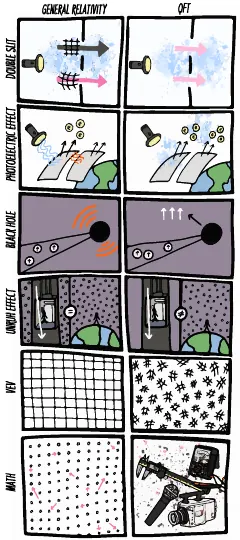 Chapter 36Renormalize All the ThingsThe two most successful theories in physics cannot coexist. Quantum field theory treats forces as particle exchanges on a fixed stage, while general relativity says the stage warps. When combined, they produce catastrophic contradictions: QFT predicts vacuum energy times larger than observed, gravity refuses renormalization, and black holes seem to destroy quantum information. Each theory works perfectly in its domain, yet they give mutually exclusive descriptions of reality. This incompatibility of theories is the most glaring problem in modern physics.
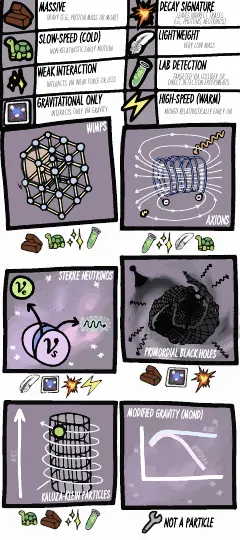 Chapter 37Darkness to Bind ThemDark matter’s existence is inferred through multiple independent lines of evidence spanning different cosmic scales. Galaxy rotation curves remain flat far beyond visible matter, indicating extended gravitational influence. Galaxy clusters contain hot gas whose temperature and confinement require gravitational potentials deeper than visible matter can provide. Gravitational lensing reveals mass distributions exceeding luminous components, particularly in systems such as the Bullet Cluster where dark and visible matter separate during collisions. The cosmic microwave background’s fluctuation patterns indicate that ordinary matter comprises only 15% of the total matter content needed to match observations, with the remainder consisting of non-baryonic material already present before photon-matter decoupling.
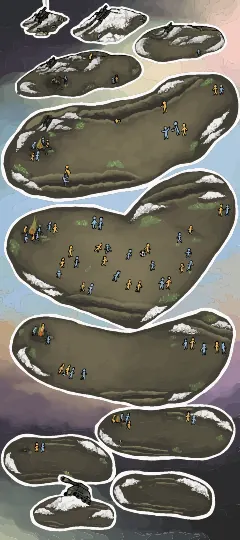 Chapter 38A Truce StoryOn Christmas 1914, enemy soldiers climbed out of their trenches and shook hands. Along sectors of the Western Front, British and German troops spontaneously ceased fire, met in No Man’s Land to exchange tobacco and souvenirs, sang carols together, and buried their dead side by side. Some kicked footballs around shell craters. This unofficial truce lasted hours to days depending on location. By Christmas 1915, high command used coordinated artillery barrages to prevent any recurrence.
 Chapter 39SuperanonymousA significant combinatorial breakthrough from an unlikely source: an anonymous 4chan post (2011) responding to a question about anime episode viewing orders. Superpermutations are strings containing every possible ordering of n symbols as substrings. For years, mathematicians believed the minimal length followed the pattern of factorial sums observed in small cases. The anonymous poster derived a rigorous lower bound, modeling the problem as path optimization through a permutation graph. This proof remained obscure until 2014 when mathematician Robin Houston rediscovered it, leading to the disproof of the long-standing conjecture and establishing new bounds on this combinatorial problem — with the original derivation still officially credited to “Anonymous 4chan Poster.”
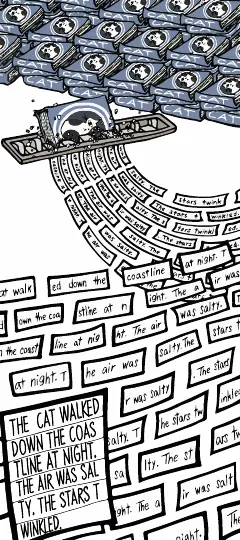 Chapter 40Slices of LifeDNA sequencing has evolved from Sanger’s chain-termination method through the next-generation revolution of 454 pyrosequencing, Ion Torrent, and Illumina platforms to modern nanopore technologies. The computational challenge of genome assembly uses sophisticated algorithms such as de Bruijn graphs to reconstruct complete genomes from millions of short fragments, while paired-end chemistry and long-read technologies help resolve repetitive regions that have long frustrated genomic reconstruction efforts.
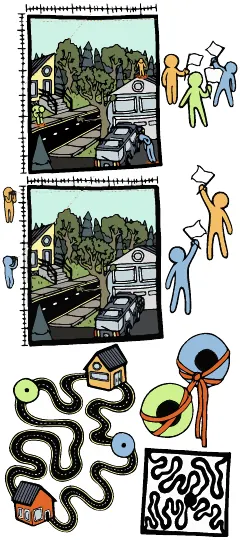 Chapter 41It Is Just a PhaseThe Hough transform detects geometric shapes in images by converting the problem from image space to parameter space. Images undergo edge detection to identify significant brightness transitions. Each edge pixel then “votes” for all possible geometric structures that could contain it. For line detection, edge points generate constraints in parameter space through the relation . Points lying on the same line create intersecting lines in parameter space, forming accumulator peaks.
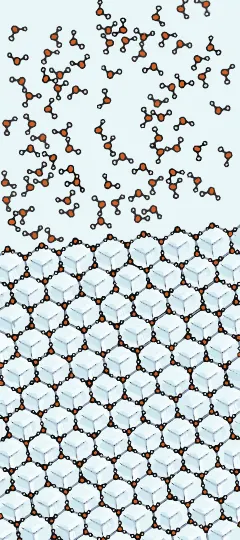 Chapter 42Wet, Cold, Slippery SlopeIce’s exceptional slipperiness results primarily from a quasi-liquid layer (QLL) of disordered water molecules at its surface rather than from commonly assumed mechanisms. While pressure melting and frictional heating contribute under specific conditions, neither explains ice’s slickness at rest nor across wide temperature ranges. Surface molecules, having fewer hydrogen bonds than those in the interior crystal lattice, form a nanometer-thick disordered layer that functions as a molecular lubricant even well below freezing. Counterintuitively, ice is most slippery around -7°C rather than at 0°C, as the QLL is sufficiently mobile at this temperature while the underlying ice remains hard enough to resist deformation.
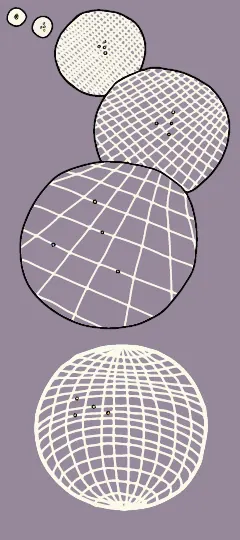 Chapter 43Flat UniversersThe universe appears flat to within 0.4% precision according to cosmic microwave background measurements. This flatness, described by the Lambda-CDM model, indicates that space follows Euclidean geometry even across vast cosmological distances. The universe may be spatially infinite while having a finite age of 13.8 billion years. This implication comes from the Big Bang model: an expansion of intergalactic space rather than an explosion within pre-existing space. If space was already infinite at the beginning, it expanded uniformly from every point. No center to the universe!
 Chapter 44The Man in the Velvet MaskThe prisoner known as “Eustache Dauger” remained in state custody for thirty-four years (1669–1703) under extraordinary protocols of secrecy. His confinement spanned four locations under the continuous supervision of a single jailer, Bénigne Dauvergne de Saint-Mars. Official correspondence reveals exceptional measures: a specially constructed cell with sound isolation, strict limitations on communication, and a requirement to wear a black velvet mask when visible to anyone outside Saint-Mars’s control. The prisoner served as valet to another detainee at Pignerol before eventual transfer to the Bastille, where he died and was buried under the alias “Marchioly.”
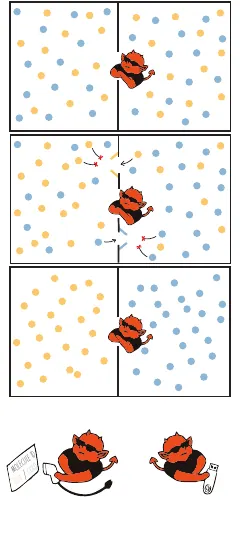 Chapter 45The Demon is in the DetailsMaxwell’s Demon, proposed in 1867, describes a thought experiment where a tiny being controls a door between two gas chambers, selectively allowing fast molecules into one chamber and slow ones into another. This sorting creates a temperature gradient from uniformity, seemingly decreasing entropy and violating the second law of thermodynamics. The resolutions are through work costs of measurement and the information-theoretic cost of manipulating information.
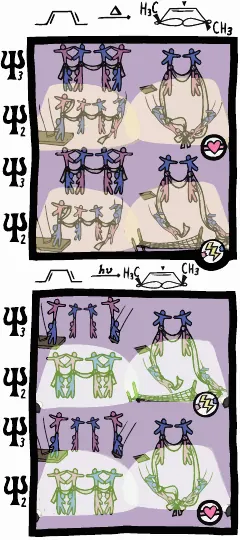 Chapter 46Orbital AffairsThe Woodward-Hoffmann rules establish how mathematical symmetry conservation governs chemical reaction pathways at the quantum level. In pericyclic reactions, the symmetry properties of molecular orbitals — represented by wave functions with specific nodal patterns analogous to trigonometric functions — must be conserved throughout the reaction coordinate. This conservation requirement creates selection rules that determine allowed stereochemical outcomes. The symmetry constraints differ fundamentally between thermal and photochemical conditions, as light excitation inverts the orbital symmetry relationships, thereby enabling reaction pathways forbidden under thermal conditions and vice versa.
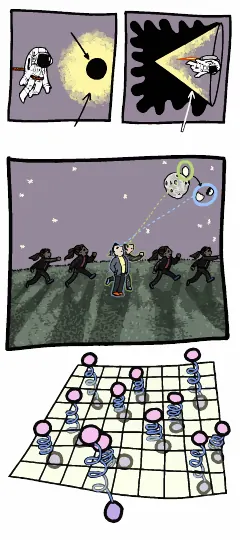 Chapter 47Matter of PerspectiveEmpty space isn’t empty — and even that depends on who’s looking. The quantum vacuum teems with field fluctuations, but two observers can fundamentally disagree about whether particles exist. An astronaut floating peacefully sees perfect vacuum. Her twin, accelerating through the same region, is bombarded by thermal radiation at temperature — the Unruh effect. Particle content becomes relative, like simultaneity in Einstein’s relativity.
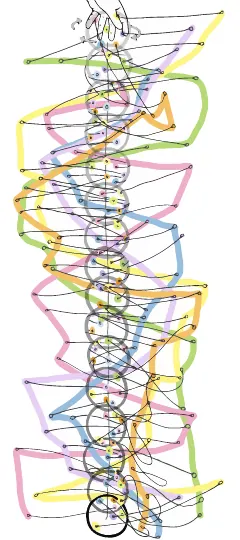 Chapter 48Chaotic NeutralityDeterministic systems can exhibit chaotic behavior, where minuscule differences in initial conditions lead to drastically different outcomes. The double pendulum and three-body gravitational problem exemplify this despite having few components and simple equations. Counterintuitively, far more complex systems such as falling objects often behave predictably because dissipative effects continuously suppress perturbations.
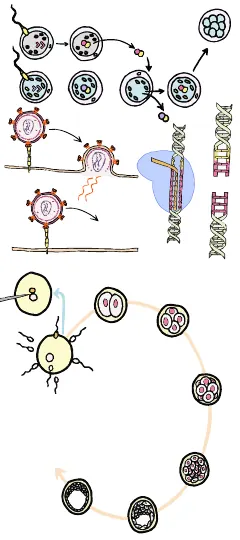 Chapter 49The Three Genome ProblemEvery human inherits two distinct genomes: nuclear DNA from both parents and mitochondrial DNA almost exclusively from the oocyte. This second genome — 37 genes controlling cellular energy production — mutates 10–100 times faster than nuclear DNA, causing devastating diseases when defective. Traditional IVF cannot prevent mothers from passing faulty mitochondria to children. Enter mitochondrial replacement therapy: scientists transfer nuclear DNA from an affected mother’s egg into a donor egg with healthy mitochondria. From single-base edits to chromosome transfers — many ethical questions arise to be discussed.
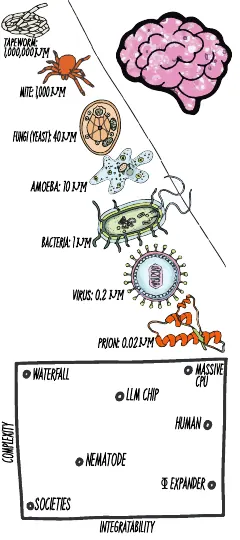 Chapter 50A Freely Willful IgnoranceMilligrams of propofol erase consciousness in seconds. Fatal familial insomnia prevents its cessation for months until death. While we can reliably toggle awareness, no unified mechanism explains why subjectivity vanishes. Consciousness cannot be reduced to neural correlates or fit by classifiers. Any attempt to locate its origin in physical mechanisms presupposes the very phenomenon under study. Free will and physics appear incompatible, but the standoff is asymmetric: agency is the lived fact that makes physics construction possible. Consciousness occupies the apex of a revision hierarchy where, in any conflict with lower-level descriptions, the knower must prevail.
No chapter matches that. Try a broader word.
Editions & where to read
US author edition
Kernel Keys Press, 2026
The author’s edition in US English, typeset by the author in LaTeX.
UK edition · open access
Open Book Publishers, 2026
The same fifty chapters in UK English, peer-reviewed and published open access. Free to read and download.
David H. Silver, Unpopular Science. Kernel Keys Press, 2026. US English edition of Beyond Popular Science (Open Book Publishers, DOI 10.11647/OBP.0526).
Both editions are licensed under Creative Commons Attribution-NonCommercial 4.0 International: share and adapt for non-commercial purposes, with attribution.
Coming to YouTube
Each chapter is becoming a short film: the book’s own words, read to camera, with its figures, sources and equations animated alongside.
The films go out under the UK edition’s title, Beyond Popular Science. The fifty chapters are the same in both editions.
Coming soon
Subscribe to the channelYouTube (opens in a new tab)Relatively YellowFilm in production
Dark Energies Are Pushing Us ApartFilm in production
An Axiom of Your ChoiceFilm in production
Think Outside the WireFilm in production
A Circle of PIEFilm in production
The Apple Falls the Slowest from the TreeFilm in production