Chapter 17 of 50
The Busy Beaver That Ate the TREE
„Das Unendliche hat wie keine andere Fragevon jeher so tief das Gemüt der Menschen bewegt...Aus dem Paradies, das Cantor uns geschaffen,soll uns niemand vertreiben können.“
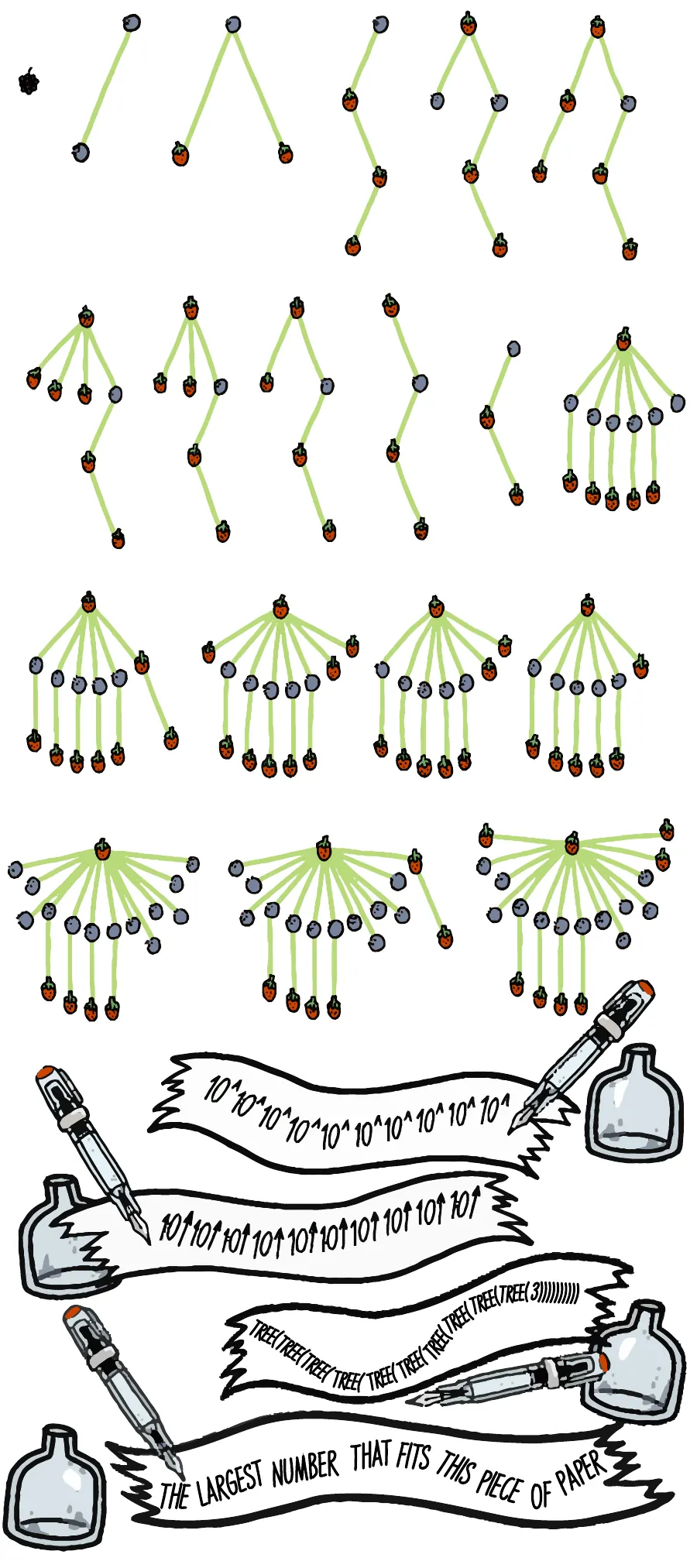
Imagine you are given a pen with enough ink to write 20 centimeters and you are to write the biggest number you can think of. You can start by a tower of exponents , but it is not that big. In this chapter we explore the hierarchy from computable functions to TREE(3) — a number so immense that even if you built a tower of exponentials starting with a trillion raised to the power of a trillion, and then repeated that construction every attosecond for a trillion years, the result would still be vanishingly small in comparison. Yet even TREE(3) sits as close to infinity as the number eight, placing us in an infinity zoo where sizes exceed the categories brains evolved to handle.
Topics
- Sand Reckoner
- Tower Notation
- Knuth Arrows
- 20cm Ink Competition
- Ackermann Function
- TREE(3) Combinatorics
- Tree Embedding Game
- Busy Beaver
- Halting Undecidability
- Rayo’s Function
- Large Cardinals
Sidenote
Top (Valid TREE(3) Sequence Prefix): An initial segment of a TREE(3)-avoiding sequence. Each rooted tree is added in such a way that no earlier tree is homeomorphically embeddable into a later one. The sequence starts with simple trees and becomes rapidly more complex. Exponentiating a googolplex by itself a googolplex times is comically dwarfed by TREE(3).
Bottom (Largest Number Competition): Using 20 cm of ink, write the largest number possible. Early entries include exponential towers and Knuth up-arrow notation. But one leverages the TREE function hierarchy in — a number vastly larger than previous contenders. The final banner is a different type of entry, more reminiscent of Rayo’s number.