Chapter 16 of 50
An Empty Threat
“Darling, there’s a place for us,Can we go, before I turn to dust?”
“כִּי הִנֵּה הַיּוֹם בָּא בֹּעֵר כַּתַּנּוּר וְהָיוּ כָל זֵדִים וְכָל עֹשֵׂה רִשְׁעָה קַשׁ וְלִהַט אֹתָם הַיּוֹם הַבָּא אָמַר ה צְבָאוֹת„(“For, behold, the day cometh, that shall burn as an oven; and all the proud, yea, and all that do wickedly, shall be stubble: and the day that cometh shall burn them up, saith the Lord ...”)
Our universe may exist in a false vacuum — a metastable state that could decay through quantum tunneling, producing a bubble of altered physics expanding at light speed. Current Higgs boson measurements suggest that while such decay is improbable for timescales far exceeding the age of the universe, the possibility remains that reality itself could undergo a phase transition that abolishes matter and forces — with the bonus side effect of no more spam.
Topics
- False Vacuum
- Higgs Field 246 GeV
- Mexican Hat Potential
- Top Quark Mass Sensitivity
- Metastability Edge
- Quantum Tunneling
- Coleman-De Luccia Instanton
- Bubble Nucleation
- Year Lifetime
- Virtual Particle Corrections
- Renormalization Group Flow
Sidenote
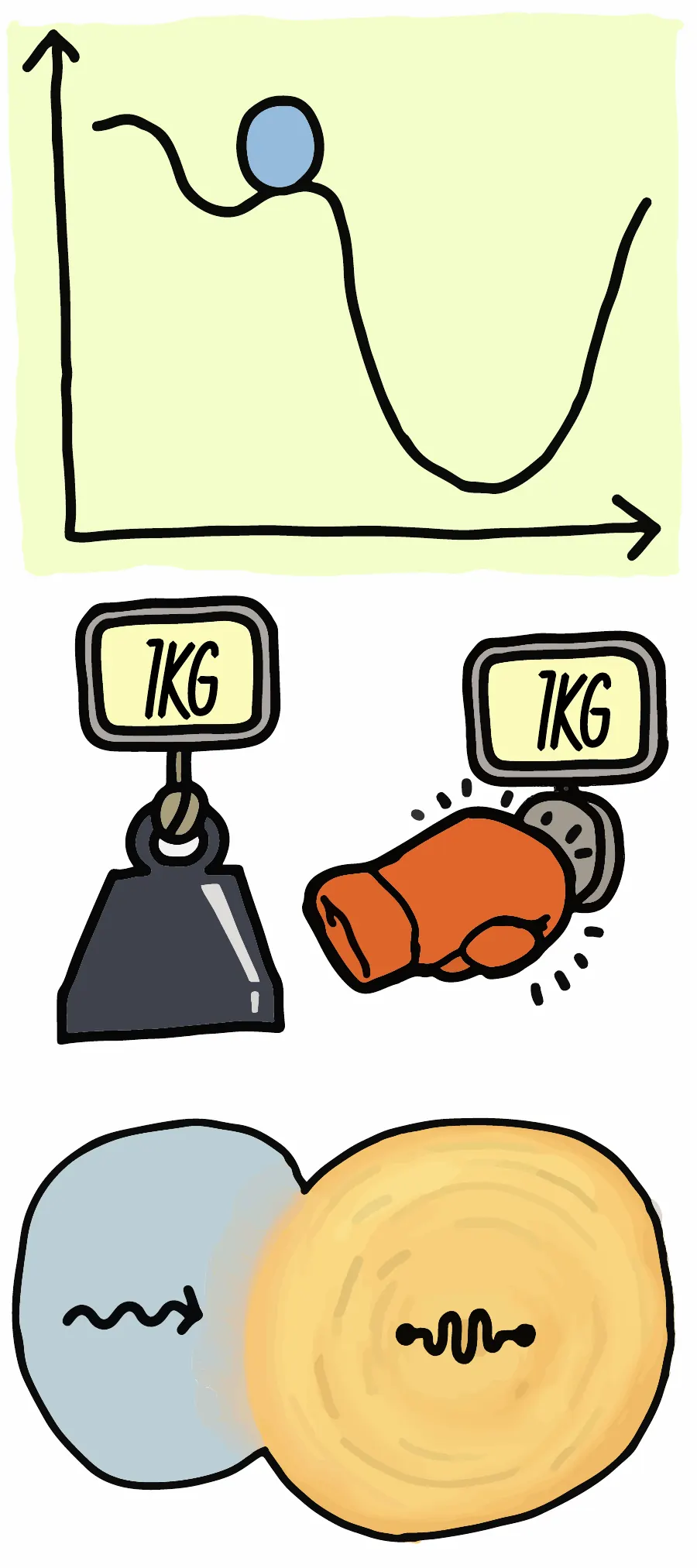
Top (Metastable State): A system stuck in a local energy minimum. Though not at the true lowest-energy state, it remains trapped unless perturbed. The ball resting in a shallow well represents temporary stability — common in physical phenomena such as false vacuum decay or the Sun.
Middle (Inertial vs Gravitational Mass): Both sides read “1KG,” but differ in interpretation. Inertial mass resists acceleration (right), while gravitational mass dictates weight in a field (left). Although equivalent, they arise differently. The Higgs mechanism contributes to inertial mass through interaction with the Higgs field; why gravitational mass follows, remains an open question in quantum gravity.
Bottom (Higgs Mechanism): A particle (left) moves through the Higgs field (right), acquiring mass via constant interaction. The disturbance in the field (rippled line) corresponds to a Higgs boson. The mechanism explains how otherwise massless particles — like W and Z bosons — gain mass while preserving gauge symmetry.