Chapter 15 of 50
Envelope Trade-Up
“How wonderful that we have met with a paradox;now we have some hope of making progress.”
The Envelope Paradox presents two envelopes where one contains twice the money of the other. After selecting one envelope, seemingly valid probabilistic reasoning suggests an expected gain by switching (averaging x/2 with 2x), regardless of which envelope was initially chosen. This symmetric conclusion creates a logical inconsistency since perpetual switching cannot be optimal. The paradox arises from improper application of expected value calculations to scenarios with unbounded distributions or when conditional probabilities are not properly accounted for. Resolving the paradox requires distinguishing between known values and variables, recognizing when probability distributions are ill-defined, and understanding the limitations of calculations with potentially infinite quantities.
Topics
- Two Envelopes Paradox
- Switching Expectation
- Incompatible Baselines
- Bounded Distribution Solution
- Improper Prior Problem
- Bertrand’s Chord Paradox
- Random Without Context
- Boundary Cancellation
- Symmetric Model Zero Gain
- Kraitchik 1930
- Simulation Verification
Sidenote
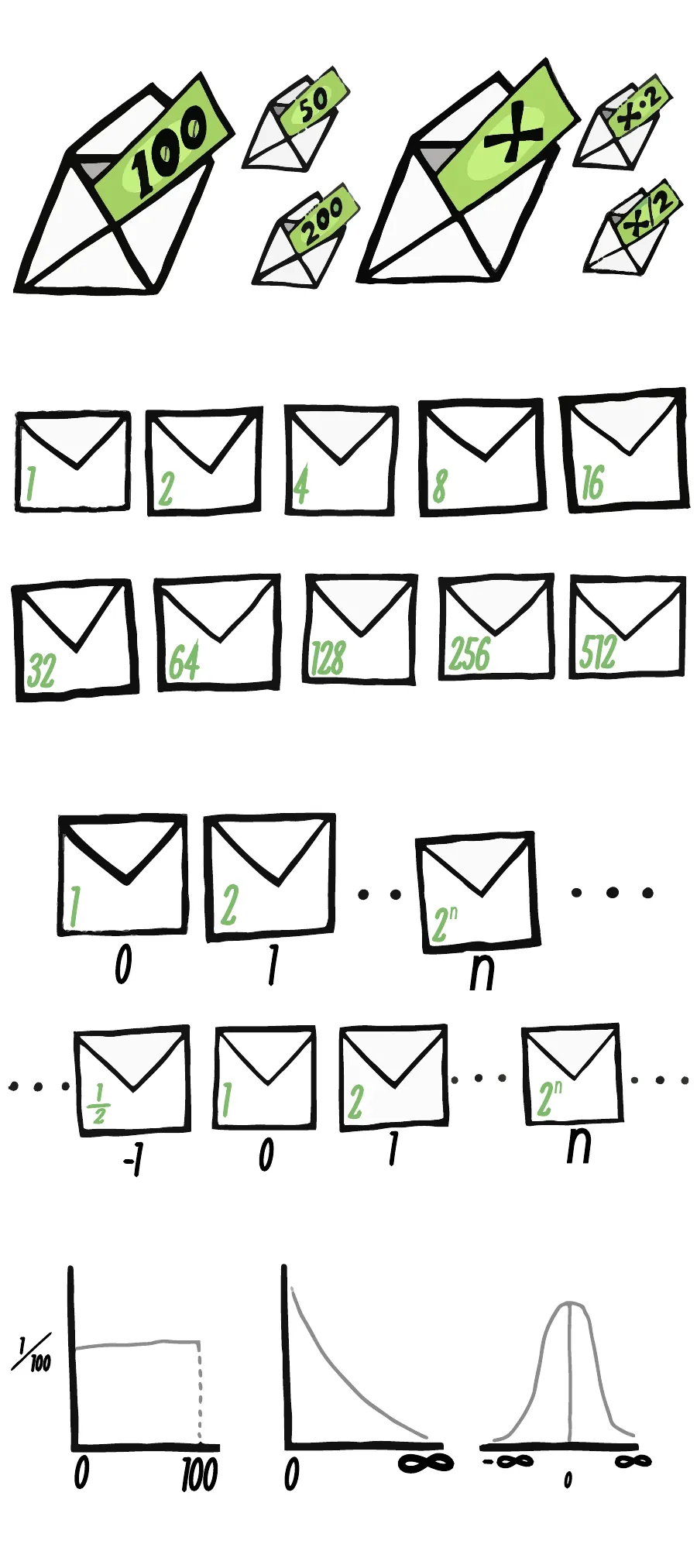
Top (Basic Setup): The left scenario shows concrete values: one envelope contains $100, with potential alternatives of $50 or $200. The right scenario generalizes this with variables: envelope could correspond to either or in the alternative envelope. This applies regardless of specific amounts.
Second (Bounded Finite): Eight envelopes containing represent a bounded geometric sequence. In this finite setup, edge effects matter: the smallest value can only be paired with , while the largest can only be paired with . These boundary constraints resolve the paradox.
Third (Semi-Infinite): The sequence extends infinitely in one direction. This introduces asymmetry: there’s a smallest possible value but no largest. The lower bound affects the expectation calculation.
Fourth (Bi-Infinite): The sequence extends infinitely in both directions. This symmetric case is where the classical paradox is the most clear, as there are no boundary effects to break the apparent symmetry.
Bottom (Probability Distributions): Three different priors over envelope values: (1) Uniform distribution over assigns equal probability to each value. (2) Exponentially decaying distribution over positive integers gives decreasing probability as values increase. (3) Gaussian distribution over all real numbers.