Chapter 14 of 50
A Circle of Time
“Time is an illusion. Lunchtime doubly so.”
“I’m not a creative type like youwith your work sneakers and your left-handedness.”
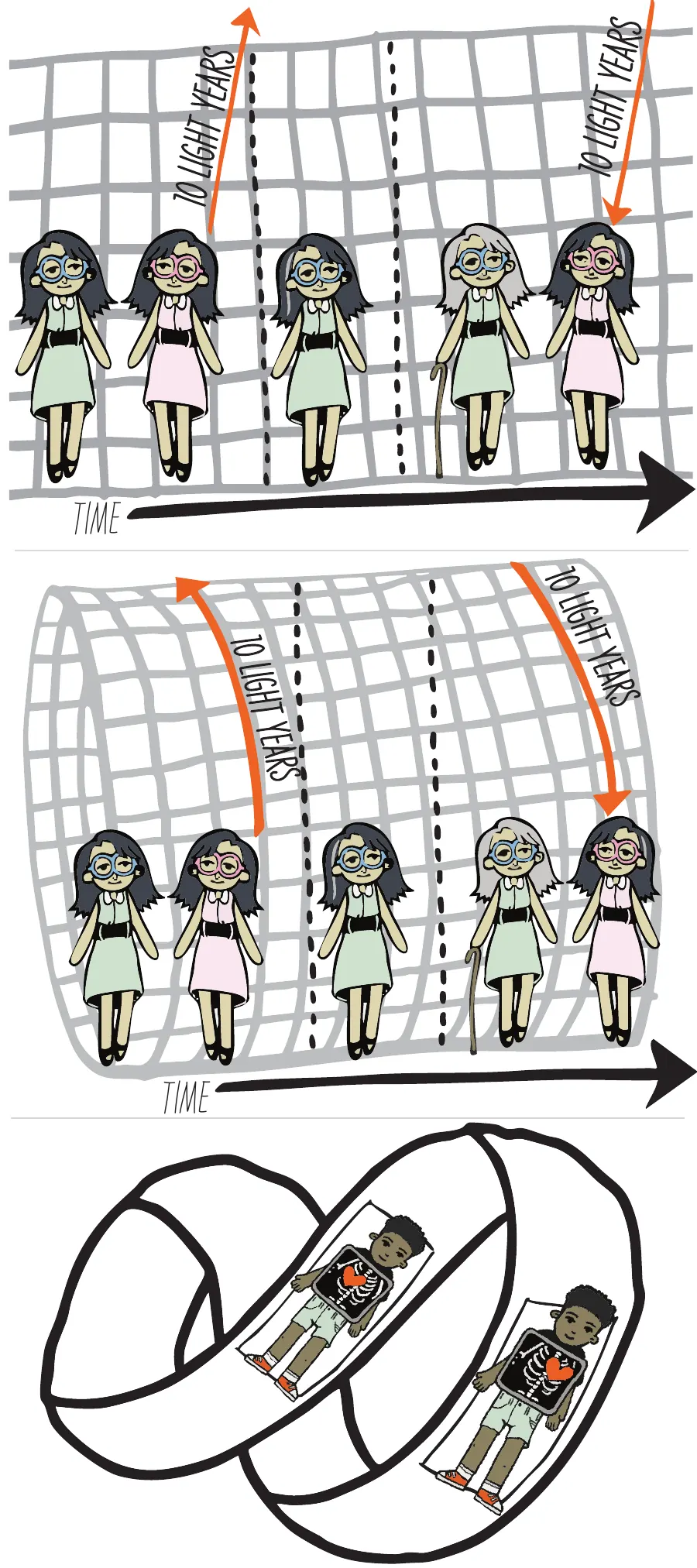
In a cylindrical universe with compact spatial dimensions, twins can separate and reunite without acceleration, with one traveling around the circumference while the other remains stationary. Despite neither experiencing acceleration, they age differently upon reunion, creating a variant of the famous special relativistic paradox. In non-orientable topologies such as the Klein bottle universes, travelers can additionally experience reversal of chirality. Even a thoroughly non-dextrocardic explorer might come back from a cosmic stroll with his heart on the right side, no trauma needed.
Topics
- Twin Paradox
- Special Relativity Postulates
- Proper Time Paths
- Compact Space Topology
- Cylindrical Universe
- Acceleration-Free Paradox
- Preferred Frame Detection
- Klein Bottle Spacetime
- Chirality Reversal
- CMB Topology Search
- Flatness Constraint
Sidenote
Top (Twin Paradox Variants): Variants of the twin paradox. The first shows the standard scenario: one twin remains on Earth while the other travels to a distant star and back at relativistic speed, experiencing less proper time due to time dilation and the non-inertial turnaround. The second panel sets the paradox in a compactified spacetime, where space is wrapped into a cylinder. Here, a twin can traverse the compact dimension at constant velocity — never accelerating or changing frames — yet still accumulate less proper time than the twin who remains stationary. Bottom (Non-Orientable Topology): Non-Orientable topology and global spacetime orientation. Depicted as a Möbius-like strip, this represents a spacetime where following a continuous timelike path can bring a traveler back to their starting point with their internal orientation flipped.