Chapter 13 of 50
Right on Spot
“Truth is stranger than fiction, but it is becauseFiction is obliged to stick to possibilities; Truth isn’t.”
Poisson’s spot, also called the Arago spot, demonstrates wave diffraction through the unexpected appearance of a bright point at the center of a circular object’s shadow. When Augustin-Jean Fresnel proposed light as a wave phenomenon in 1818, Siméon Poisson derived this counterintuitive prediction in an attempt to disprove the theory. The effort backfired when François Arago experimentally confirmed the spot, which corpuscular optics could not explain, providing decisive support for the wave model of light.
Topics
- Newton’s Corpuscular Theory
- Huygens’s Wave Theory
- Young’s Double Slit
- Fresnel’s Diffraction Theory
- Poisson’s Absurd Prediction
- Arago Spot Experiment
- 1818 Grand Prix
- Wave Theory Vindication
- Predictive Precision
- Scientific Method Evolution
- QED Modern View
Sidenote
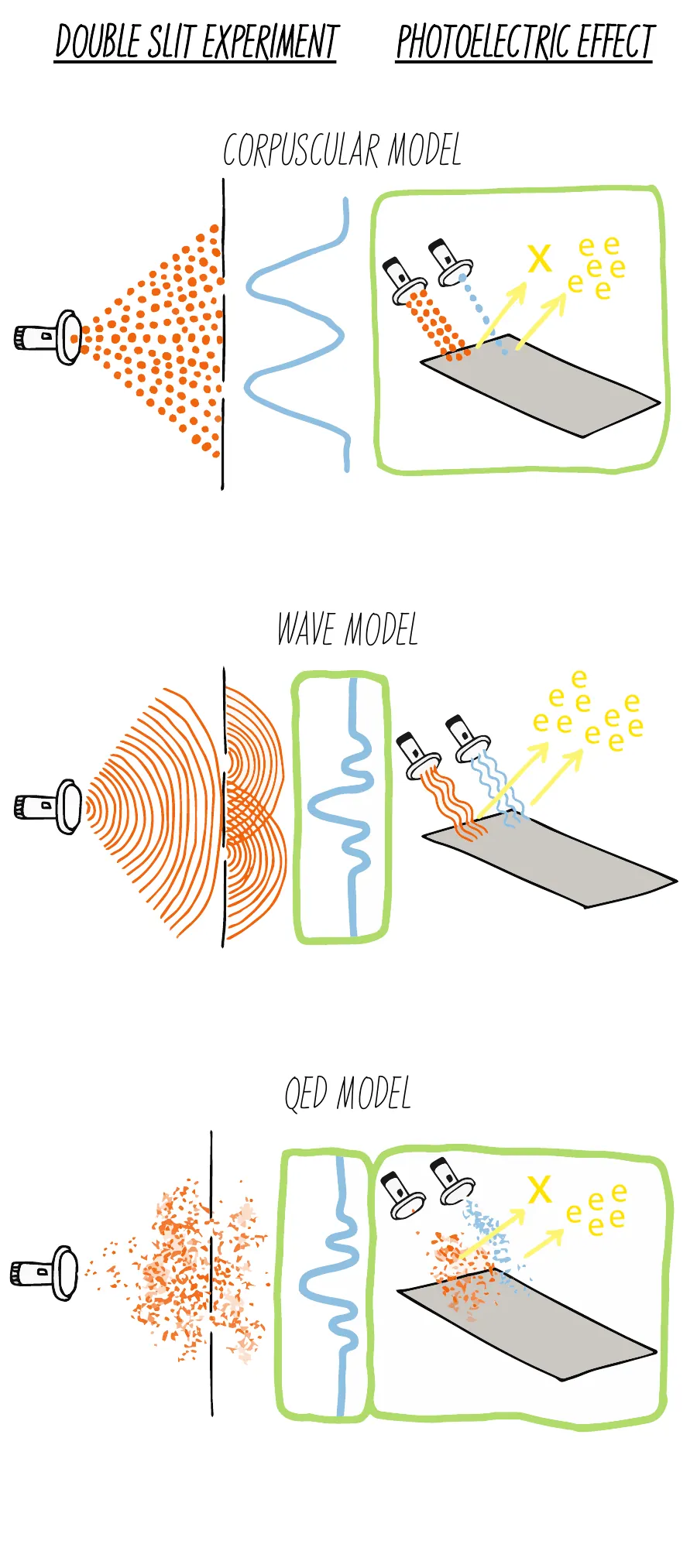
Model Comparison: Three theoretical models are applied to two classic experiments: the double slit and the photoelectric effect. The goal is to highlight where predictions agree with the observed.
Top (Corpuscular): Double-slit: no interference, . Photoelectric: emission occurs only if photon energy exceeds the threshold, .
Middle (Wave): Double-slit: interference arises from wave superposition, . Photoelectric: continuous energy absorption incorrectly predicts emission at all , .
Bottom (QED): Double-slit: coherent paths interfere, . Photoelectric: decoherent transition amplitudes yield . The same path integral formalism applies, but coherence conditions differ.
Green frames highlight where predictions match experimental outcomes.