Chapter 12 of 50
You Would Like to Order First
“I just found out that my cellular telephone was a lemon.”
GSM mobile communications used stream ciphers to protect call privacy, but protocol design left them vulnerable. Encryption was applied only after error correction and formatting, so fixed training sequences and redundant coding produced predictable ciphertext patterns. These leaks allowed attackers to recover session keys with modest effort, demonstrating that security depended less on theoretical cipher strength than on overall system design.
Topics
- GSM TDMA Structure
- Fixed Burst Format
- Processing Order Vulnerability
- Stream Cipher XOR
- Predictable Plaintext
- Convolutional Codes
- A5/2 Algebraic Attack
- Cipher Downgrade Attack
- Session Key Reuse
- Biham-Barkan-Keller
- Protocol Layer Weakness
Sidenote
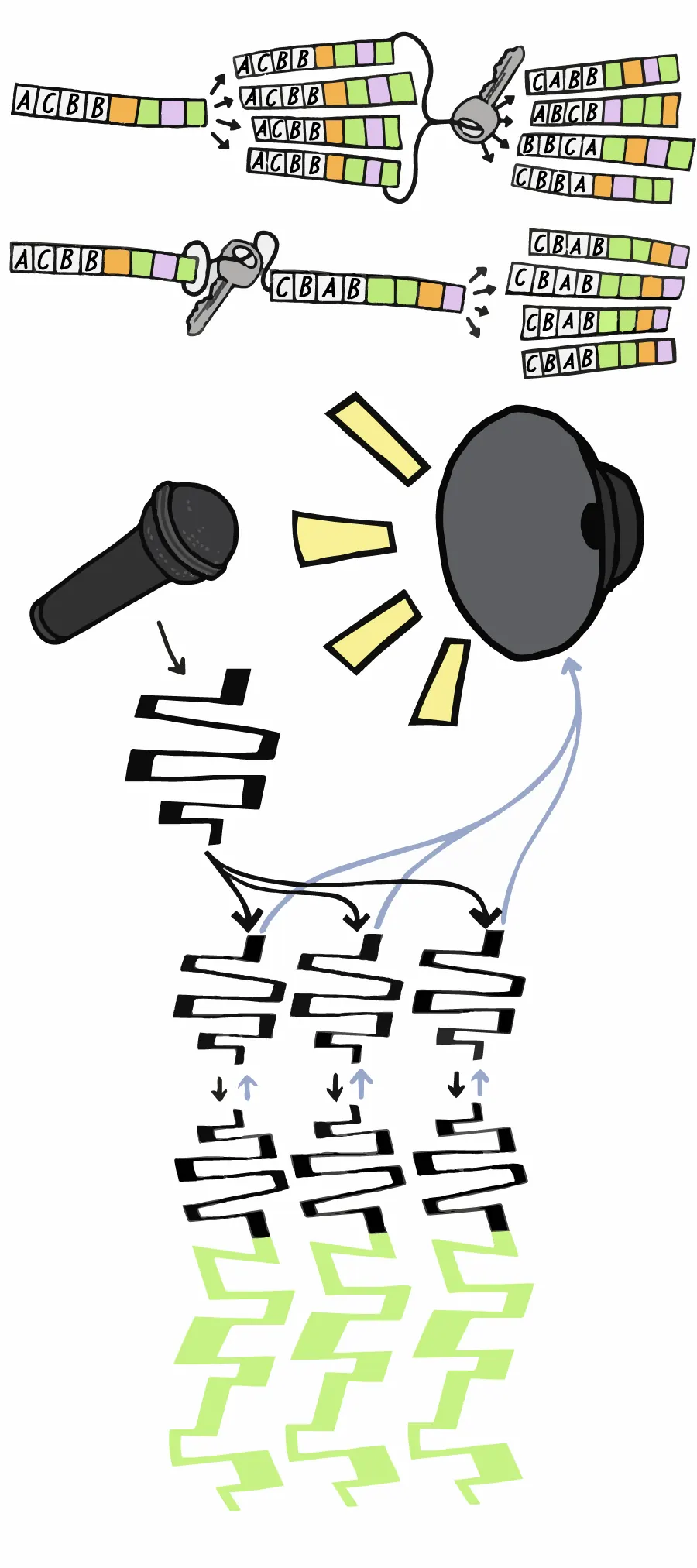
Top (Multiplex → Encrypt): The same message (ACBB) is first combined with different color-coded templates through multiplexing. Each variant is then independently encrypted using a shared key. This leads to distinct ciphertexts, but if the templates are known or public, attackers can reverse the multiplexing process and end up with multiple ciphertexts of the same underlying message, enabling algebraic attacks that exploit the known relationships between the variants.
Bottom (Encrypt → Multiplex): The message is first encrypted (producing, for example, CBAB from the original message), and the resulting ciphertext is then duplicated and wrapped in different color-coded templates. Because all copies are cryptographically identical before templating, multiplexing adds no diversity to the encrypted content. This offers attackers fewer opportunities for correlation-based attacks.
Signal Flow (Communication Path): The bottom illustration shows the complete communication path: microphone input → multiplexing → encryption → transmission → decryption → demultiplexing → speaker output.