Chapter 11 of 50
Edges of Tomorrow
“In these days the angel of topology and the devil of abstract algebrafight for the soul of each individual mathematical domain.”
Topological insulators exhibit an unusual combination of properties: insulating in their bulk yet conducting electricity perfectly along surfaces or edges. This behavior originates from the topology of the material’s electronic energy structure in momentum space, which guarantees protected conductive states resistant to scattering and imperfections. The mathematical concept of topology, concerning properties preserved under continuous deformation, manifests physically through the way electron wave functions ’twist’ as their momentum changes, leading to robust edge states and quantized conductance.
Topics
- Quantum Band Theory
- Bloch Waves & Brillouin Zone
- Metal-Insulator Classification
- Berry Phase Topology
- Band Inversion
- Bulk-Boundary Correspondence
- Kramers Pairs
- Spin-Momentum Locking
- ARPES Evidence
- Invariants
- Protected Edge States
Sidenote
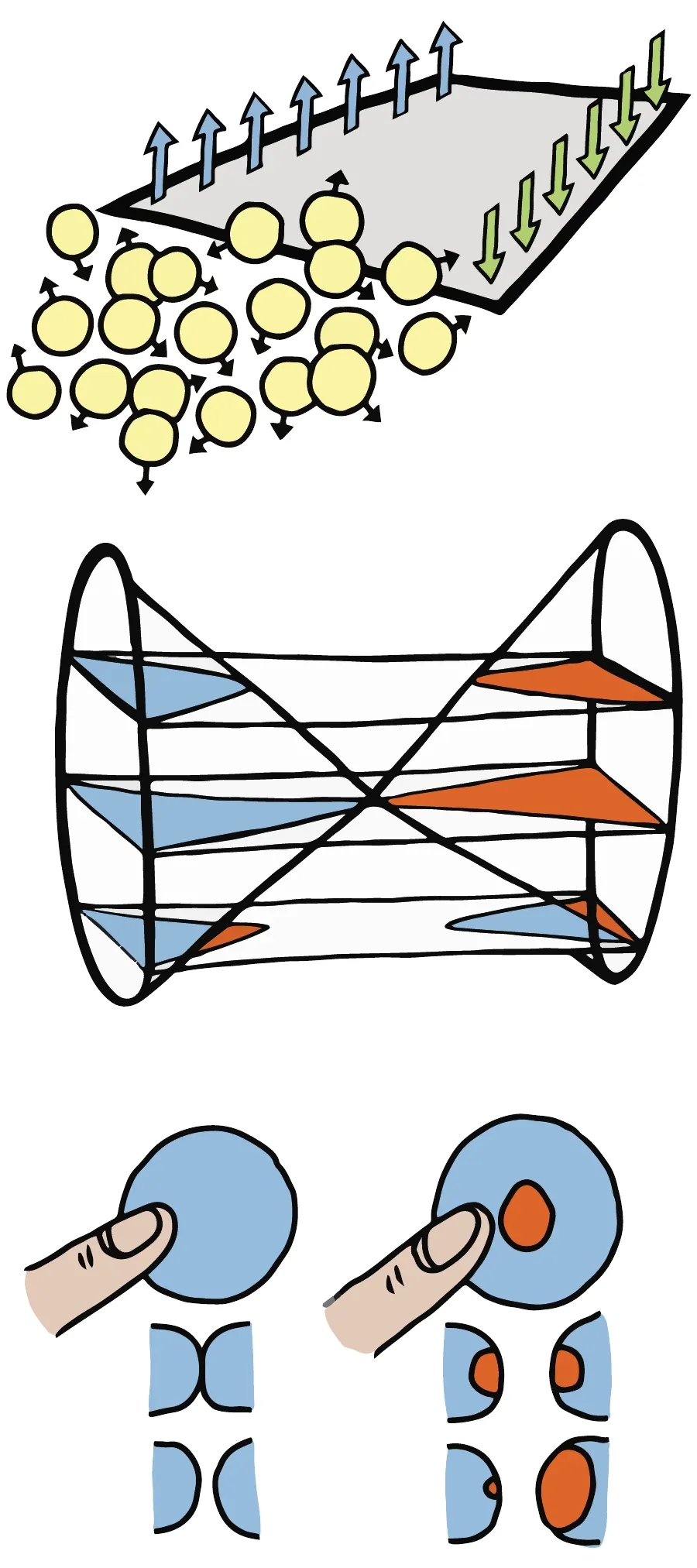
Quantum Hall Effect: In the top panel, the bulk is insulating (yellow electrons scattered inside the slab), while the edges host perfectly conducting states. Blue arrows flow along one boundary and green arrows along the opposite, illustrating chiral edge currents immune to backscattering.
Spin–Orbit Coupling and Band Inversion: The middle panel shows three popular momentum–energy diagrams stacked top to bottom, here drawn on a double-cone surface. Spin–orbit coupling reorganizes the band structure, inverting the order of conduction and valence bands (blue and orange). This inversion forces the existence of surface states that cross the gap, guaranteeing conduction channels protected by time–reversal symmetry.
Robustness of Topology: The bottom panel contrasts two shapes. On the left, a blue disk without internal twist can be smoothly deformed and split apart, representing a trivial insulator. On the right, a disk enclosing an orange region cannot be removed without tearing — a topological obstruction. This illustrates why the protected edge states of a topological insulator are resistant to continuous perturbation that preserves symmetry.