Chapter 10 of 50
The Tunnel at the Beginning of Light
«o helios esti lithos pyrodes, meizon tes Peloponnesou.»
Solar fusion proceeds despite temperatures insufficient for classical nuclear reactions because quantum tunneling enables protons to penetrate the Coulomb barrier with non-zero probability. At the Sun’s core temperature of 15 million Kelvin, the average proton possesses only about 1/20th of the energy classically required to overcome electromagnetic repulsion between positively charged nuclei. Quantum mechanics allows particles to “tunnel” through energy barriers they cannot surmount classically, with probability decreasing exponentially with barrier height and width. This tunneling effect, combined with the enormous number of interaction attempts in the solar plasma, sustains the fusion rate necessary for stellar stability over billions of years.
Topics
- Solar Core Fusion
- Proton-Proton Chain
- Coulomb Barrier Problem
- Quantum Tunneling Solution
- Gamow Factor
- Weak Force & Neutrinos
- Lepton Number Conservation
- Solar Neutrino Problem
- Neutrino Oscillations
- Hydrostatic Equilibrium
- Main Sequence Stability
Sidenote
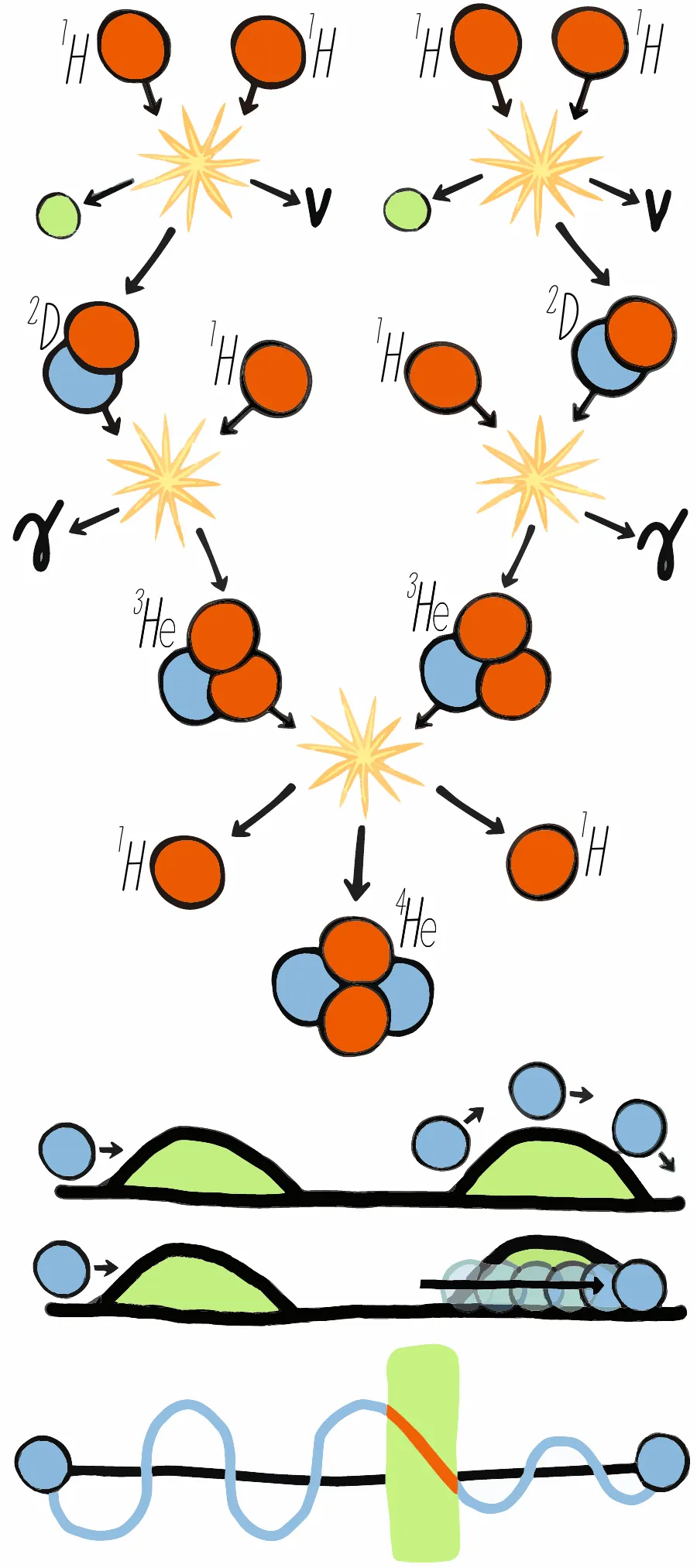
Top (Solar Fusion Process): This diagram illustrates the proton-proton (pp) chain, the dominant fusion process in the Sun’s core, where hydrogen nuclei (protons) fuse into helium, releasing energy. Here’s the breakdown of the stages shown: Stage 1: Proton-Proton Fusion: Two protons (red) fuse to form: a deuteron (one proton + one neutron — shown here as red + blue), a positron (green), and a neutrino (ν). This happens twice independently. Reaction: Stage 2: Deuteron-Proton Fusion: The deuteron (p+n) fuses with another proton (red) to form: helium-3 (two protons, one neutron — two red + one blue) and a gamma ray (γ), indicating energy release. This also occurs in parallel twice. Reaction: Stage 3: Helium-3 Fusion: Two helium-3 nuclei collide, forming: one helium-4 nucleus (two protons + two neutrons — two red + two blue), two free protons (red), released back to the plasma. Reaction: Net Result: The chain converts four protons into one helium-4 nucleus, with: energy carried by gamma rays, neutrinos, and kinetic energy of the particles, two protons recycled. This chain is responsible for the Sun’s energy production, light, and the solar neutrinos we detect on Earth. Bottom (Quantum Tunneling): This enables the entire process by allowing particles to skip energy barriers. The barrier dampens the probability wave without zeroing it. This quantum mechanical effect permits fusion to occur at the Sun’s core temperature (fifteen million K), where classical physics predicts negligible fusion rates due to insufficient thermal energy to overcome the Coulomb barrier between protons.