Chapter 09 of 50
Real Democracy Has Never Been Tried
“Democracy is the worst form of government,except for all those other forms that have been tried from time to time.”
“People like Coldplay and voted for the Nazis.You can’t trust people, Jeremy.”
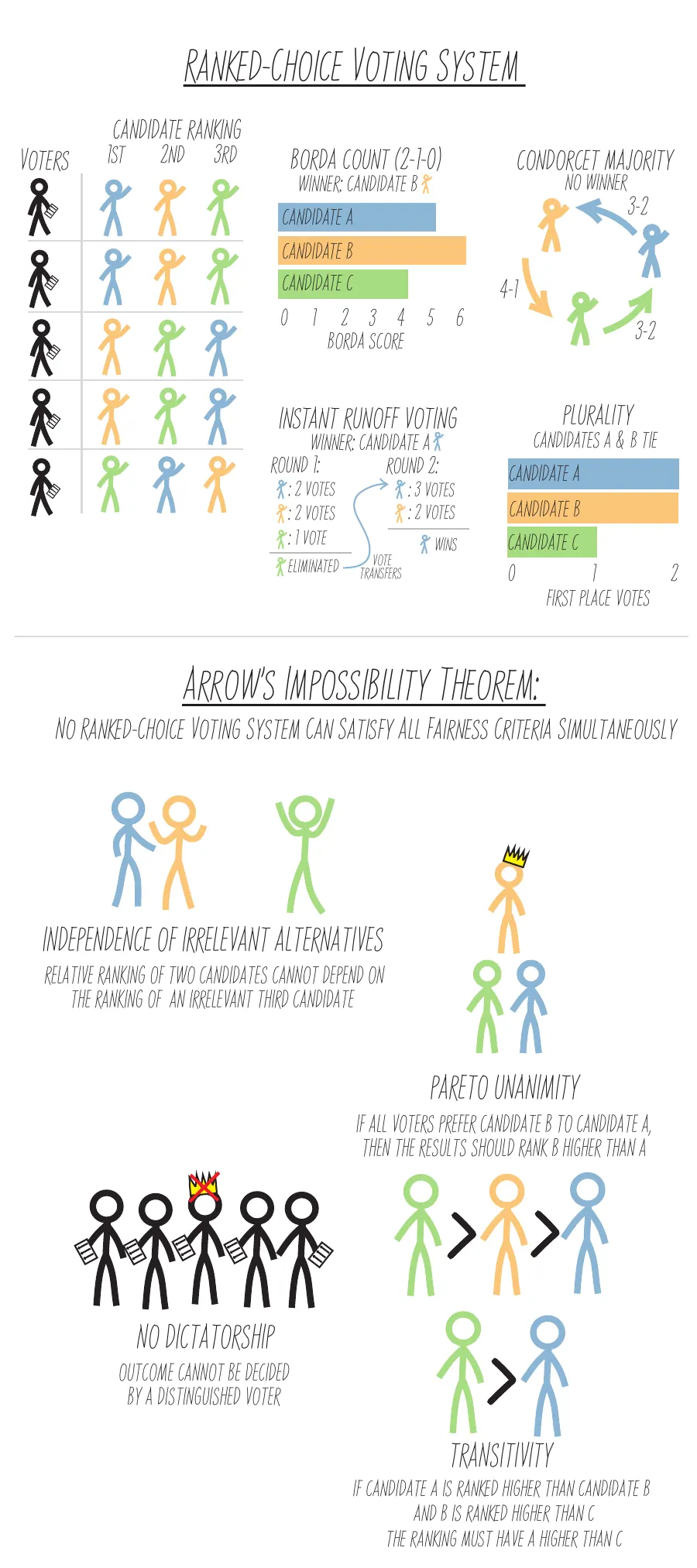
Arrow’s Impossibility Theorem shows that no voting rule can convert individual rankings into a collective decision without violating at least one basic principle of fairness. What seems like a straightforward requirement for democracy turns out to be mathematically impossible, leaving every voting system to sacrifice some aspect of fairness.
Topics
- Voting Systems
- Arrow’s Impossibility
- Preference Rankings
- Condorcet Cycles
- Independence of Irrelevant Alternatives
- Unanimity & Non-Dictatorship
- Plurality vs Borda
- Instant Runoff
- Unavoidable Trade-offs
- Social Choice Theory
- Lonely Runner Conjecture
Sidenote
Top (Voting methods): Ranked-choice voting is a system in which voters express their preferences by submitting complete rankings of all candidates, and the system aggregates them into a ranked list or a single winner. Different aggregation methods (Borda count, instant-runoff voting (IRV), plurality, Condorcet) can produce distinct winners from identical voter rankings, demonstrating the inherent ambiguity in collective decision-making. The same preference profile can yield different outcomes depending on which features of the rankings are emphasized by the chosen method. This indeterminacy means there is no canonical way to translate individual preferences into collective choices.
Bottom (Arrow’s Theorem): Arrow’s impossibility theorem proves that no ranked-choice voting method can satisfy all four fairness criteria simultaneously when there are at least three alternatives and two voters. Every democratic aggregation method must compromise at least one criterion, making trade-offs unavoidable in social choice.