Chapter 08 of 50
Mind the Gap
“If I were to awaken after having sleptfor a thousand years,my first question would be:has the Riemann Hypothesis been proven?”
In 2013, an unaffiliated Yitang Zhang proved there exists a finite bound B (initially 70,000,000) such that infinitely many prime pairs differ by at most B. While prime gaps can grow arbitrarily large, this breakthrough showed they cannot drift apart arbitrarily far. The Polymath8 collaboration subsequently reduced this bound to a few hundred. Zhang’s approach combined distribution properties of primes in arithmetic progressions with an advanced sieving technique, resolving a fundamental question about number patterns while falling short of proving the Twin Prime Conjecture that infinitely many primes differ by exactly 2.
Topics
- Prime Gaps
- Twin Prime Conjecture
- Zhang’s Bounded Gaps
- 70 Million Bound
- Weighted Sieve Method
- Polymath8 Collaboration
- Maynard Simplification
- Green-Tao Progressions
- Cramér’s Conjecture
- Riemann Hypothesis
- Zhang’s Trajectory
Sidenote
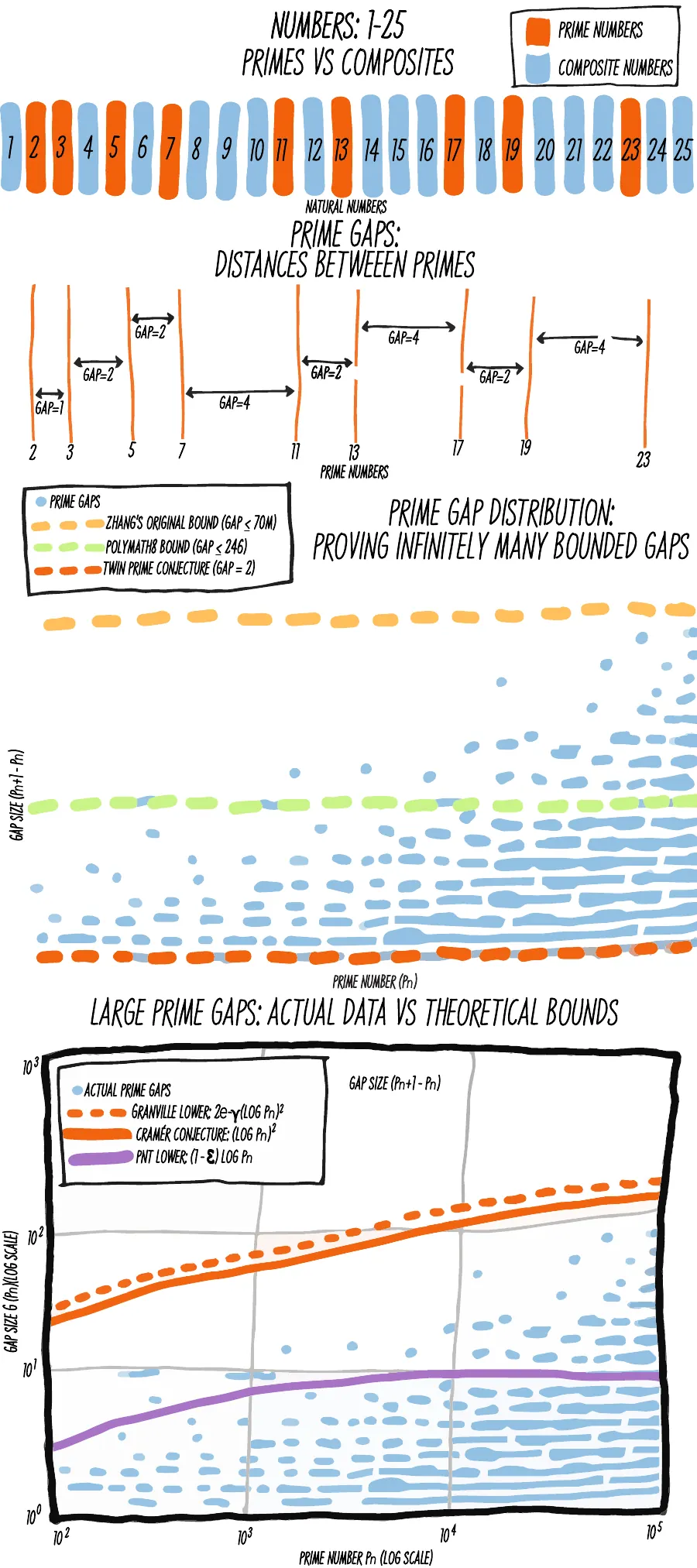
Top (Prime Distribution): Natural numbers 1–25 with primes (red) and composites (teal), showing that twin prime pairs like (3,5), (5,7), (11,13), (17,19). Second (Gap Sizes): Consecutive primes with gap sizes marked by blue arrows, from the minimal gap of 2 to larger separations such as 8 between 23 and 31. Third (Gap Analysis): Scatter plot of prime gaps versus for the first 10,000 primes, showing that most gaps are small with rare large exceptions. Reference lines mark key bounds: twin primes (gap = 2), Polymath8’s refined bound (246), and Zhang’s original breakthrough (70 million). Infinitely many gaps stay below some fixed bound, guaranteeing points always appear below these lines.
Note the key distinction: for small gaps we seek absolute bounds (fixed numbers such as 246), while for large gaps the bounds are functions of that grow as primes get larger.
Bottom (Maximum Gaps): How large can prime gaps become? This shows the largest observed gaps (light blue) compared to theoretical predictions. The red lines show upper bound conjectures for maximum gap size, while colored lower bounds prove that gaps must occasionally be large. The scatter demonstrates that while most gaps are small relative to the local prime density, some gaps are much larger than the typical spacing in their region.