Chapter 07 of 50
A Complex (Projective) Billiard Game
« La mathématique est l’art de donner le même nom à des choses différentes. »
“Algebra is the offer made by the devil to the mathematician.The devil says: I will give you this powerful machine,it will answer any question you like.All you need to do is give me your soul:give up geometry and you will have this marvelous machine.”
Poncelet’s Porism describes an unexpected property of billiard trajectories between two nested ellipses: if one path returns to its starting point after a finite number of bounces, then all starting points generate periodic trajectories with the same number of bounces. This geometric result connects to elliptic curves and measure-preserving dynamical systems, exemplifying how problems in distinct fields reduce to the same equations through appropriate frameworks.
Topics
- Elliptical Billiards
- Poncelet’s Porism
- Nested Ellipses
- Poncelet Map
- Invariant Weighted Measure
- Rotation Number
- Rational vs Irrational
- Benford’s Law
- Leading Digit Distribution
- Gelfand Framework
- Dynamical Proof
Sidenote
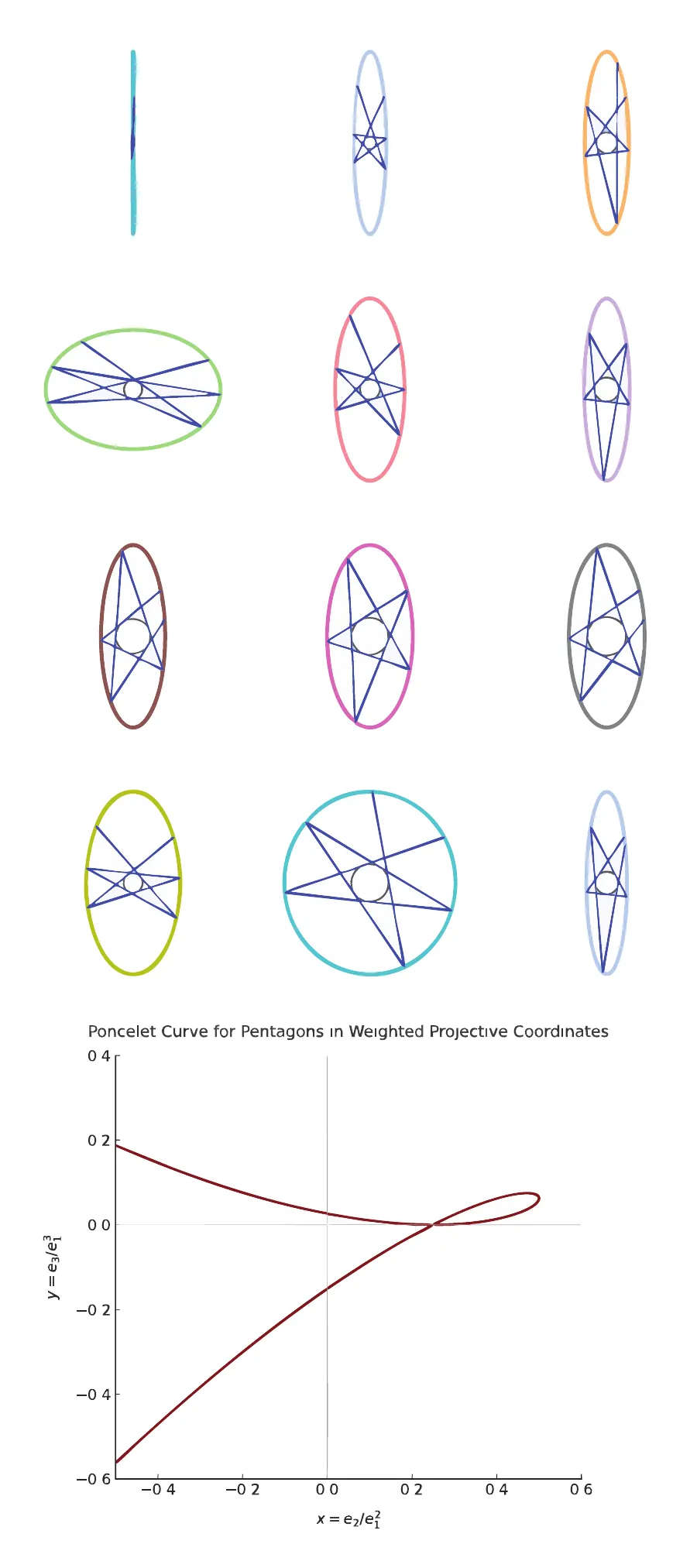
Top (Poncelet Trajectories): Each subplot in the top section displays a pair of conics: the outer circle and an inner ellipse of the form , where are derived from sampled Cayley invariants . A five-step Poncelet trajectory is drawn in blue, starting from a fixed angle and iteratively constructing tangents from the circle to the ellipse. If the polygon closes after five steps, the pair lies on the Poncelet curve.
Bottom (Poncelet Curve): The curve shown is the Poncelet curve associated with pentagonal (5-periodic) Poncelet polygons inscribed in one conic and circumscribed around another. Each point on this curve corresponds to a set of conic pairs for which a closed 5-gon exists that satisfies Poncelet’s closure condition. The coordinates represent algebraic invariants of the conic pair, specifically and , where are the elementary symmetric functions of the characteristic multipliers derived from the conic configuration. A point on the curve means that a 5-periodic polygon can be inscribed and circumscribed for that particular combination of invariants. For more, see the excellent blog of Oliver Nash at http://olivernash.org/2018/07/08/poring-over-poncelet/index.html.