Chapter 06 of 50
The Apple Falls the Slowest from the Tree
“Spacetime tells matter how to move;matter tells spacetime how to curve.”
“We have ways of making people talk...by giving them fresh apple slices.”
General relativity formulates gravity as spacetime curvature where time and space metrics are affected by mass and energy. Contrary to the depiction of gravity as bending space, as in the rubber sheet visualizations, in cases in which masses are small (the Earth, for example) it is the gradient in time’s rate that creates gravitational attraction, guiding objects towards regions of slower time. The reason an apple is falling is not because it is affected by force radiated by Earth, nor is it due to the curvature of space, but rather because it is following the shortest path through curved time.
Topics
- Equivalence Principles
- Free Fall as Geodesic
- Spacetime Metric
- Gravitational Time Dilation
- Component
- Falling Into Slower Time
- Local Inertial Frames
- Tidal Effects
- Einstein’s Elevator
- Proper Time Maximization
- GPS Clock Corrections
Sidenote
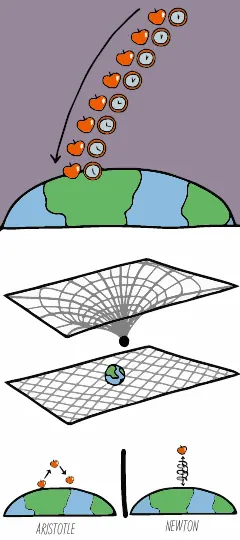
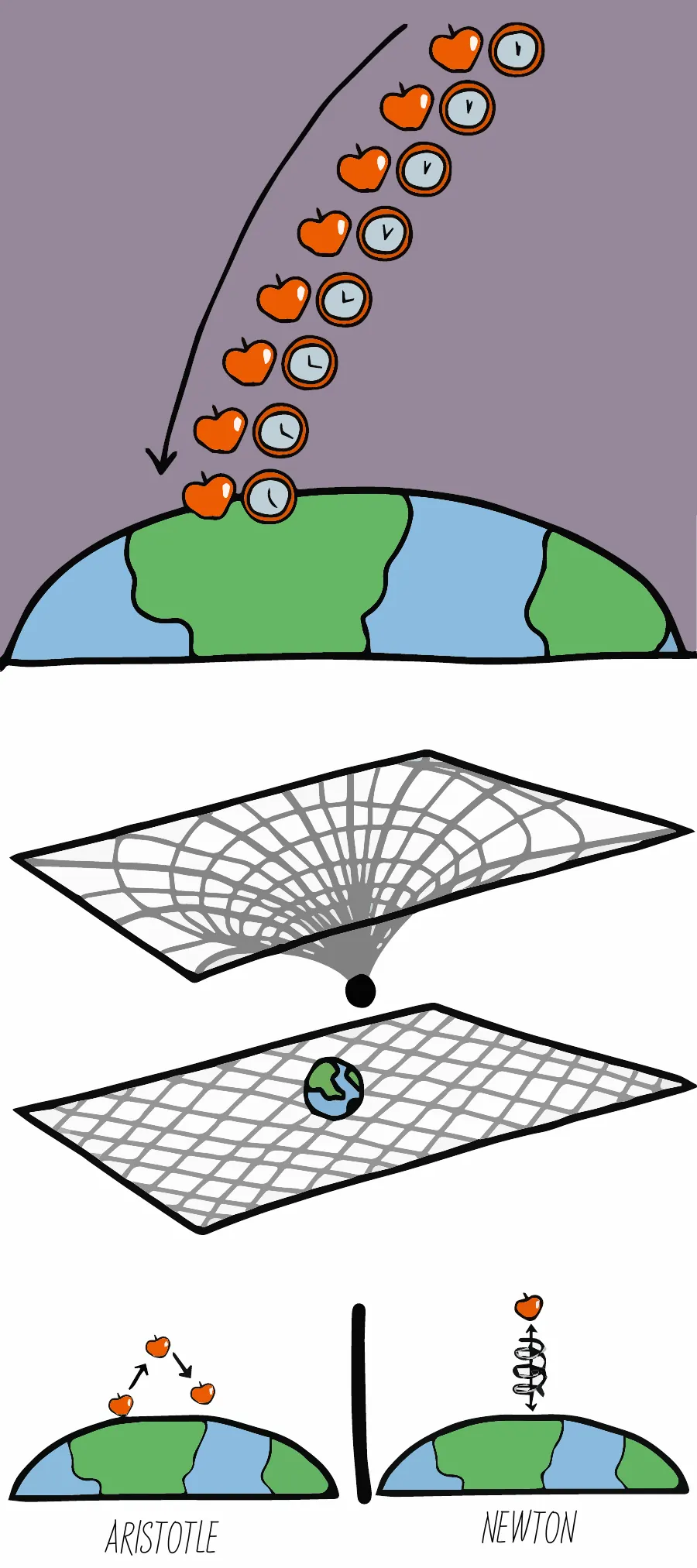
Top (GR — Falling Toward Slow Time): An apple follows a curved free-fall trajectory toward Earth. Along the path, it is shown accompanied by clocks, which tick progressively slower as they get closer to Earth. This is an insight relativity: free-falling objects move toward regions where proper time is maximized — in other words, where the time component of the metric, , decreases. The apple is not being pulled by a force, but slides through spacetime toward slower time.
Middle (Misleading Space Bending): Two “rubber sheet” grid diagrams are shown. The top depicts an exaggerated funnel-shaped distortion caused by a black mass — a common pop-science depiction of gravity. The bottom shows the Earth resting on a seemingly flat grid, emphasizing that for small masses such as Earth, spatial curvature is negligible. What matters is the distortion of time, not space. Gravity in this regime is governed almost exclusively by the gradient.
Bottom (Aristotle to Newton): Left: Aristotle’s model shows apples falling back to Earth because they “belong” there — matter returning to its natural place. Right: Newton’s model depicts a single apple being pulled downward by an invisible gravitational force, with spring lines suggesting mutual attraction between masses. This is Newton’s universal law of gravitation — a force acting at a distance.