Chapter 05 of 50
A Circle of PIE
“English isn’t a language, it’s three languagesstacked on top of each other wearing a trenchcoat.”
The terms ‘wheel’ and ‘cycle’ (but not circle!) derive from Proto-Indo-European *kʷékʷlos despite their phonetic dissimilarity in modern languages. Regular sound shifts transformed this root differently in Germanic and Hellenic branches through documented phonological processes. These linguistic patterns preserve evidence of Bronze Age terminology and illustrate consistent patterns of language change. Comparative methods identify these transformations through sound correspondences across Indo-European languages.
Topics
- Proto-Indo-European
- *kʷékʷlos Wheel
- *dʰugh₂tḗr Daughter
- Comparative Method
- Sound Correspondences
- False Cognates
- Reduplication & Circularity
- Hebrew g-l-l Root
- וחוזר חלילה Mystery
- High-Retention Vocabulary
- Linguistic Reconstruction
Sidenote
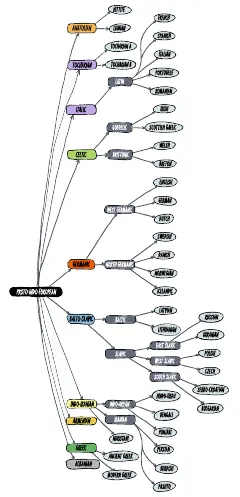
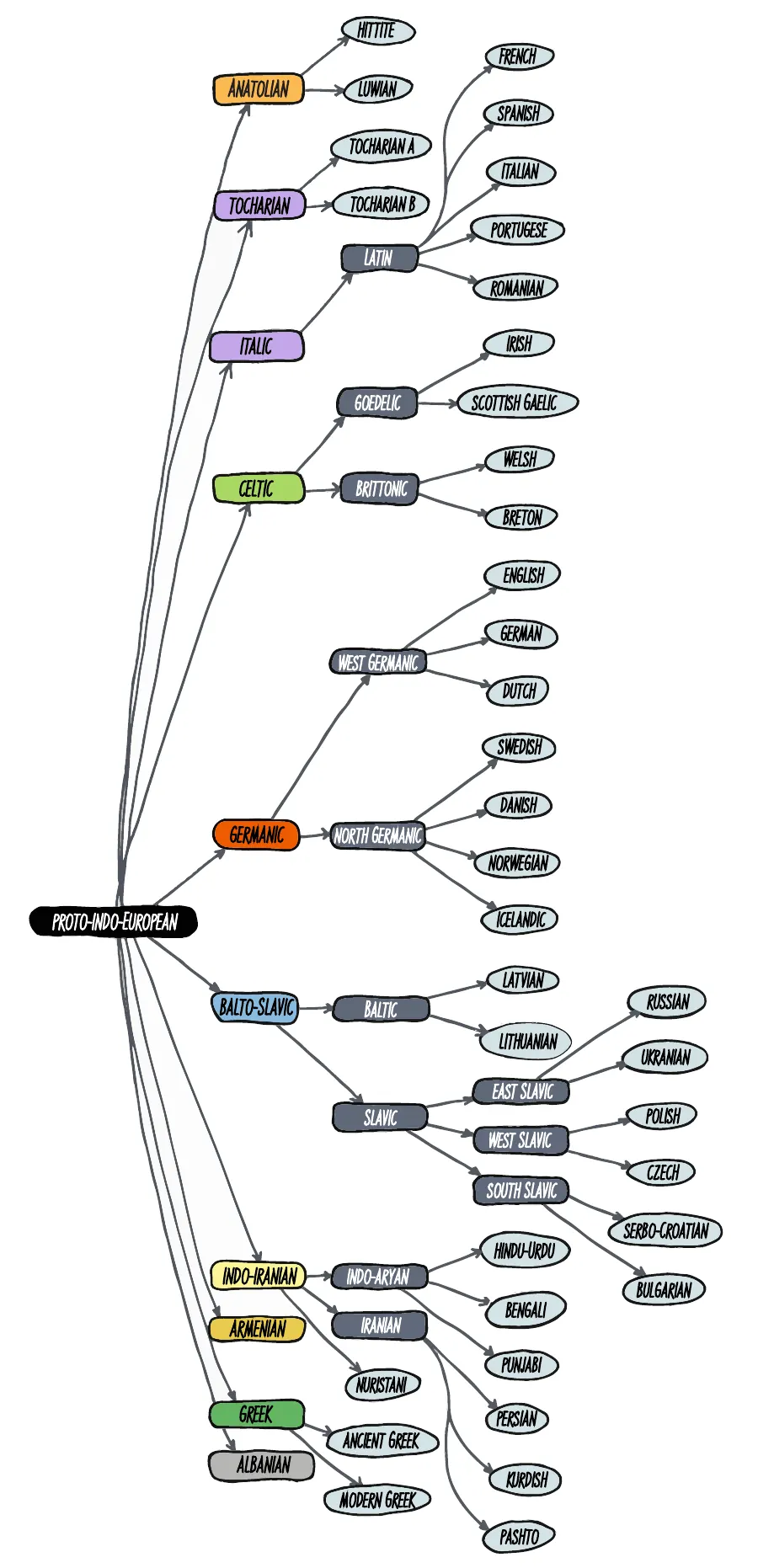
Indo-European Language Family Tree: This phylogenetic reconstruction illustrates the hierarchical relationships among Indo-European languages, flowing from Proto-Indo-European (PIE) on the left to modern languages on the right. The tree demonstrates the systematic branching described by the comparative method, where shared innovations define intermediate nodes and regular sound correspondences link ancestral forms to their descendants.
The diagram directly supports the etymological analysis presented in this chapter. The PIE root *kʷékʷlos (‘wheel, circle’) appears across multiple branches with predictable phonological transformations: Greek κύκλος (kyklos) via labiovelar to velar shift, Sanskrit चक्र (chakra) through labiovelar palatalization, and English ‘wheel’ via Grimm’s Law (*kʷ > hw). Each pathway reflects the systematic sound changes that characterize individual language families.
Major branches are color-coded: Germanic (red) encompasses English, German, and Scandinavian languages; Celtic (green) includes Irish and Welsh; Italic (purple) covers Latin and its descendants; Balto-Slavic (blue) spans Russian, Polish, and Baltic languages; Indo-Iranian (yellow) includes Hindi, Persian, and related languages. The tree reveals morphological and phonological spread through subgroups.