Chapter 04 of 50
Think Outside the Wire
“Electricity is actually made up of extremely tiny particles called electrons,that you cannot see with the naked eye unless you have been drinking.”
Electrical energy travels primarily through electromagnetic fields surrounding conductors, not through the movement of electrons in wires. While electrons drift at millimeters per second, energy transfer occurs near light speed through the Poynting vector (S = E × H), which describes energy flow perpendicular to both electric and magnetic fields. This field-based transmission explains why circuits respond almost instantly despite slow electron movement, as opposed to the common misconception that electricity flows like water through pipes.
Topics
- Poynting Vector
- Energy in Fields
- Maxwell’s Displacement Current
- Drift Velocity Slowness
- Drude Model Failures
- Debye Phonons
- Sommerfeld Quantum Gas
- Boundary Conditions
- Wire as Field Guide
- Veritasium Misconception
- Field vs Charge Flow
Sidenote
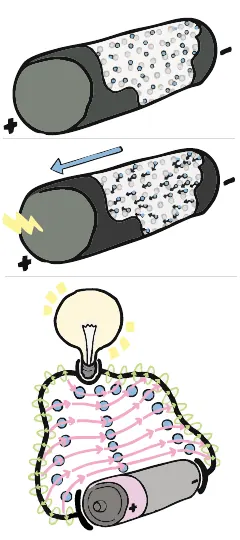
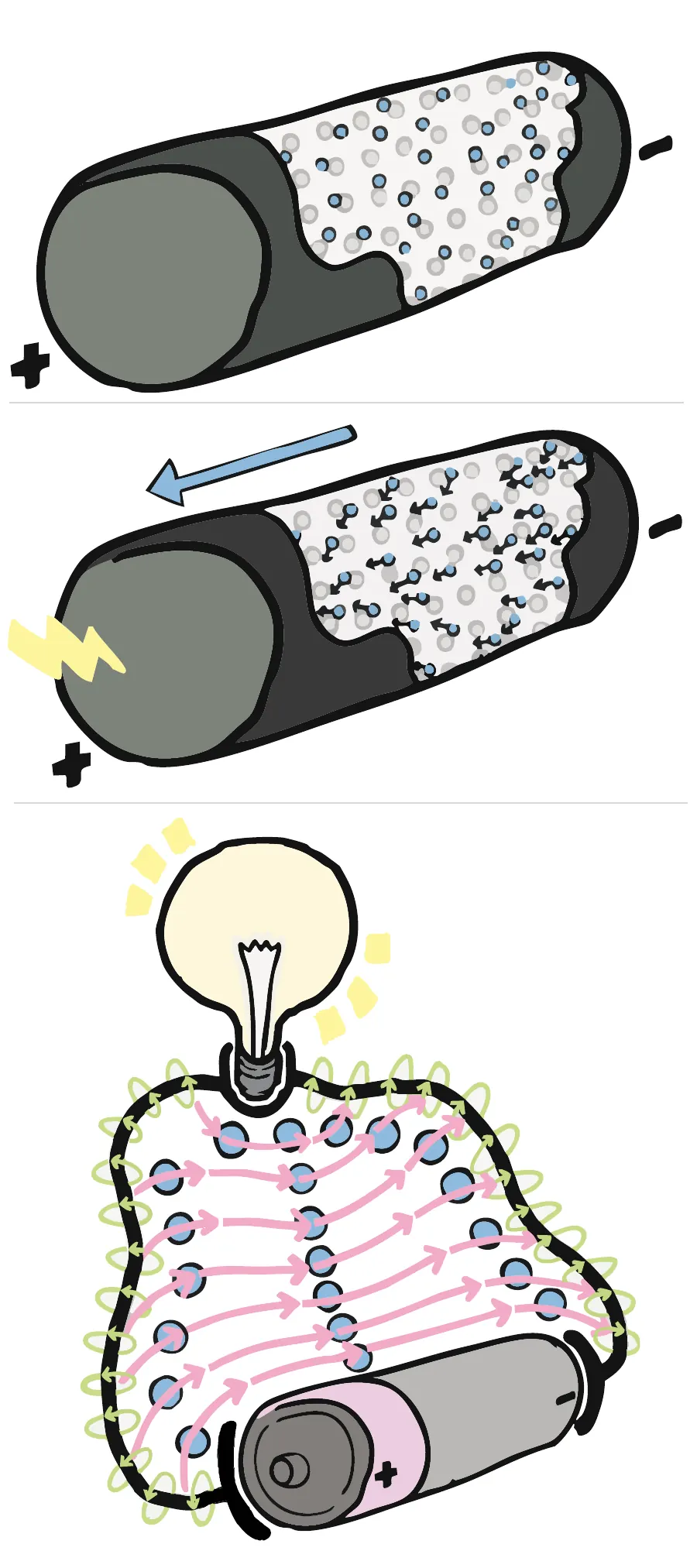
Top (Thermal Motion): Thermal motion in equilibrium. Even with no applied voltage, conduction electrons within the wire exhibit rapid random motion (thermal velocities on the order of to m/s), but with no net directional flow — resulting in zero macroscopic current. Middle (Net Drift): Net drift under an applied electric field. Applying a voltage creates an electric field along the wire, introducing a slight statistical bias in electron velocities. This produces a slow net drift (typically fractions of a millimeter per second), superimposed on the much faster thermal motion. Despite the minuscule drift speed, the circuit responds almost instantly to changes in voltage, as the electromagnetic field propagates at near light speed. Bottom (Energy Flow): Macroscopic current and surrounding fields. The collective electron drift constitutes a measurable current, which, according to Ampère’s Law, is accompanied by a magnetic field encircling the wire (as shown by the green loops and the right-hand rule). Together, the electric field driving the current and the magnetic field generated by it produce a nonzero Poynting vector oriented along the wire. This indicates that energy flow occurs through the electromagnetic field in the space surrounding the conductor — not within the conductor itself. The drift of electrons ensures charge continuity but plays no role in determining the speed of energy delivery.