Chapter 03 of 50
An Axiom of Your Choice
„Das ist nicht Mathematik, das ist Theologie!“
„... auch die Theologie hat ihre Verdienste.“
The Banach–Tarski paradox shows that a solid sphere can be partitioned into finitely many disjoint pieces and, using only rigid motions, reassembled into two spheres identical to the original. This construction depends on the Axiom of Choice and the existence of non-measurable sets, whose behavior diverges from intuitions about volume. While not physically realizable, the result illustrates how certain set-theoretic assumptions allow decompositions that defy standard notions of size and conservation.
Topics
- Axiom of Choice
- Non-Measurable Sets
- Sphere Paradox
- Free Group
- Orbit Decomposition
- Rigid Motion Invariance
- Countable Additivity
- von Neumann Naturals
- Hilbert’s Hotel
- Volume Non-Conservation
- Mathematical Constructivism
Sidenote
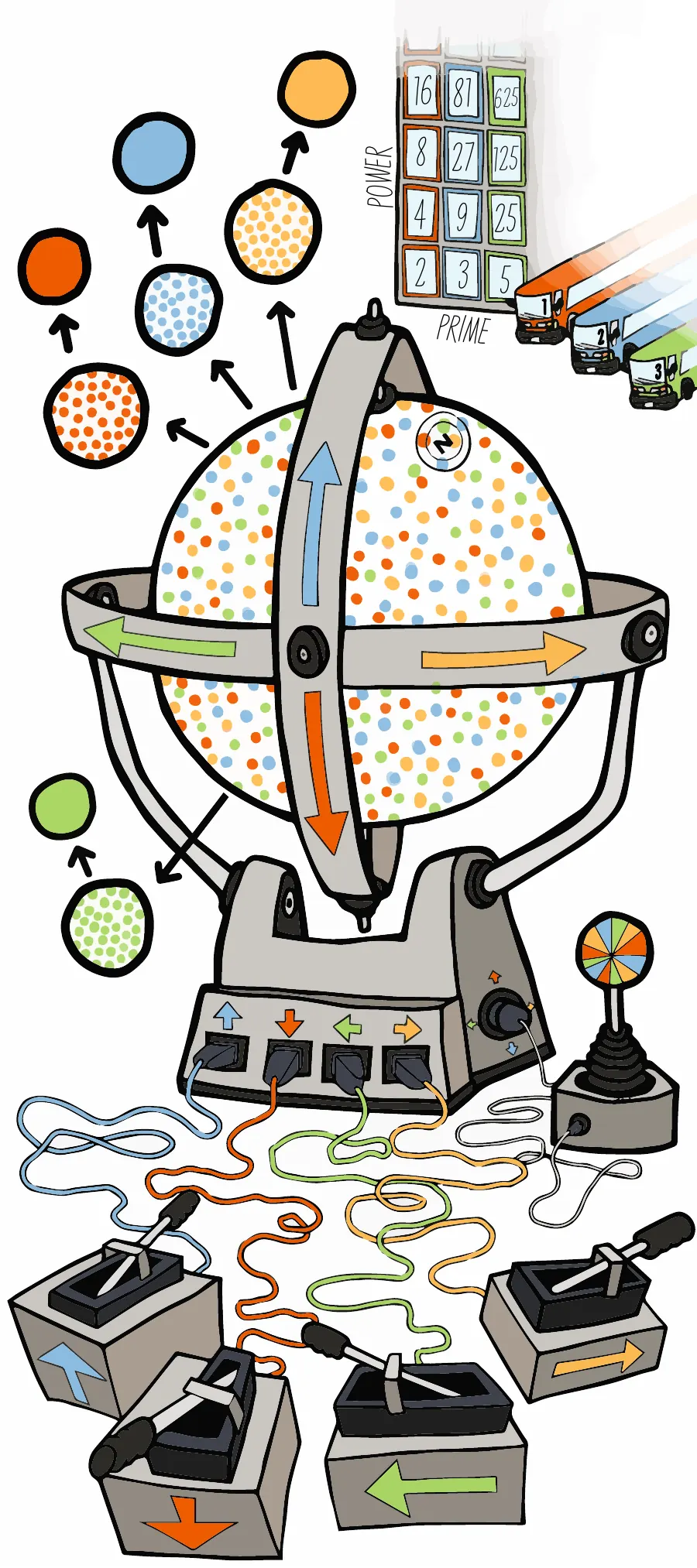
Hilbert’s Hotel with Infinite Buses: An infinite number of buses, each carrying infinitely many passengers, arrives at a hotel with countably infinite rooms. To accommodate everyone, each passenger on bus is assigned to room , where is the th prime number. No two passengers ever collide, since distinct prime powers are never equal: for , there are no integers such that .
Banach-Tarski as a Card Game: Imagine a deck with cards , where you can make any pile of cards, under one rule: and cancel, and cancel (the cards disappear if they are next to one another). Each card represents a rigid rotation: rotate around one axis; around another. In the diagram, blue and red are inverses, as are green and yellow.
Four players each take all reduced sequences (no canceling cards neighbor each other) beginning with a specific card, forming four disjoint point sets: .
Now prepend an to every sequence in , practically rotating the whole set, forming . This transforms sequences that began with into sequences that no longer do. For instance, , and identity. The union now covers all sequences — forming one full copy of the sphere. Similarly, forms a second.