Chapter 02 of 50
Dark Energies Are Pushing Us Apart
“The simplest calculation involves summing the quantum mechanicalzero-point energies of all the fields known in Nature. This gives an answerabout 120 orders of magnitude higher than the upper limits on set by cosmological observations. This is probably the worst theoreticalprediction in the history of physics! Nobody knows how to make senseof this result. Some physics mechanism must exist that makesthe cosmological constant very small.”
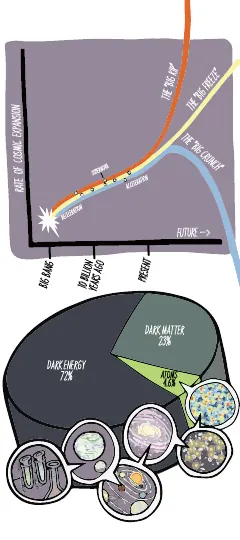
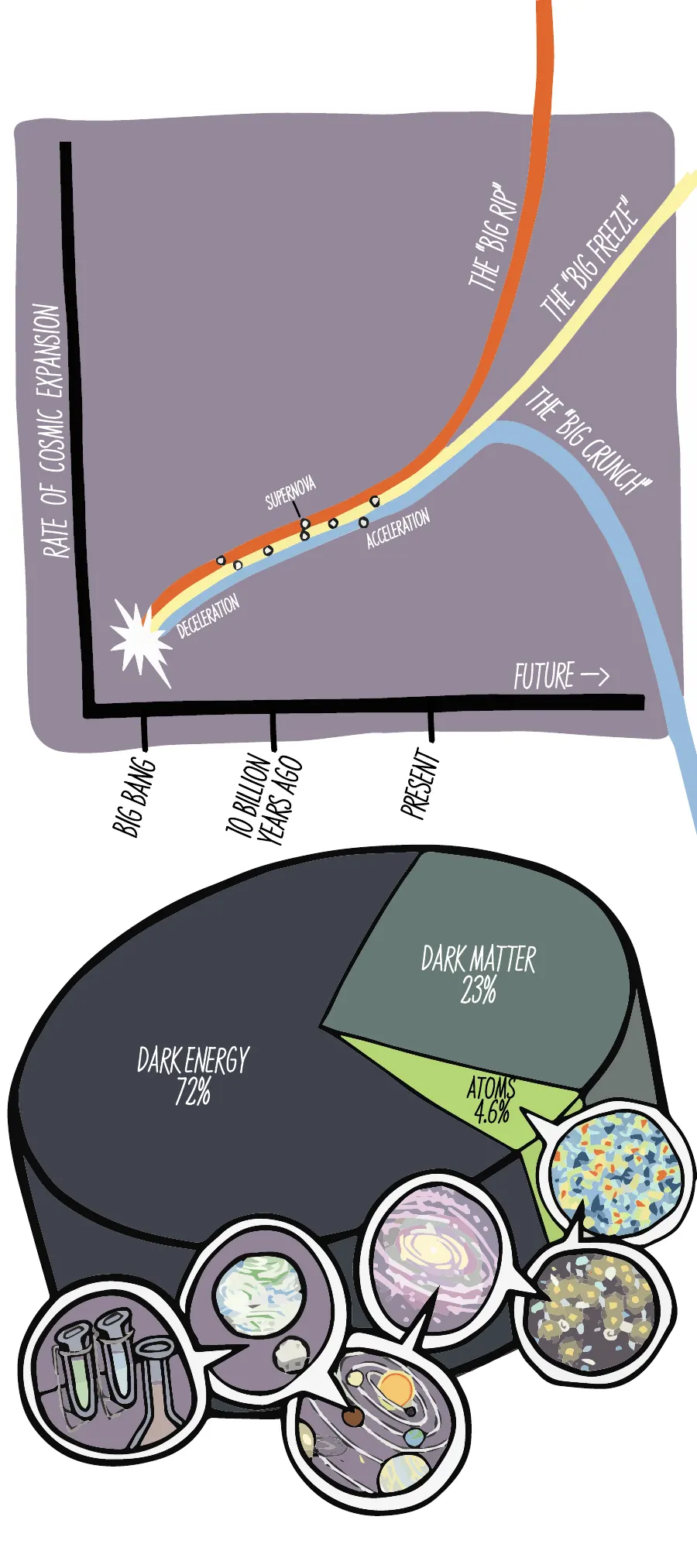
Observations of distant supernovae in the 1990s revealed that the universe’s expansion is accelerating, contradicting earlier models that predicted gravity would slow cosmic expansion. This acceleration requires dark energy, an unknown component comprising about 70% of the universe’s energy density. Dark energy counteracts gravity at cosmological scales, manifesting as either a cosmological constant in Einstein’s equations or a dynamical field.
Topics
- Type Ia Supernovae
- Standard Candles
- Hubble Diagram
- Cosmic Acceleration Discovery
- Dark Energy
- Cosmological Constant
- Distance Modulus
- Redshift-Luminosity
- CDM Model
- CMB Confirmation
- 68% Dark Energy
Sidenote
Top (Cosmic Expansion Scenarios): The universe’s rate of expansion is shown across time, beginning with an early deceleration due to gravity, followed by the observed acceleration linked to dark energy. Possible future outcomes are indicated: the Big Crunch (re-collapse), the Big Freeze (endless cooling expansion), and the Big Rip (runaway acceleration tearing structures apart). Supernova data points provide the evidence anchoring this curve. Bottom (Cosmic Energy Composition): The universe’s mass-energy content is divided into dark energy (72%), dark matter (23%), and atoms (4.6%), with small additional contributions from neutrinos and photons. Within this narrow slice of atomic matter we can zoom in further: the large-scale structures of the cosmos stars and galaxies planetary systems laboratory beakers. This exponentially dropping sequence highlights how minuscule the portion we directly observe is compared with the vast domain over which the same physical laws are successfully extrapolated.