Chapter 01 of 50
Relatively Yellow
“All that is gold does not glitter,not all those who wander are lost;the old that is strong does not wither,deep roots are not reached by the frost.”
“All that glitters may not be gold,but at least it contains free electrons.”
The yellow color of gold requires relativistic quantum mechanics to explain, unlike silver’s silvery appearance. Electrons in gold atoms reach 58% of light speed, causing changes in the 6s and 5d orbitals. This shifts absorption to blue wavelengths, resulting in the reflection of yellow-red light. Similar relativistic effects explain mercury’s liquid state and platinum’s white appearance. These everyday properties demonstrate how modern physics manifests in macroscopic observations.
Topics
- Quantum Numbers
- Gold’s Yellow Color
- Relativistic Orbital Contraction
- Scaling
- 5d-6s Energy Reversal
- Blue Light Absorption
- Dirac vs Schrödinger
- Heavy Atom Effects
- Inert Pair Effect
- Mercury Liquid State
- Relativistic Chemistry
Sidenote
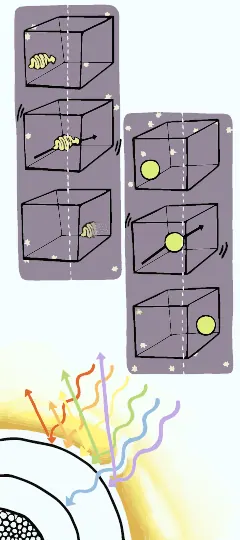
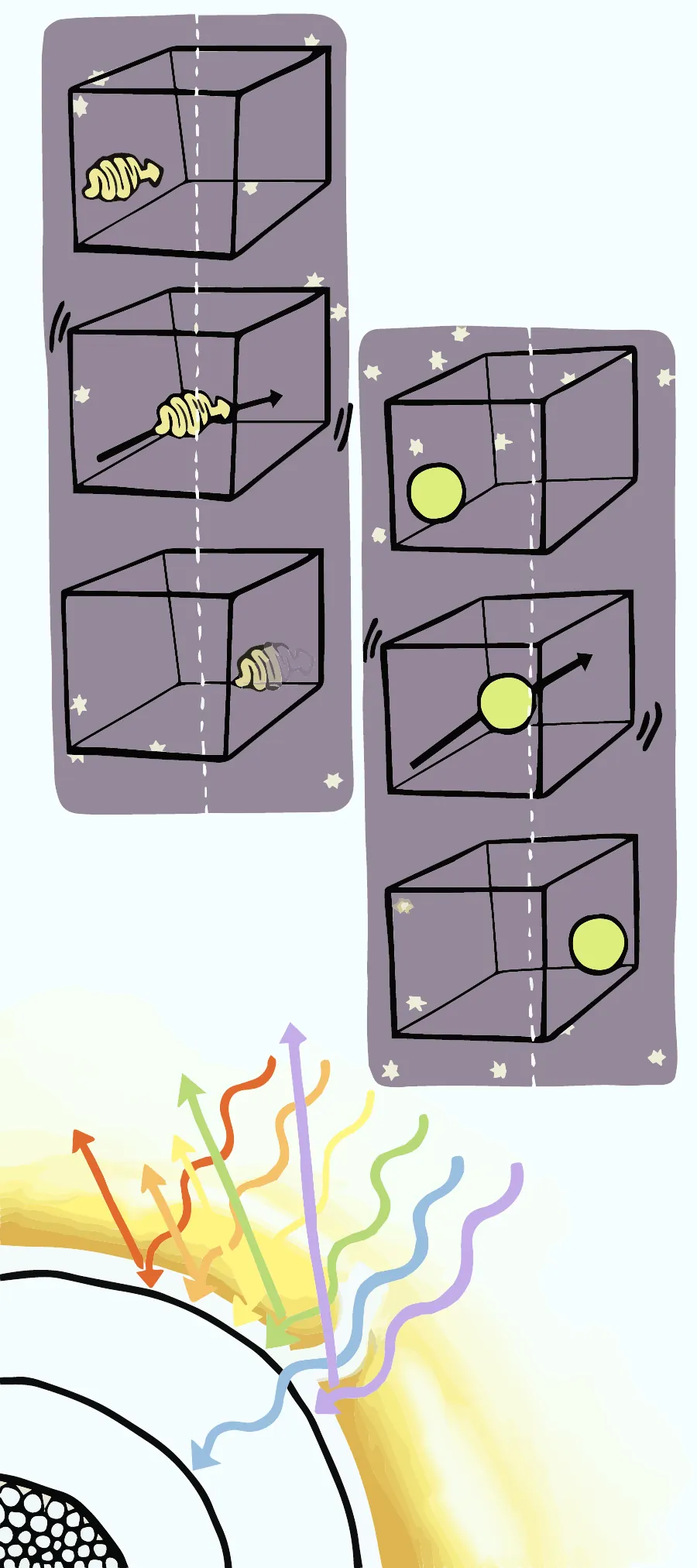
Energy–Mass Equivalence: A box of mass and length emits a light pulse of energy from its left wall. The pulse carries momentum , so to conserve momentum the box recoils leftward with speed (for ). The pulse reaches the right wall in time , during which the box drifts left by . After absorption the box is again at rest, but its location has shifted — seemingly moving the system’s center of energy despite no external forces.
To prevent any net shift, the emission must reduce the box’s rest mass at the left wall by (which reappears at the right upon absorption). This relocation shifts the system’s center of energy rightward by . Setting gives , hence .
Relativistic Energy and Momentum: In the middle-right panel, a massive particle crosses the box; both rest mass and motion contribute. Lorentz symmetry packages energy and momentum into the four‑momentum . Its Minkowski norm is invariant: . Therefore (or, with , ).
Why Gold Is Yellow: In the final panel, blue light is absorbed at the surface of a gold atom. Relativistic contraction of inner orbitals (due to high-velocity 6s electrons) shifts energy levels. This narrows the 5d–6s gap, bringing blue transitions into range. The missing blues tint the reflection yellow. Gold is yellow because relativity bends its atomic spectrum.