Chapter 27 of 50
A Spectrum of Skies
“Oh, I’m sorry. Well, I could put the trash into a landfillwhere it’s going to stay for millions of years,or I could burn it up and get a nice smoky smell in hereand let that smoke go into the sky where it turns into stars.”
“That doesn’t sound right,but I don’t know enough about stars to dispute it.”
Sky colors are determined by light scattering and spectral signatures. Earth’s blue sky results from Rayleigh scattering, where nitrogen and oxygen molecules preferentially scatter shorter wavelengths by factors of 10–100 times more efficiently than longer ones. Mars’s butterscotch-orange haze results from suspended dust particles 1–10 micrometers across, scattering all wavelengths equally while absorbing blue light. Titan’s deep orange hue comes from photochemical hazes (tholins) produced by UV irradiation of methane, while Venus’s perpetual cloud deck creates brilliant white from sulfuric acid droplets.
Topics
- Rayleigh Scattering
- Blue Sky Physics
- Mars Iron Oxide
- Venus Sulphuric Acid
- Uranus-Neptune Methane
- Stellar Temperature Colors
- H Red Nebulae
- Interstellar Reddening
- Doppler Color Shift
- Spectroscopy Tool
- Atmospheric Path Length
Sidenote
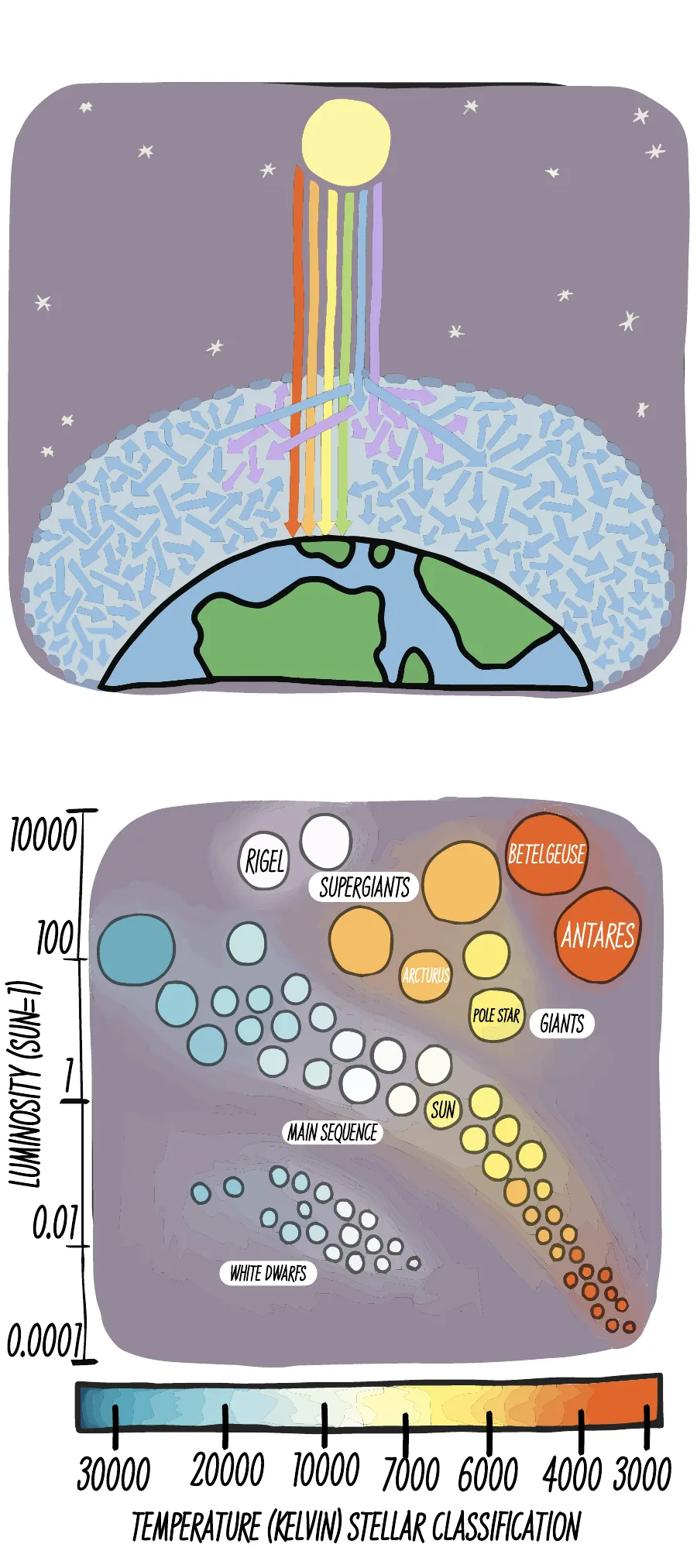
Top (Atmospheric Filtering of Stellar Radiation): Sunlight reaching Earth undergoes selective scattering by the atmosphere. Shorter wavelengths (blue, violet) are scattered in all directions, while longer wavelengths (red, orange) pass through more directly. This results in both the blue sky and the reddening of the Sun near the horizon.
Bottom (Hertzsprung–Russell Diagram): Stars are plotted by surface temperature (x-axis, decreasing rightward) and luminosity (y-axis, log scale). Main sequence stars form a diagonal band; giants and supergiants lie above, white dwarfs below. The Sun sits in the middle of the main sequence. The temperature scale reflects stellar classification: blue-hot stars (left) are hotter and more luminous; red stars (right) are cooler.