Chapter 28 of 50
You’re So Hot, You Cool Me Down
“Give a man a fire and he’s warm for a day,but set fire to him and he’s warm for the rest of his life.”
“Winter is coming.”
Temperature measures how entropy changes with energy (∂S/∂E), not merely kinetic activity. While unbounded systems such as ideal gases can only reach positive temperatures, quantum systems with finite energy spectra reveal different dynamics. When energy addition increases disorder, temperature is positive; when maximum entropy is reached, temperature becomes infinite; further energy addition creates more ordered states with negative temperatures. These negative temperature states are not colder than absolute zero but as hot as infinity — they transfer energy to any positive-temperature system when brought into contact.
Topics
- Temperature Definition
- Heat Flow Direction
- Carnot Universal Scale
- Kinetic Theory
- Statistical Mechanics
- Negative Temperature
- Population Inversion
- Bounded Energy Systems
- Boltzmann vs Gibbs
- Dunkel-Hilbert Controversy
- Coldness Parameter
Sidenote
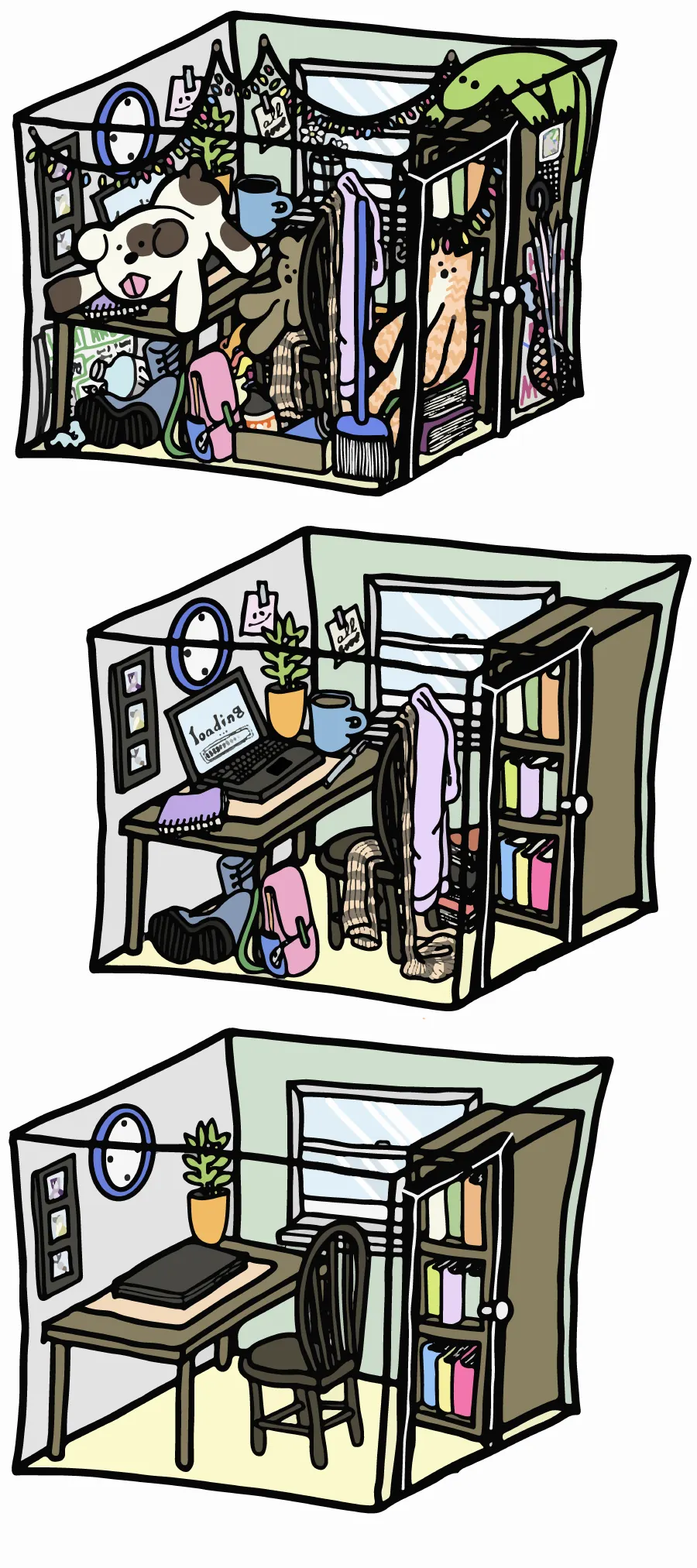
Top (Maximum Entropy – Overcrowded Room): A metaphor for a negative temperature system. The room is so disordered — crammed with objects, decor, and chaos — that any change would make it more ordered. This represents a population-inverted state: energy is at its maximum, and the system is beyond the entropy peak where β = 0. Thermodynamically, such states must have negative temperature.
Middle (Positive Temperature – Typical Disorder): A moderately cluttered room. It reflects a normal positive temperature system: there’s room for more disorder, and adding energy generally increases entropy. This is the typical regime described by classical statistical mechanics.
Bottom (Low Temperature – Ordered State): A clean, sparse room. This is a low-entropy state where most particles (or objects) are in low-energy configurations. Adding energy would increase disorder. The system is clearly in the conventional positive-temperature regime, but near the low end.