Chapter 29 of 50
A Plane Hat Trick
“There is something in such laws that takes the breath away.They are not discoveries or inventions of the human mind,but exist independently of us.In a moment of clarity, one can at most discoverthat they are there and take them into account.Long before there were people on the earth,crystals were already growing in the earth’s crust.On one day or another, a human being first came acrosssuch a sparkling morsel of regularity lying on the groundor hit one with his stone tool and it broke off and fell at his feet,and he picked it up and regarded it in his open hand, and he was amazed.”
The “Einstein problem”, named from German “ein Stein” (one stone), asks whether a monotile could tile the plane only aperiodically. In 2022, David Smith, a retired printer experimenting with shapes, discovered the thirteen-sided “hat” that solved this sixty-year puzzle. The hat tiles infinitely without ever repeating its pattern. The study of tilings previously revealed a connection between mathematics and physical quasicrystals, a discovery that won a Nobel Prize in 2011.
Topics
- Hat Monotile 2023
- Aperiodic Tiling
- David Smith Discovery
- 13-Sided Einstein
- Penrose Tiles
- Local Forces Global
- Quasicrystal Connection
- Euler’s Formula
- Substitution Tiling
- Spectre Variant
- Amateur Contributions
Sidenote
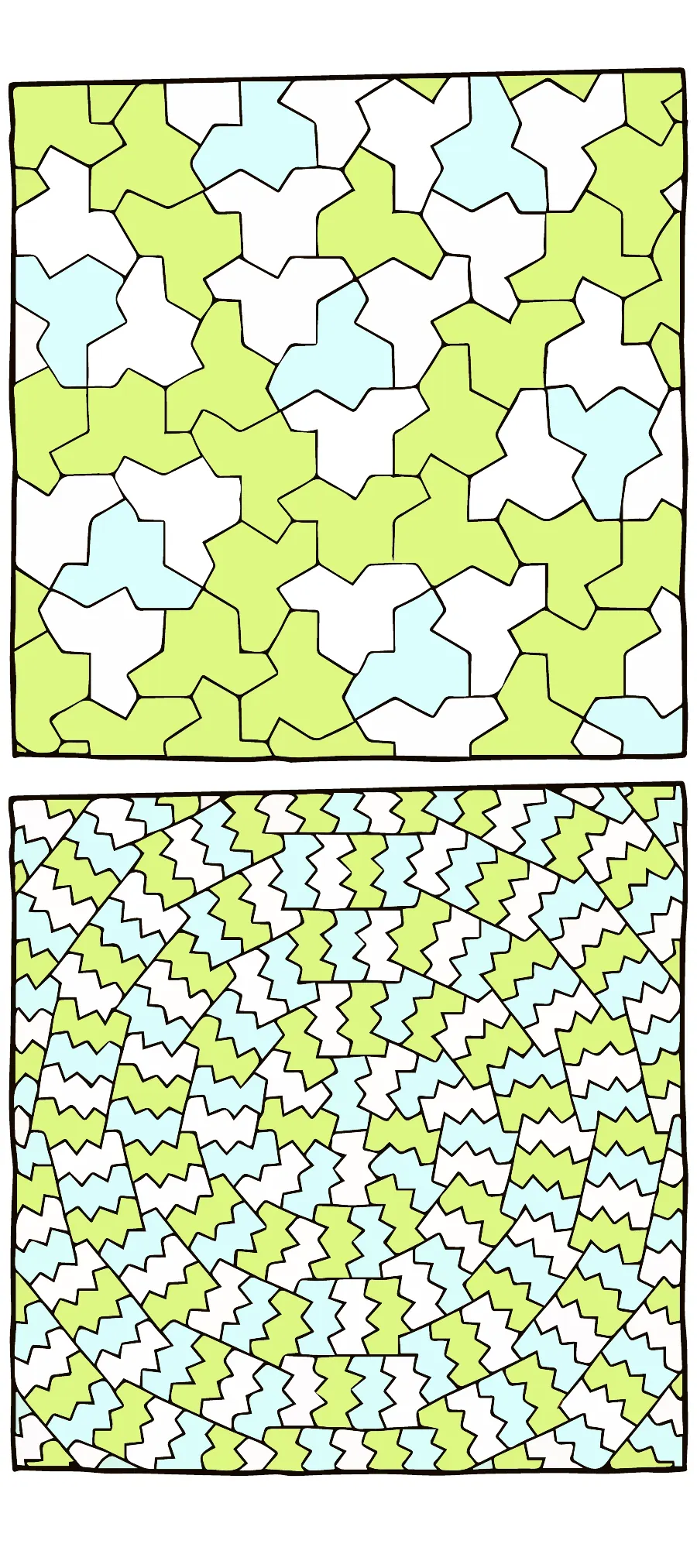
Top (Einstein Monotile – The Hat Tile): Discovered by David Smith in 2022 and formalized in 2023 with Kaplan, Myers, and Goodman-Strauss, this thirteen-sided polygon — nicknamed the “hat” — was the first proven aperiodic monotile, or einstein (German for “one stone”). It tiles the plane completely without repeating periodically. Smith’s discovery also led to related tiles such as the “spectre,” with matching-rule colorings, and to an infinite family of aperiodic monotiles.
Bottom (Imura Spiral Monotile): A symmetric monotile family discovered by Miki Imura in 2023. These tiles expand in four interlaced spiral arms and admit elegant 3-colorings. Although they can form periodic strip tilings, the illustrated spiral configuration highlights their mathematical and aesthetic appeal. The tile corners have angles of and , permitting intricate lawful assemblies.