Chapter 30 of 50
Divide and Conquer
“If you torture the data long enough,it will confess to anything.”
“Correlation is not causation,but they keep close company.”
Simpson’s Paradox occurs when a statistical trend present in separate groups reverses when the groups are combined. This effect is a result of unequal group sizes or hidden confounding variables that distribute non-uniformly across the data. For example, a treatment might show positive effects in both male and female subgroups yet appear harmful in the aggregate population if the treatment is disproportionately given to patients with more severe conditions and males and females differ in average severity. The apparent paradox demonstrates that causal inference requires careful consideration of the causal relationship rather than relying solely on raw correlations.
Topics
- Simpson’s Paradox
- Correlation Reversal
- Weighted Averages
- Kidney Stone Example
- Gerrymandering Math
- UC Berkeley Bias
- Subgroup vs Aggregate
- Confounding Variables
- Statistical Grouping
- North Carolina 2012
- Data Partitioning
Sidenote
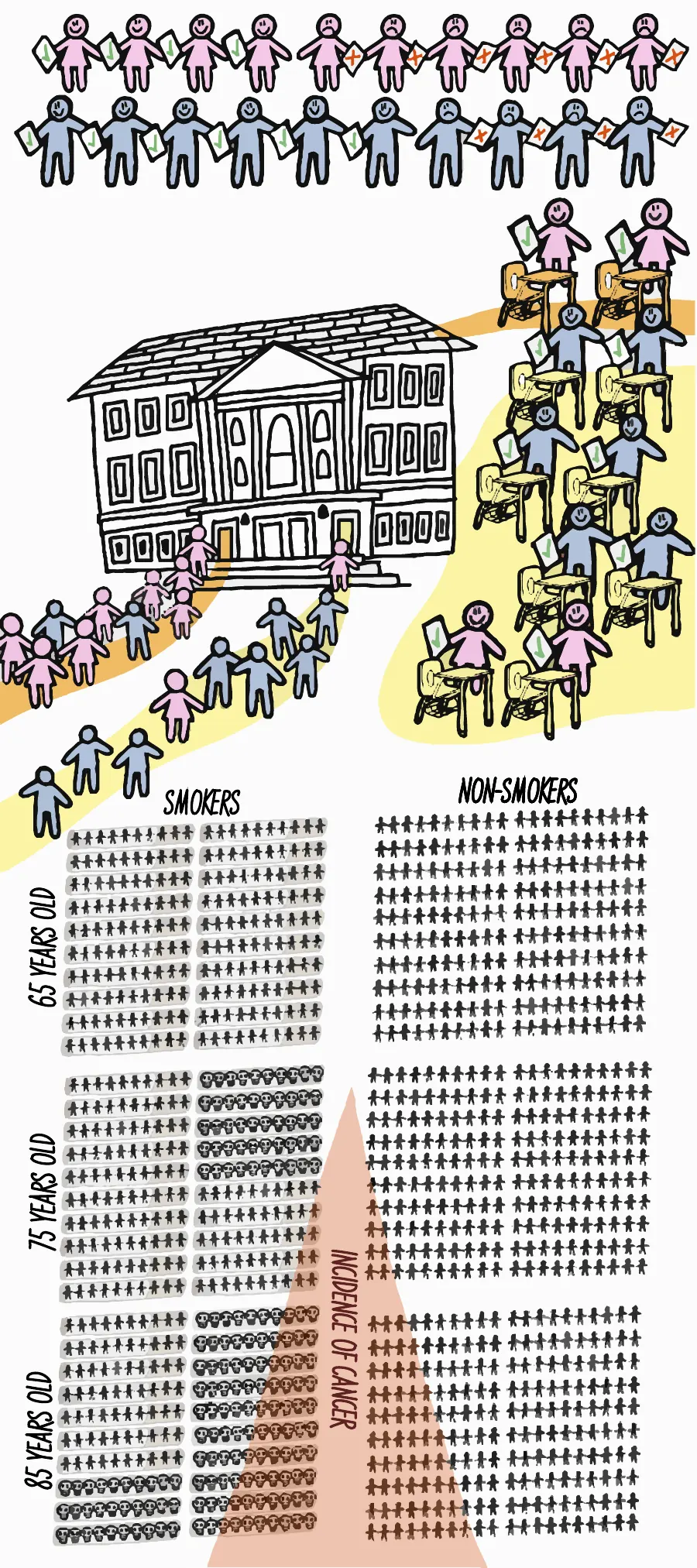
Top (Simpson’s Paradox – Admissions): At the aggregate level, a higher percentage of men are admitted compared to women, suggesting gender bias. But disaggregating by department reveals that women applied more often to highly competitive departments with low acceptance rates, while men applied to departments with higher admission rates. Within departments, women were often admitted at equal or higher rates. This reversal — where an apparent bias in subgroups contradicts the overall trend — is known as Simpson’s Paradox.
Bottom (Survivorship Bias – Cancer in Smokers): Cancer incidence increases sharply with age, but smokers have higher early mortality from other causes. As a result, fewer smokers survive into the high-risk age brackets where cancer becomes common. This skews the population-level data, making it seem as though smokers have lower cancer rates than non-smokers. The truth is hidden by survivorship bias: smokers often die before cancer can occur.