Chapter 31 of 50
Concentrate on Osmosis
“There is, I think, no more wonderful and illuminating spectaclethan that of an osmotic growth — a crude lump of brute inanimate mattergerminating before our very eyes.”
Standard osmosis explanations based solely on water concentration gradients fail to account for measured flow rates that far exceed diffusion limits. The ratio of osmotic permeability to diffusive permeability (Pf/Pd) commonly exceeds 100 in biological systems with aquaporins, while purely diffusive transport would yield a ratio near 1. Mechanical explanations, notably Debye’s model, attribute osmosis to pressure gradients arising from solute-membrane interactions rather than simple diffusion. When solutes are excluded by a semipermeable membrane, their momentum cannot transfer across the boundary, creating a localized pressure drop that drives water movement.
Topics
- Osmosis Misconceptions
- Debye Interface Theory
- Membrane Selectivity
- Transport Ratio
- Van ’t Hoff Law
- Vegard Pressure Drop
- Virial Theorem
- Solute-Solvent Collisions
- Aquaporin Channels
- Galaxy Cluster Dynamics
- Interfacial Forces
Sidenote
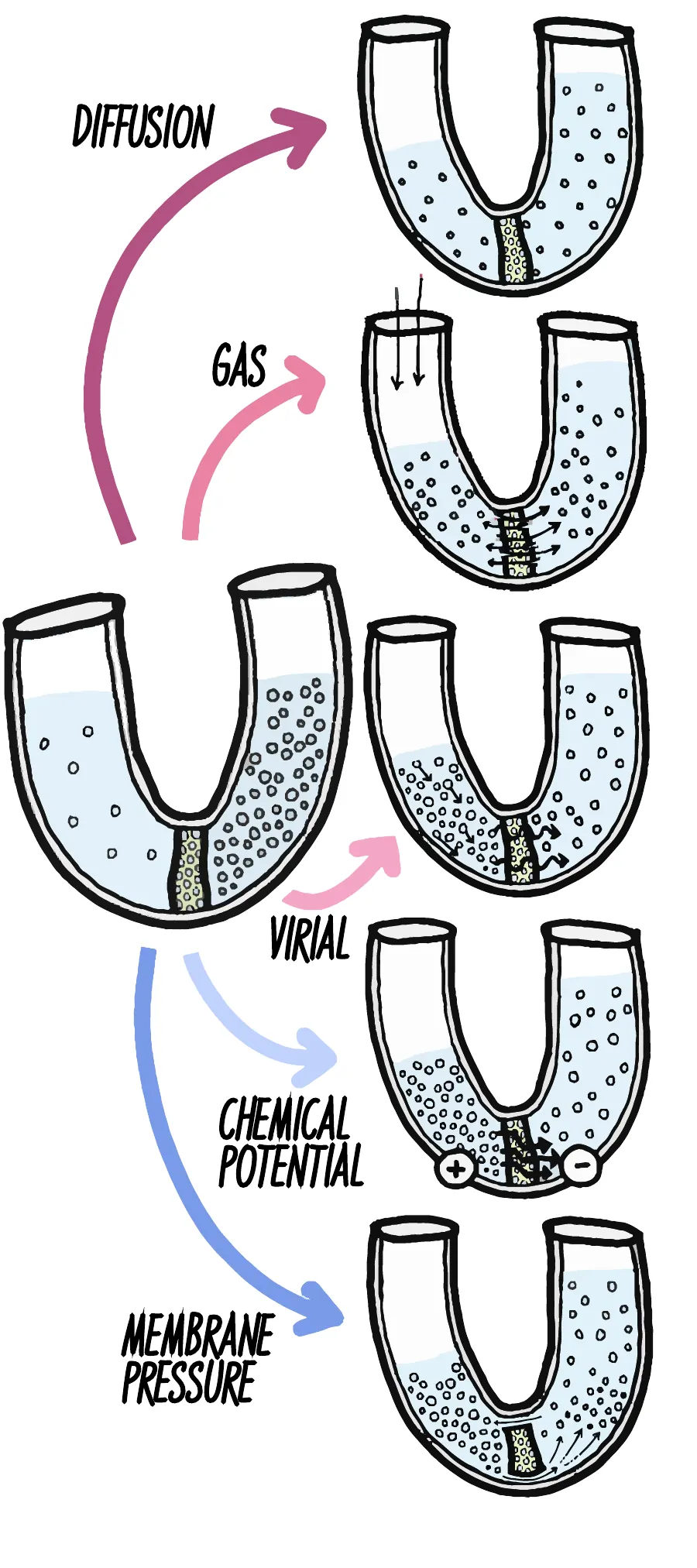
Top (Diffusion Model of Osmosis): Historically, osmosis was explained as a type of diffusion: solute concentration differences cause water to move from low to high solute concentration to “even things out.” This intuitive model treats the membrane as a passive barrier and water flow as driven by statistical mixing.
Second (Gas Pressure Analogy): Water molecules are thought of as a vapor-like phase. The side with more solute has fewer free water molecules, reducing its effective vapor pressure. This creates a pressure imbalance across the membrane, driving water toward the more concentrated side.
Third (Virial Theorem Approach): Here, osmotic pressure is derived from molecular interactions — akin to pressure in gases. Solute particles exert directional momentum transfer through collisions, and the semi-permeable membrane selectively blocks these, resulting in net force buildup.
Fourth (Chemical Potential Explanation): Osmosis is understood in terms of chemical potential gradients. Water flows from high to low chemical potential, and solutes lower the chemical potential of water. This aligns with thermodynamic definitions and governs equilibrium conditions.
Bottom (Membrane Force Model – Debye’s View): In this modern (1923) mechanistic picture, the membrane itself plays an active role. It exerts differential mechanical forces on solute and solvent. Osmotic flow results from water being pulled across in response to these localized interactions.