Chapter 32 of 50
Timing Is Everything
„Zeit ist das, was man an der Uhr abliest.“
Timekeeping has progressively moved toward smaller physical phenomena: from Earth’s rotation to pendulums, from crystal oscillations to atomic transitions, and now toward nuclear resonances. The SI second, defined by 9,192,631,770 periods of cesium-133’s hyperfine transition, relies on quantum interactions between nuclear and electronic magnetic moments. This shift to microscopic reference standards improves precision exponentially — hydrogen masers achieve stability of one part in , while optical lattice clocks using strontium reach one part in by probing transitions at Hz. The progression continues toward nuclear clocks using thorium-229, which promises precision of one part in by exploiting transitions in atomic nuclei rather than electron shells.
Topics
- Time as Coordinate
- Cesium-133 Standard
- Hz
- Hyperfine Transitions
- Optical Lattice Clocks
- Frequency Combs
- GPS Time Corrections
- Thorium-229 Nuclear Clock
- Chronometric Geodesy
- Proper Time Invariance
- Fundamental Physics Probe
Sidenote
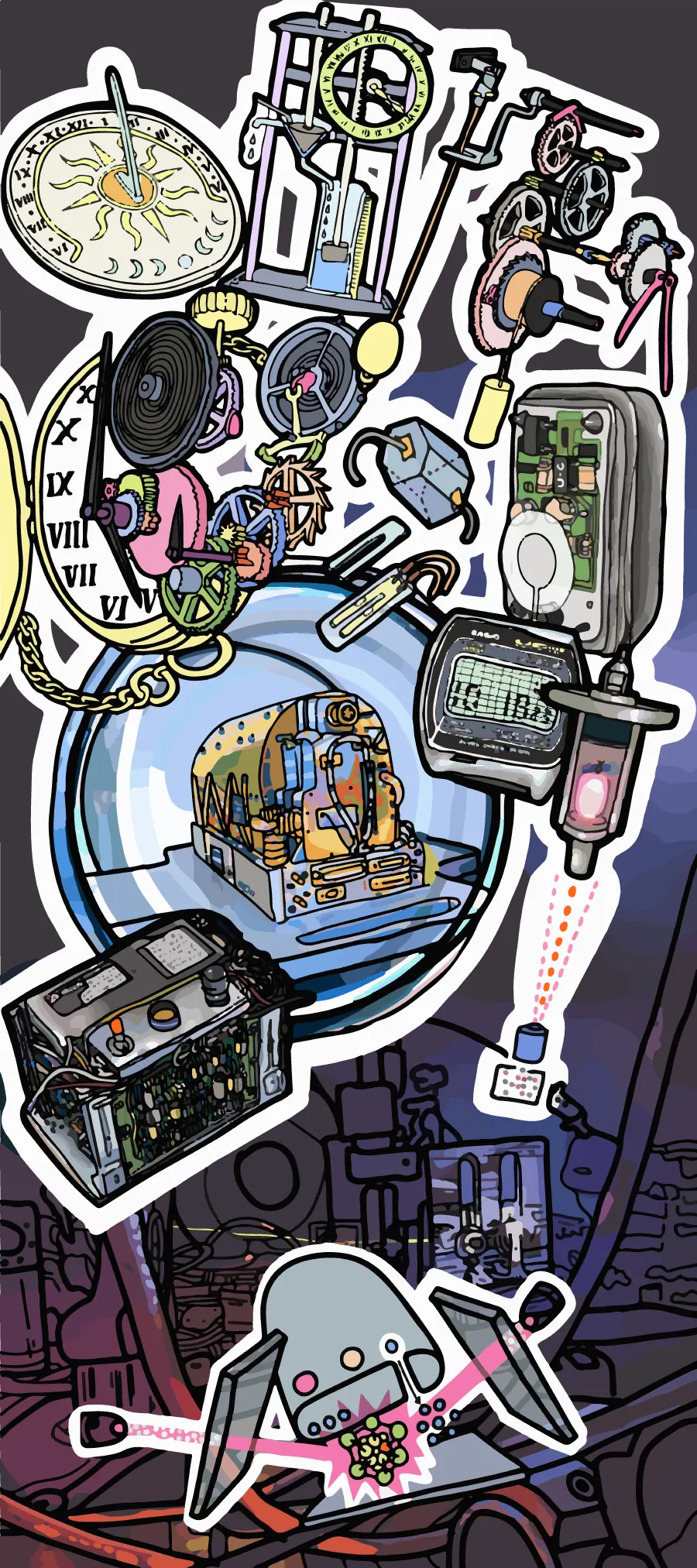
Top (Mechanical and Early Timekeeping): The image begins with sundials — using cast shadows to track solar position. Mechanical clocks follow: weight-driven escapements, pendulums, and balance springs. These systems introduced regular, countable oscillations, enabling precision independent of sunlight.
Middle (Electronic and Atomic Clocks): The transition to electronic timing brought quartz crystal oscillators, tuning forks, and circuit-based digital clocks. Atomic clocks, such as the cesium beam and rubidium standards, use microwave transitions in atoms to define the second with extreme precision. These devices revolutionized navigation, telecommunications, and metrology.
Bottom (Next-Generation Nuclear Clocks): The current frontier involves optical lattice and nuclear clocks — probing energy levels in nuclei rather than electrons. These offer unprecedented temporal stability and resolution. If perfected, they could detect minute variations in gravity, test general relativity, and redefine the basic unit of time.