Chapter 33 of 50
The Center Holds
« Tout le monde y croit cependant, me disait un jour M. Lippmann,car les expérimentateurs s’imaginent que c’est un théorème de mathématiques,et les mathématiciens que c’est un fait expérimental. »
A geometric puzzle about Gaussian probability stumped mathematicians for over sixty years: prove that convex sets that are symmetric around the origin have enhanced overlap under Gaussian measure — that P(A ∩ B) ≥ P(A) · P(B). Despite partial results for boxes, ellipsoids, and slabs, the general case resisted all attempts. In 2014, Thomas Royen, a retired pharmaceutical statistician from a small German university, solved it using textbook methods: transforming to squared variables, applying Laplace transforms, and checking matrix determinants. His proof, published in an obscure journal, went unnoticed for years.
Topics
- Gaussian Correlation Inequality
- Thomas Royen 2014
- Convex Symmetric Sets
- High-Dimensional Geometry
- Concentration of Measure
- Squared Variables Method
- Laplace Transform Proof
- 60-Year Conjecture
- Multivariate Gaussian
- Elementary Solution
- Outsider Discovery
Sidenote
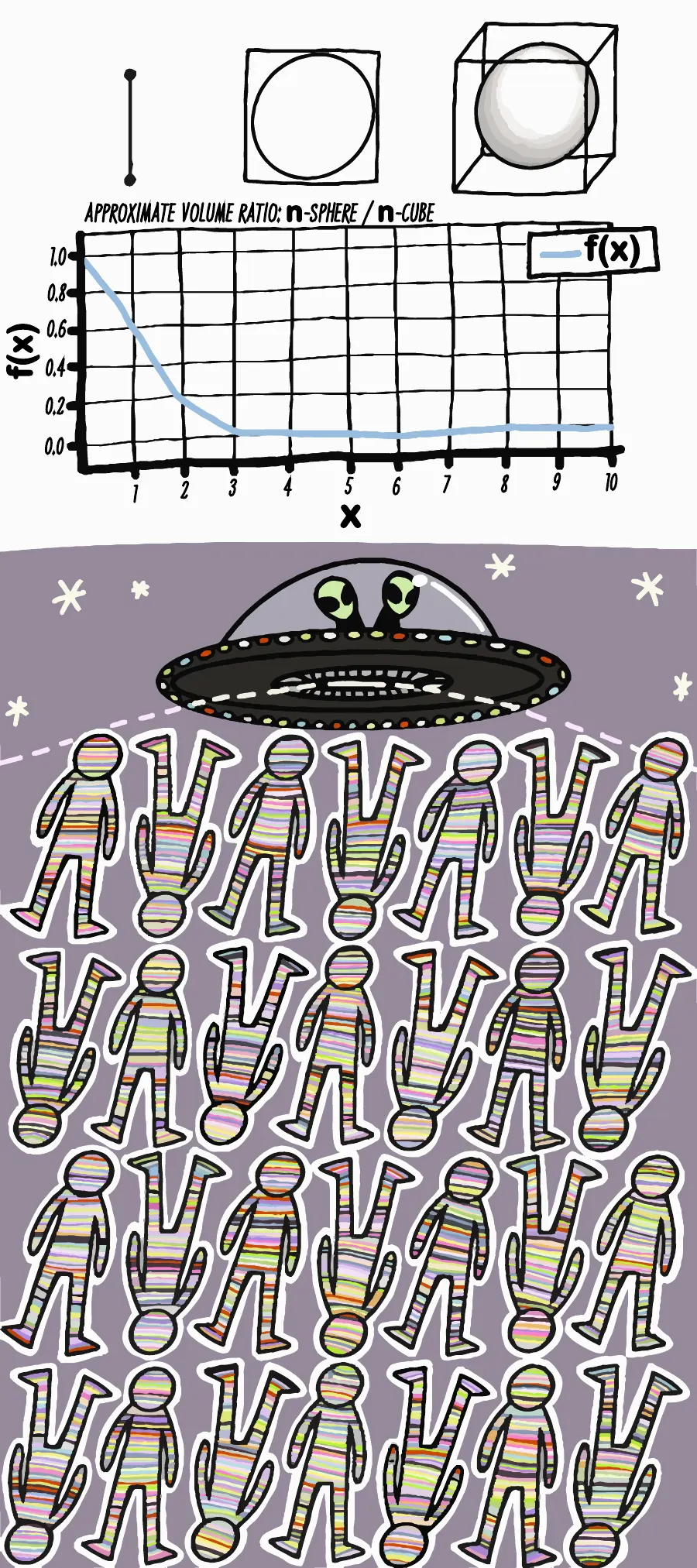
Top (Curse of Dimensionality – Vanishing Volume of the Sphere): As dimensionality increases, the volume of an -sphere relative to the surrounding -cube rapidly shrinks toward zero. In low dimensions, the sphere fills most of the cube; by around ten dimensions, it’s practically gone. This shows that intuition from 2D or 3D fails in high dimensions — most volume concentrates in the corners.
Bottom (Blessing of Dimensionality – Human Uniqueness in High-D Spaces): If each person is described by even fifty independent traits (drawn from uniform or Gaussian distributions), then the “average” human lies in a vanishingly small region of space. Almost everyone is in the high-dimensional fringes — radically unique combinations of attributes. High dimensionality ensures that individuality is not rare but inevitable.