Chapter 34 of 50
A Thought About Nothing
“Thoroughly conscious ignoranceis the prelude to every real advance in science.”
“הֲבֵל הֲבָלִים אָמַר קֹהֶלֶת, הֲבֵל הֲבָלִים הַכֹּל הָבֶל.„(“Vanity of vanities, saith the Preacher,vanity of vanities; all is vanity.”)
The Boltzmann Brain paradox shows that statistical mechanics predicts a disturbing outcome: random fluctuations in a high-entropy universe would produce isolated conscious entities more frequently than entire ordered universes such as ours. A single brain with false memories requires orders of magnitude fewer unlikely coincidences than 13.8 billion years of cosmic evolution. These hypothetical observers would experience coherent thoughts and apparent histories, yet exist only as momentary statistical fluctuations. It is not easy to dismiss this preposterous theory based on scientific reasoning alone.
Topics
- Boltzmann Brain Paradox
- Entropy Fluctuations
- de Sitter Future
- Eternal Expansion
- Cognitive Without Causation
- Epistemic Disconnection
- Observer Selection Problem
- Measure Proposals
- Gott’s Turing Test
- Multiverse Crisis
- Scientific Dead End
Sidenote
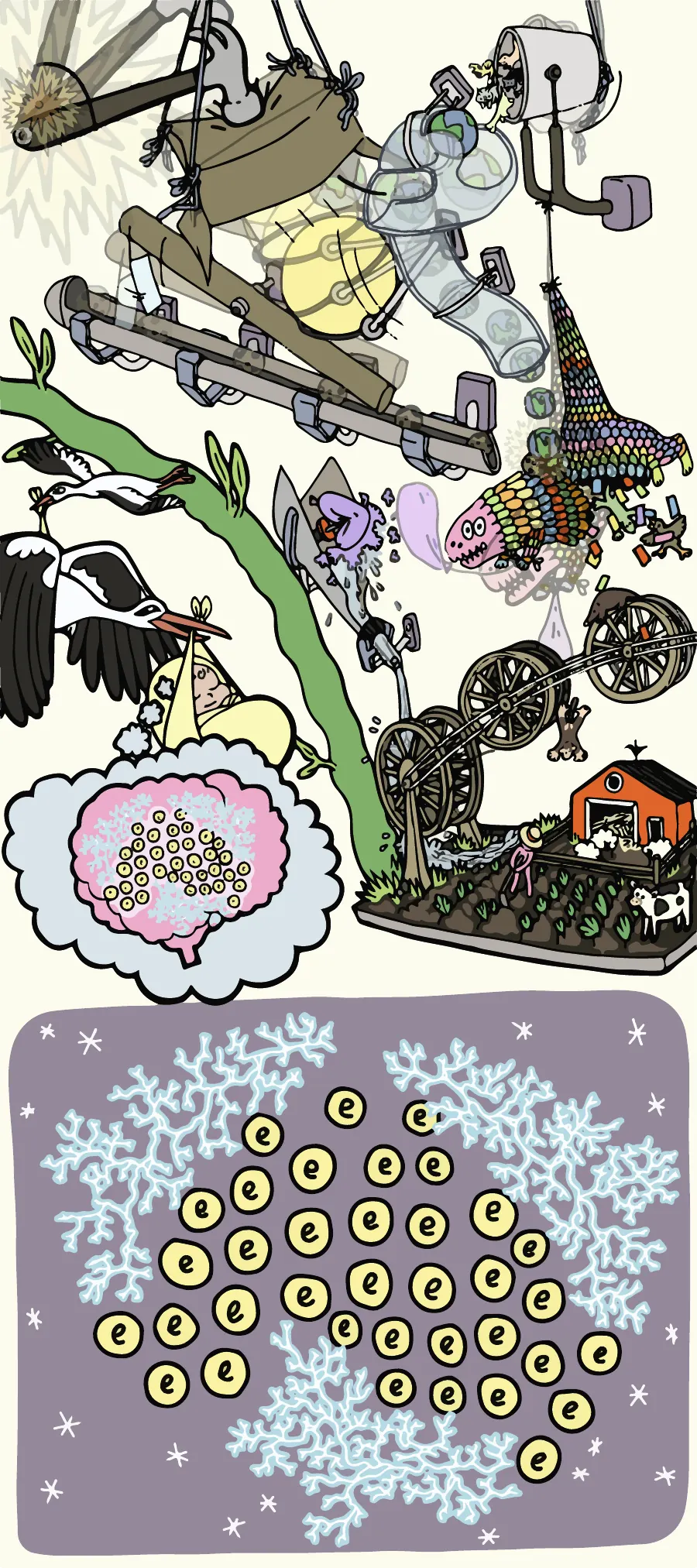
Top (Rube Goldberg Universe): The probability that the physical universe evolved over billions of years — from low-entropy initial conditions, through stars, planets, chemistry, and biology — to produce a thinking mind like yours at this moment is vanishingly small. This intricate causal chain cosmic Rube Goldberg machine needs to be tuned to such perfection that it is nigh impossible.
Bottom (Boltzmann Brain Fluctuation): By contrast, the spontaneous appearance of a fleeting brain — formed by a random fluctuation in an otherwise empty universe — is far more probable. It requires no stars, no galaxies, no history. Just a brief, ordered arrangement of matter or fields.