Chapter 35 of 50
From Air to Arbor
“I am the Lorax and I speak for the trees.”
“It is not the deer that is crossing the road,rather it is the road that is crossing the forest.”
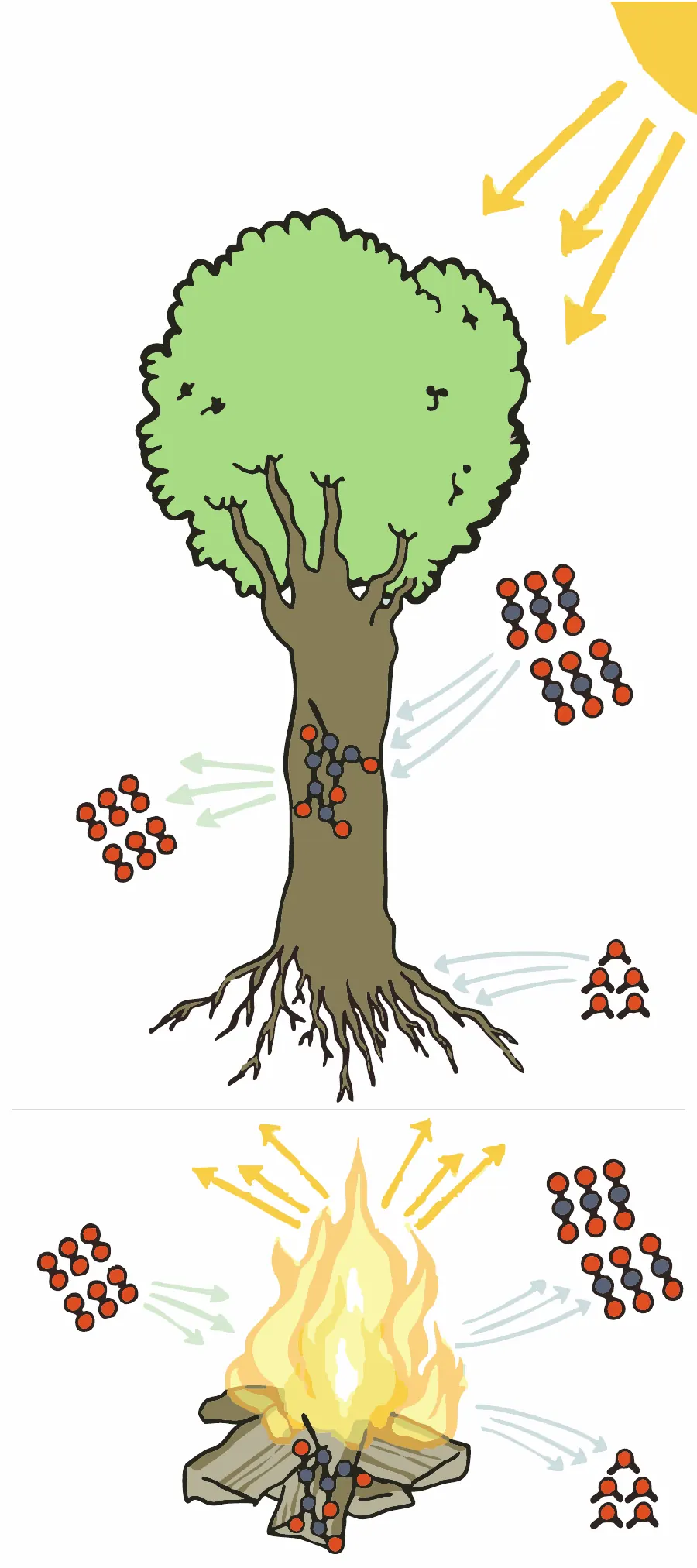
Ask where a tree’s mass comes from and intuition points downward: soil, water, nutrients drawn up through roots. This is almost entirely wrong. Trees are made of air — 95% of their dry mass comes from atmospheric CO₂. Through photosynthesis, plants build themselves from carbon dioxide, converting invisible gas into solid wood, cellulose, and lignin using sunlight. Van Helmont’s 1640s willow experiment demonstrated this: a tree gained 164 pounds (74 kg) while the soil lost only two ounces (60 g). Isotope labeling confirms the molecular accounting — carbon in wood comes from air, not earth or water. When trees burn, they simply return their borrowed carbon and sunlight to the atmosphere, completing a chemical cycle that temporarily crystallizes air into living architecture.
Topics
- Trees Made of Air
- Atmospheric Fixation
- Photosynthesis Energy Capture
- Water Splitting & Release
- Calvin-Benson Cycle
- Cellulose & Lignin
- Stored Solar Energy
- Great Oxygenation Event
- O Isotope Experiments
- Feynman’s Air Quote
- Combustion Symmetry
Sidenote
Photosynthesis and Carbon Fixation: This diagram illustrates the process by which trees build their mass from atmospheric CO₂ rather than soil nutrients. The top section shows the molecular mechanism of photosynthesis: light energy driving the conversion of carbon dioxide and water into glucose through the Calvin-Benson cycle. Chloroplasts in leaf cells capture photons to power the fixation of atmospheric carbon into organic compounds. The bottom section demonstrates the carbon flow: from diffuse CO₂ in the atmosphere, through stomatal uptake, into the structural polymers (cellulose, lignin, hemicellulose) that comprise wood. Each ring of tree growth represents a year’s accumulation of atmospheric carbon, transformed by solar energy into solid biomass. As Feynman noted, trees are literally “made of air” — their dry weight consists primarily of carbon atoms that were once distributed throughout the atmosphere.