Chapter 36 of 50
Renormalize All the Things
„Es scheint hart, dem Herrgott in die Karten zu gucken.Aber dass er würfelt und sich telepathischer Mittel bedient(wie es ihm von der gegenwärtigen Quantentheorie zugemutet wird),kann ich keinen Augenblick glauben.“
The two most successful theories in physics cannot coexist. Quantum field theory treats forces as particle exchanges on a fixed stage, while general relativity says the stage warps. When combined, they produce catastrophic contradictions: QFT predicts vacuum energy times larger than observed, gravity refuses renormalization, and black holes seem to destroy quantum information. Each theory works perfectly in its domain, yet they give mutually exclusive descriptions of reality. This incompatibility of theories is the most glaring problem in modern physics.
Topics
- QFT vs General Relativity
- Standard Model Forces
- Gauge Symmetries
- Higgs Mechanism
- Fixed vs Dynamic Spacetime
- Vacuum Energy Problem
- Non-Renormalizable Gravity
- Black Hole Information
- Quantum Superposition of Geometry
- String Theory Landscape
- Unification Challenge
Sidenote
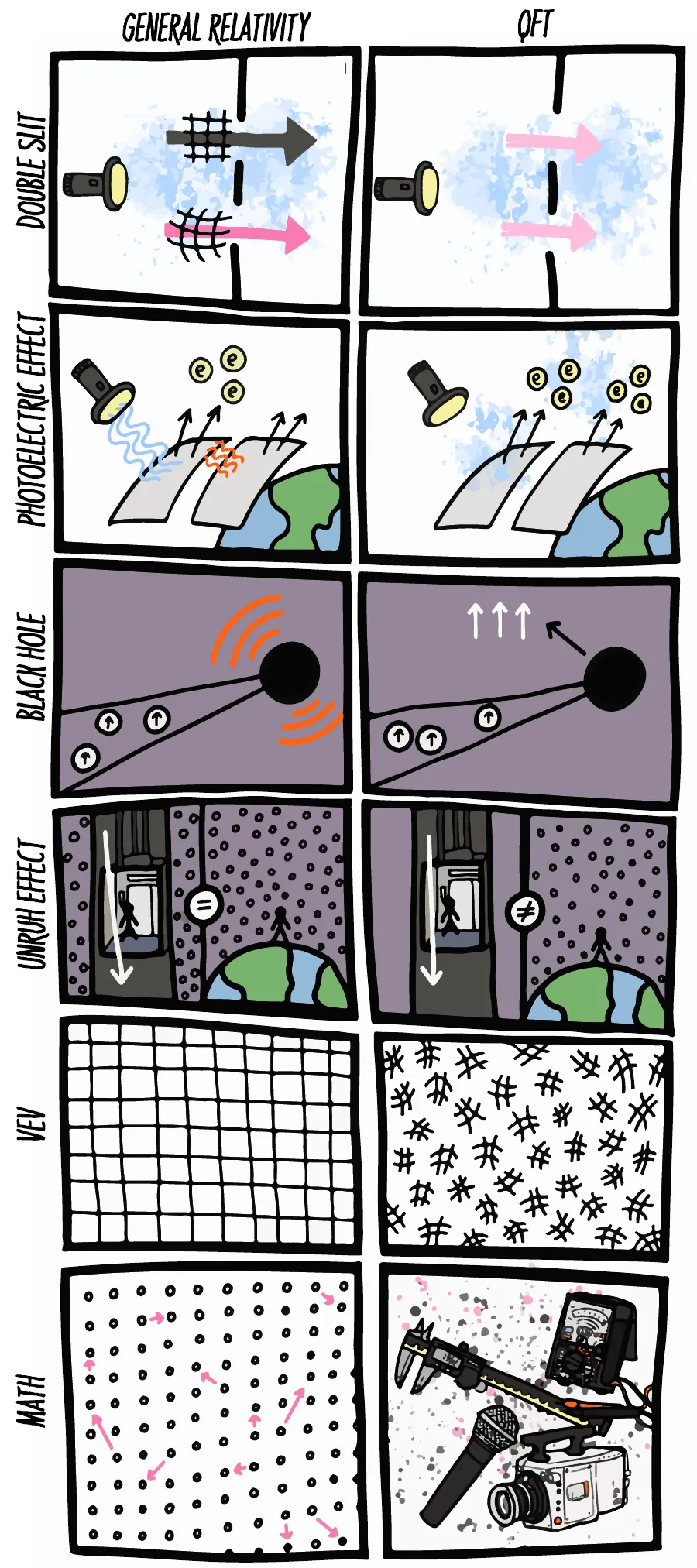
Top (Double Slit): In general relativity (GR), each possible photon path carries mass-energy and should bend spacetime accordingly. In quantum field theory, superpositions of paths interfere — but how does spacetime metric respond to a superposed trajectory?
Second (Photoelectric Effect): Near a gravitating body such as Earth, GR predicts redshift of both incoming photons and bound electronic orbitals. Does the threshold for photoelectric emission shift? GR lacks quantum orbitals; QFT lacks spacetime curvature.
Third (Black Hole Information): GR predicts thermal Hawking radiation with no memory of what fell in. But QFT requires unitary evolution: information, such as spin, must be preserved.
Fourth (Unruh Effect): In GR, an observer in free fall detects no force and is locally equivalent to inertial motion. But in QFT, an accelerating observer perceives a thermal particle bath. Do both observers agree on the particle content or not?
Fifth (Vacuum Energy): QFT assigns enormous energy density to the vacuum via zero-point fluctuations. GR says that energy curves spacetime. Does the vacuum bend space violently?
Bottom (Definition of Space): In GR, space is a manifold with tensor fields assigning numbers to each point. In QFT, space is a passive backdrop where operators act to extract observables. GR side of the equation is numbers, QFT side of the equation is operators.