Chapter 37 of 50
Darkness to Bind Them
“נְטֵ֤ה יָֽדְךָ֙ עַל־הַשָּׁמַ֔יִם וִ֥יהִי חֹ֖שֶׁךְ עַל־אֶ֣רֶץ מִצְרָ֑יִם וְיָמֵ֖שׁ חֹֽשֶׁךְ„(“...darkness spreads over Egypt — darkness that can be felt”)
Dark matter’s existence is inferred through multiple independent lines of evidence spanning different cosmic scales. Galaxy rotation curves remain flat far beyond visible matter, indicating extended gravitational influence. Galaxy clusters contain hot gas whose temperature and confinement require gravitational potentials deeper than visible matter can provide. Gravitational lensing reveals mass distributions exceeding luminous components, particularly in systems such as the Bullet Cluster where dark and visible matter separate during collisions. The cosmic microwave background’s fluctuation patterns indicate that ordinary matter comprises only 15% of the total matter content needed to match observations, with the remainder consisting of non-baryonic material already present before photon-matter decoupling.
Topics
- Dark Matter Evidence
- Galaxy Rotation Curves
- Doppler Spectroscopy
- 21cm Hydrogen Mapping
- Gravitational Lensing
- Bullet Cluster Collision
- Cluster Dynamics
- CMB Acoustic Peaks
- Structure Formation Timeline
- Non-Luminous Mass
- MOND Limitations
Sidenote
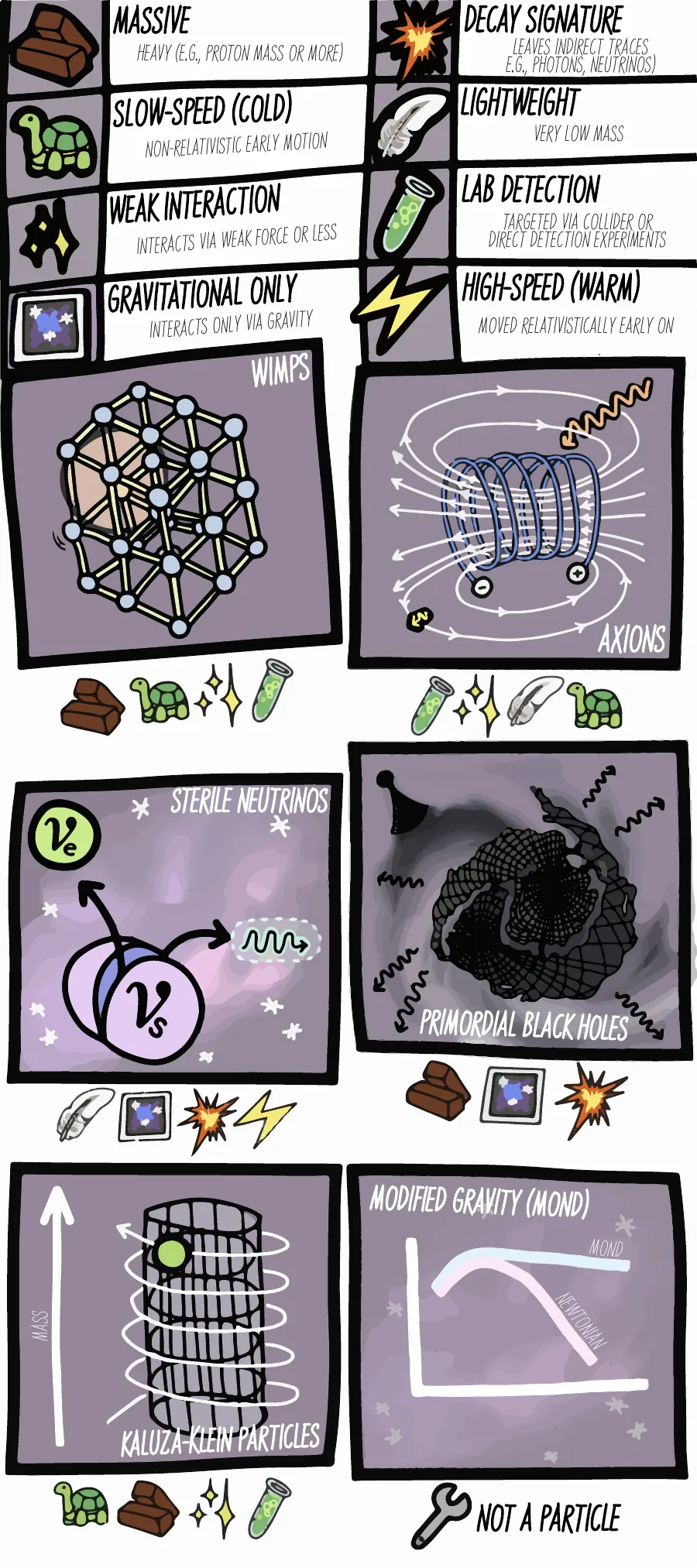
Top (Candidate Properties): Dark matter candidates are evaluated by properties such as mass (from massless to heavy), speed (cold vs warm), interaction type (weak, gravitational only), and detectability (via lab or decay signatures). Each row indicates a possible property constraint.
Second Row (WIMPs and Axions): WIMPs (Weakly Interacting Massive Particles) are cold, massive, and weakly interacting, long favored due to supersymmetric theories. Axions are extremely light, produced via field misalignment, and may convert to photons in magnetic fields.
Third Row (Sterile Neutrinos and Primordial Black Holes): Sterile neutrinos mix with active ones but don’t interact via the weak force, allowing them to evade detection. Primordial black holes are relics from the early universe that behave as cold dark matter through pure gravitational influence.
Bottom Row (Kaluza-Klein theories and MOND): Kaluza-Klein particles arise from extra spatial dimensions; their quantized modes could serve as dark matter if stable. Modified Newtonian Dynamics (MOND) suggests gravity itself needs correction at low accelerations — removing the need for particle dark matter.