Chapter 23 of 50
A Place at the End of Time
“So much universe, and so little time.”
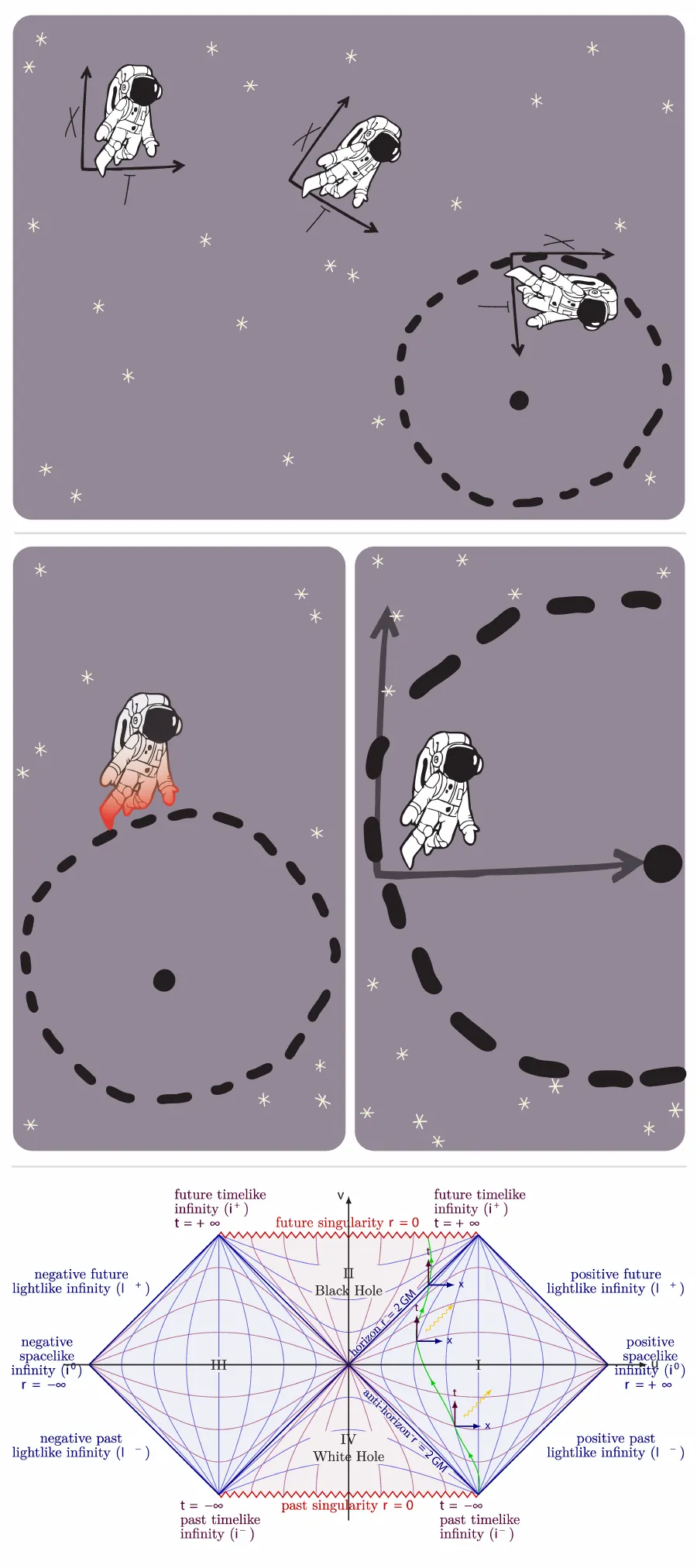
Black holes create an observational paradox: external observers see infalling objects freeze at the event horizon with infinite redshift, while the falling objects cross in finite proper time experiencing nothing unusual. This contradiction arises from extreme spacetime curvature near the horizon (), where gravitational time dilation becomes unbounded. Inside the horizon, causality inverts — the radial coordinate becomes timelike, making the singularity not a place but a future moment that all trajectories must reach.
Topics
- Black Hole Event Horizon
- Schwarzschild Radius
- Time Becomes Spacelike
- Singularity as Future
- LIGO Gravitational Waves
- EHT M87 Image
- Coordinate Dependencies
- Penrose-Hawking Theorems
- Kerr’s Quora Objections
- White Holes & Wormholes
- Becomes Timelike
Sidenote
Top (Spacetime Geometry): The geometry near a black hole distorts spacetime so severely that, from a coordinate perspective, the black hole itself lies in the future light cone of any nearby event. For an infalling observer, continuing forward in time inevitably means moving closer to the singularity — tomorrow is the black hole in spacetime terms. Middle (Observer Perspectives): Two perspectives on crossing the horizon. From the distant observer’s viewpoint (left), the astronaut appears to freeze at the horizon, increasingly redshifted and dimmed, never quite crossing. From the astronaut’s own frame (right), there’s no discontinuity — no freezing, no slowdown — only smooth, uninterrupted free fall through the horizon in finite proper time. Bottom (Penrose Diagram): The full Penrose diagram for the maximally extended Schwarzschild solution, showing all causal regions: the external universe, black hole interior, white hole region, and a second asymptotically flat universe. The diagram captures the global causal structure: horizons, infinities and singularities.