Chapter 22 of 50
Creeping Bug
“Once you’ve got a task to do,it’s better to do it than live with the fear of it.”
“The first 90 percent of the code accounts forthe first 90 percent of the development time.The remaining 10 percent of the code accounts forthe other 90 percent of the development time.”
Minecraft’s Creeper began as a mistake. Markus Persson entered the pig’s dimensions backwards, producing a tall, thin figure that looked nothing like an animal. Instead of deleting it, he added a texture, a frown, and an explosive routine borrowed from the game’s block-destruction code. The result was a creature that crept silently, paused, and detonated. A simple modeling error became Minecraft’s most iconic enemy.
Topics
- Creeper Origin Story
- Pig Model Bug
- Entity Component Systems
- AI Task Composition
- Game Engine Evolution
- Bugs Becoming Features
- Street Fighter Combos
- Rocket Jumping
- Minecraft Redstone Logic
- Emergent Gameplay
- Fail-Soft Design
Sidenote
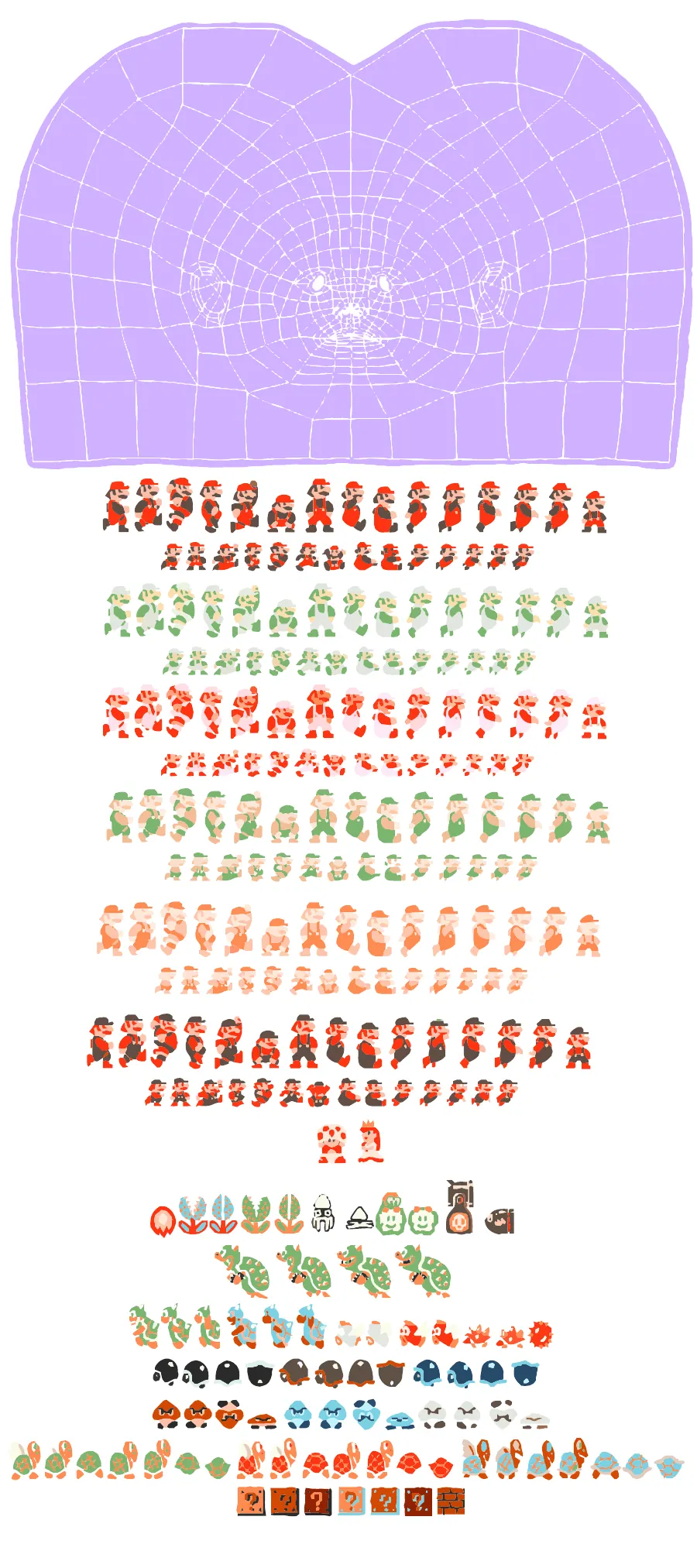
Top (3D Mesh with UV Grid): A polygonal model is shown with a superimposed UV grid. The grid flattens a surface into 2D coordinates, assigning each vertex to a location in texture space. This mapping determines how an image will be wrapped onto the surface. Bottom (Texture Atlas): A sprite sheet provides the 2D image data: character animations, items, and enemies. Each region of the sheet corresponds to a set of UV coordinates. During rendering, the engine looks up the correct portion of the texture based on UV mapping and projects it onto the surface, aligning 2D artwork with 3D geometry.