Chapter 21 of 50
Exponentially Generalizable
“The rate of increase of inflation is decreasing.”
“This was the first time a sitting presidentused the third derivative to advance his case for reelection.”
The exponential function extends far beyond calculus, appearing across mathematics as a bridge between local and global structure. From power series to Lie theory, from Riemannian geometry to sheaf cohomology, exponential maps carry additive or infinitesimal data into multiplicative, compositional, or curved settings. What began as a trick for quick computation has become a central map linking analysis, geometry, and algebra.
Topics
- Exponential as Bridge
- Additive to Multiplicative
- Lie Algebra to Group
- Geodesic Exponential
- Power Series
- Sheaf Cohomology Sequence
- Category Theory Exponentials
- Local to Global
- Multiple Definitions
- Universal Pattern
- Generalizations
Sidenote
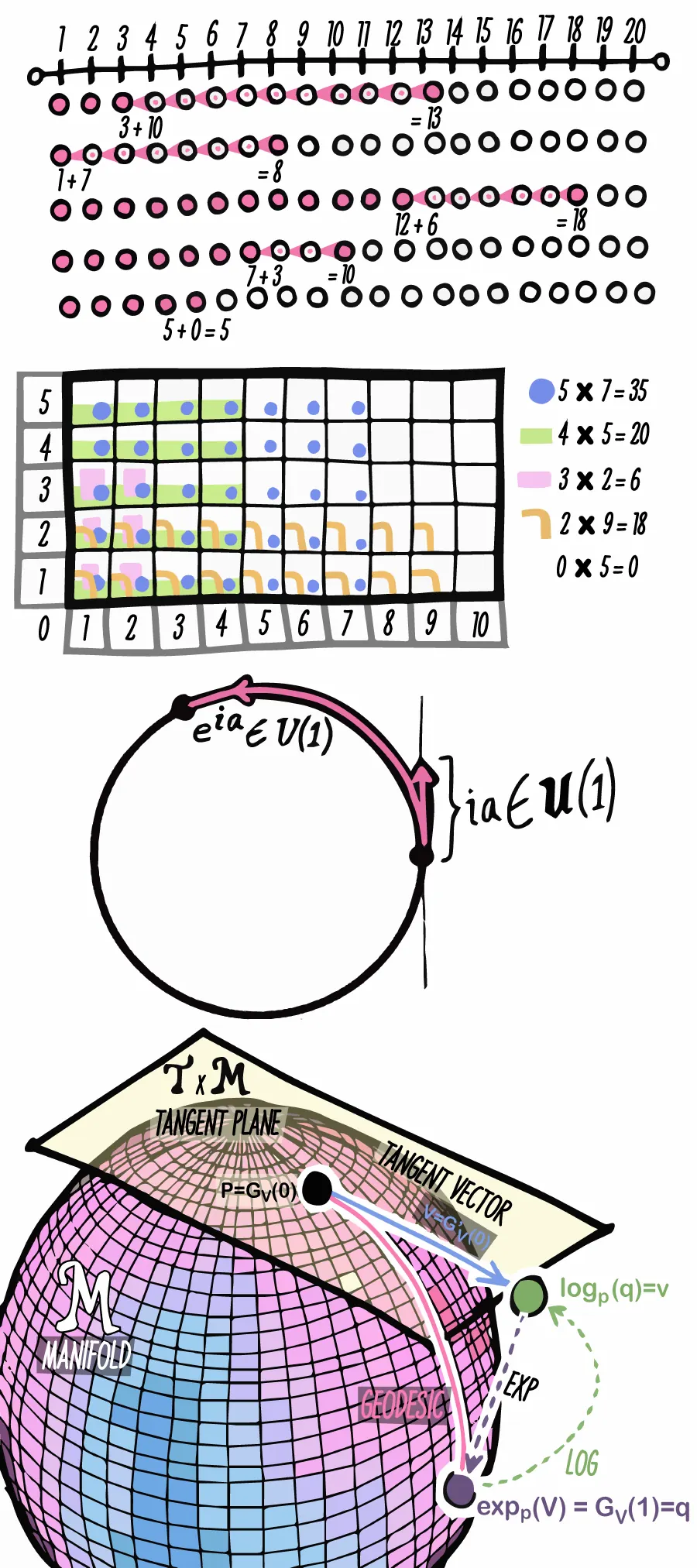
Top (Addition and Multiplication): The exponential map translates addition into multiplication. Sequences of additions along the number line become products, such that . Middle (Unit Circle Mapping): On the complex plane, the exponential maps purely imaginary numbers to points on the unit circle . Tangent vectors correspond to directions in the Lie algebra, while their exponential images wrap around the circle as group elements. Bottom (Manifold and Tangent Plane): In differential geometry, the exponential map extends to manifolds. A tangent vector at a point defines a geodesic, whose endpoint on the manifold is . Conversely, the logarithm map returns tangent vectors from manifold points. This generalization connects linear structure in tangent spaces to nonlinear geometry of manifolds.