Chapter 20 of 50
Capish, Comprehendes, Computes?
“Words are the only bullets in truth’s bandolier.And poets are the snipers.”
S’il y avait de telles machines […] jamais elles ne pourraient user de paroles ni d’autres signes en les composant, comme nous faisons pour déclarer aux autres nos pensées.(“If there were such machines […] they could never use words by composing them, as we do, to declare their thoughts to others.”)
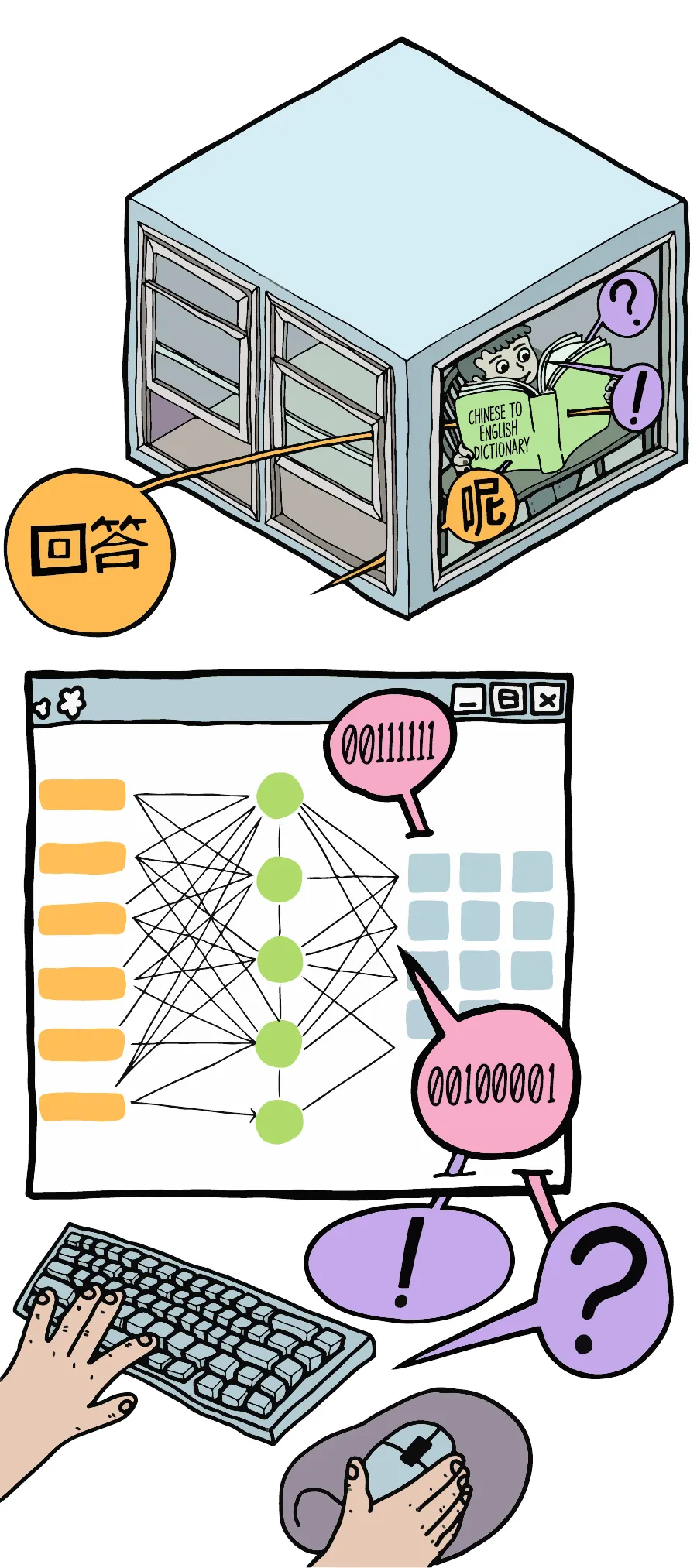
Searle’s Chinese Room thought experiment challenges computational theories of mind: someone manipulates Chinese symbols according to rules without understanding the language. They produce appropriate responses, passing a linguistic Turing test, yet possess no comprehension. The argument distinguishes syntax (symbol manipulation) from semantics (understanding), suggesting that computers executing algorithms operate only at the syntactic level.
Topics
- Chinese Room Experiment
- Syntax Without Semantics
- Searle’s Argument
- Strong AI Critique
- Large Language Models
- Next-Word Prediction
- Trillion Parameters
- Compression & Generalization
- In-Context Learning
- Substrate Independence
- Belief Formation Patterns
Sidenote
Top (Chinese Room Experiment): The Chinese Room Thought Experiment (John Searle, 1980). An English-speaking person sits inside a sealed room, using a rulebook to manipulate Chinese symbols without understanding their meaning. The system produces fluent-looking Chinese responses purely through syntactic manipulation. Searle’s point: following formal symbol-manipulation rules does not constitute understanding. Bottom (Modern Language Models (LLMs)): Instead of explicit rules, LLMs use high-dimensional vector representations and learned statistical patterns from massive datasets. Inputs are converted into embeddings, processed through multiple nonlinear layers, and decoded into probable outputs. Yet for all the architectural difference, LLMs — like the Chinese Room — operate without intrinsic semantic understanding. They produce contextually appropriate language based on training distributions, not genuine comprehension.