Chapter 19 of 50
Consider the Muon’s PoV
“Who ordered that?”
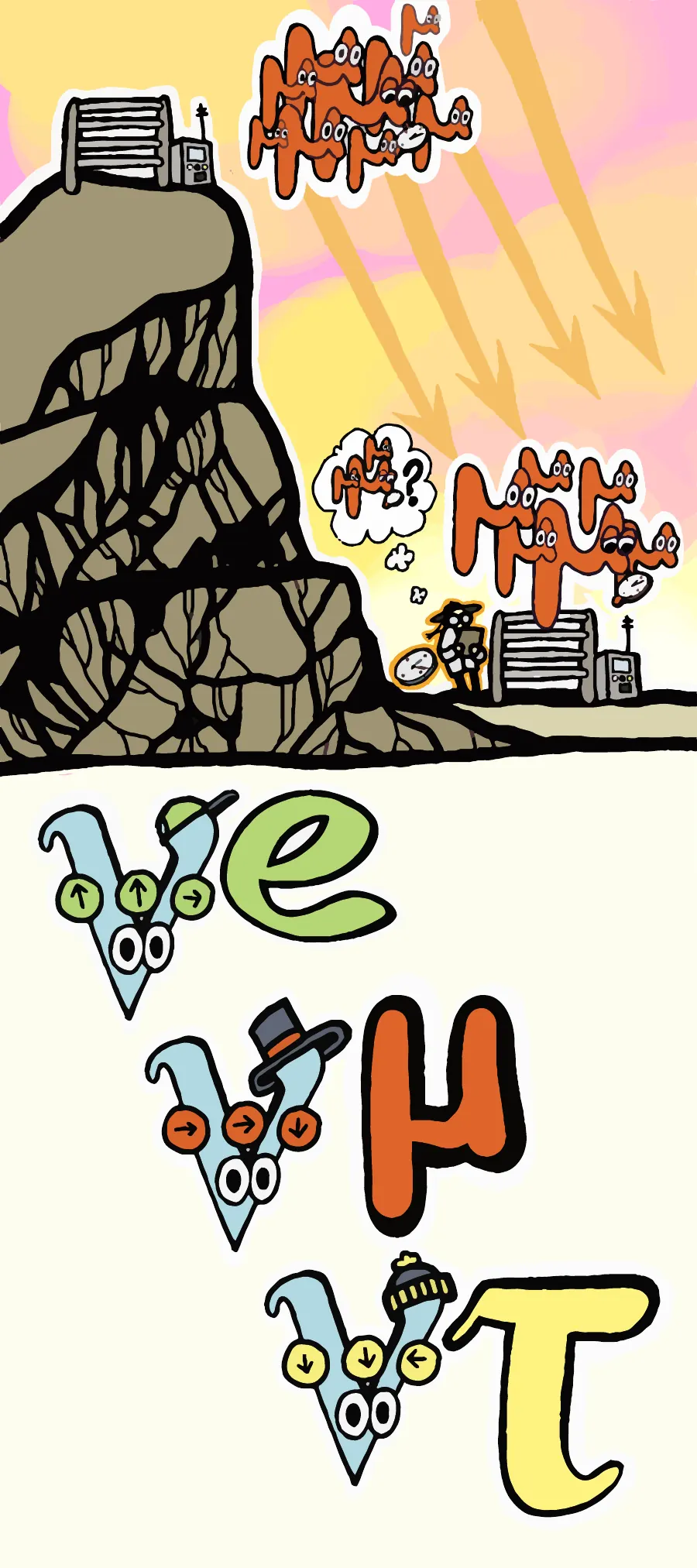
Muons created by cosmic rays colliding with the upper atmosphere provide direct evidence for time dilation. With a rest-frame lifetime of approximately 2.2 microseconds and traveling close to light speed, classical physics predicts these particles should decay before reaching Earth’s surface. Instead, detectors routinely observe muons at sea level. Special relativity explains this observation: from Earth’s reference frame, the muons’ time runs slower by a factor of γ (approximately 10–50 depending on energy), extending their lifetime enough to reach ground level. From the muon’s perspective, relativistic length contraction reduces the distance traveled.
Topics
- Atmospheric Muons
- 2.2 Microsecond Lifetime
- Relativistic Time Dilation
- at 0.998c
- Pion Decay Origin
- Cosmic Ray Showers
- Lepton Generations
- Rossi-Hall 1941
- Sea Level Detection
- Length Contraction
- Natural Relativity Test
Sidenote
Top (Muon Time Dilation): Cosmic rays strike the upper atmosphere, producing showers of muons. At rest, muons have a lifetime of only about 2.2 microseconds, which should not allow many of them to reach detectors on the surface. However, due to relativistic time dilation, their internal clocks run slower from the Earth’s frame of reference, allowing far more muons to survive and be detected than expected under classical assumptions. Bottom (Neutrino Flavor Oscillations): When produced in cosmic-ray interactions, neutrinos come in three flavors: electron, muon, and tau. Early atmospheric neutrino experiments detected only about two-thirds of the expected muon neutrinos, a puzzle known as the atmospheric neutrino anomaly. The resolution came from neutrino oscillations: as neutrinos travel, they can change “hats” between flavors, converting among types. This explains why detectors only saw a fraction of the muon neutrinos originally predicted.