Chapter 24 of 50
Put on Your 4D Glasses
“The miracle of the appropriateness of the language of mathematicsfor the formulation of the laws of physicsis a wonderful gift which we neither understand nor deserve.”
Why does our universe have exactly three spatial dimensions plus time? Multiple independent constraints converge on : only in 3D space do inverse-square laws produce stable planetary orbits and bound atoms; only in 4D spacetime are fundamental forces renormalizable in quantum field theory; only in 4D do waves propagate cleanly without trailing echoes (Huygens’s principle). The arithmetic fact that creates unique mathematical properties — from quaternion algebra to self-dual gauge fields — that cascade through physics. Lower dimensions cannot support complex chemistry, while higher dimensions destabilize matter and causality.
Topics
- Four-Dimensional Spacetime
- Inverse-Square Force Law
- Stable Orbits Only
- Huygens’s Principle
- QFT Renormalizability
- Exotic Topology
- Division Algebras
- Identity
- Black Hole No-Hair
- Atomic Stability
- Chemical Bonding
Sidenote
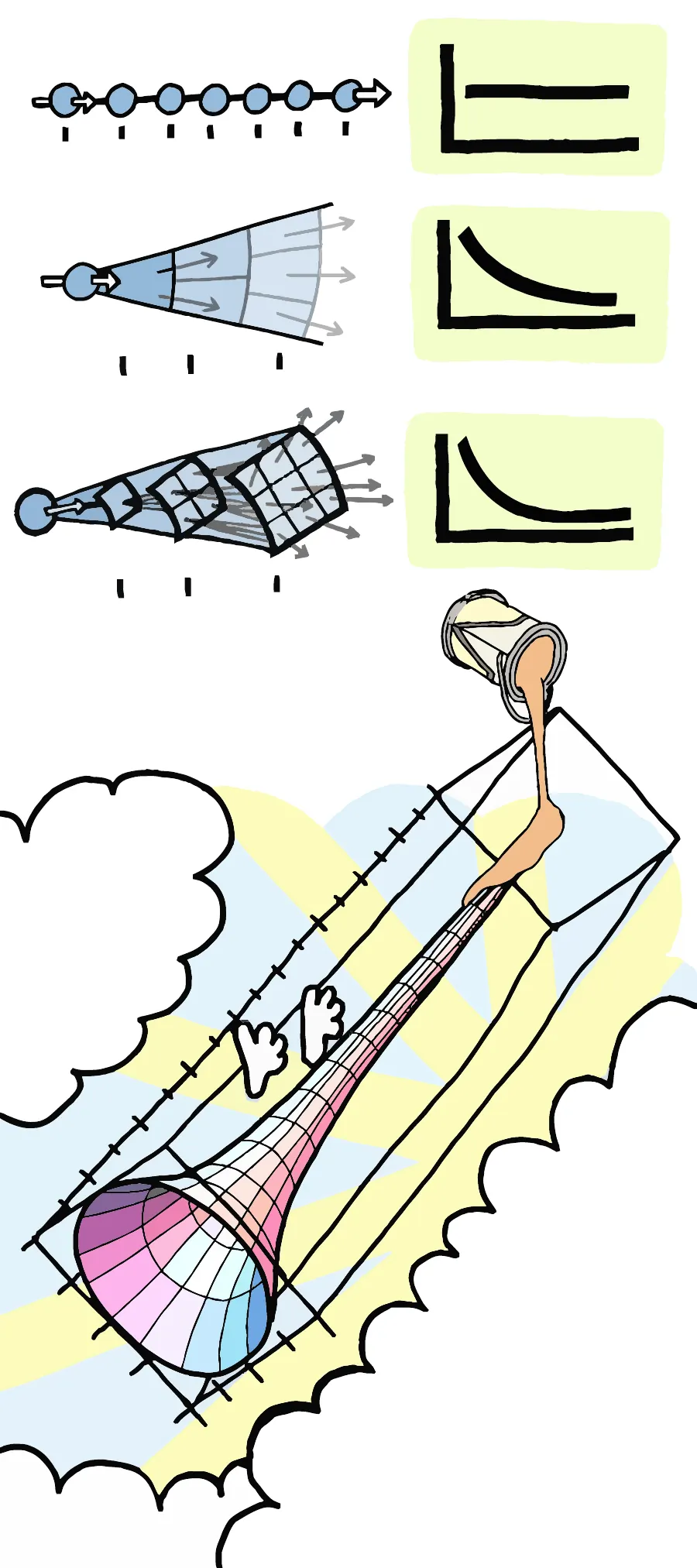
Top (Dimensional Scaling of Inverse Laws): The same point-source strength spreads differently depending on spatial dimension. In 1D, the influence remains constant along a line. In 2D, the effect dilutes like as it spreads over a circle. In 3D, it falls off as , spreading over the surface of a sphere. This explains why gravitational and electrostatic forces scale as inverse-square laws in 3D space.
Bottom (Gabriel’s Horn and the Painter’s Paradox): A surface of revolution formed by rotating around the -axis for . Though the horn extends infinitely, it encloses a finite volume () but has infinite surface area (). Paradoxically, one could “fill” it with a finite amount of paint, but never coat its inner surface.