Chapter 39 of 50
Superanonymous
“Why should I refuse a good dinnersimply because I don’t understand the digestive processes involved.”
A significant combinatorial breakthrough from an unlikely source: an anonymous 4chan post (2011) responding to a question about anime episode viewing orders. Superpermutations are strings containing every possible ordering of n symbols as substrings. For years, mathematicians believed the minimal length followed the pattern of factorial sums observed in small cases. The anonymous poster derived a rigorous lower bound, modeling the problem as path optimization through a permutation graph. This proof remained obscure until 2014 when mathematician Robin Houston rediscovered it, leading to the disproof of the long-standing conjecture and establishing new bounds on this combinatorial problem — with the original derivation still officially credited to “Anonymous 4chan Poster.”
Topics
- Superpermutation Problem
- Permutation Overlap
- Hamiltonian Path Approach
- Sum-of-Factorials Conjecture
- n=6 Counterexample
- Anonymous 4chan Proof
- Haruhi Anime Origin
- Robin Houston Discovery
- Greg Egan Upper Bound
- Combinatorial Compression
- Non-Academic Mathematics
Sidenote
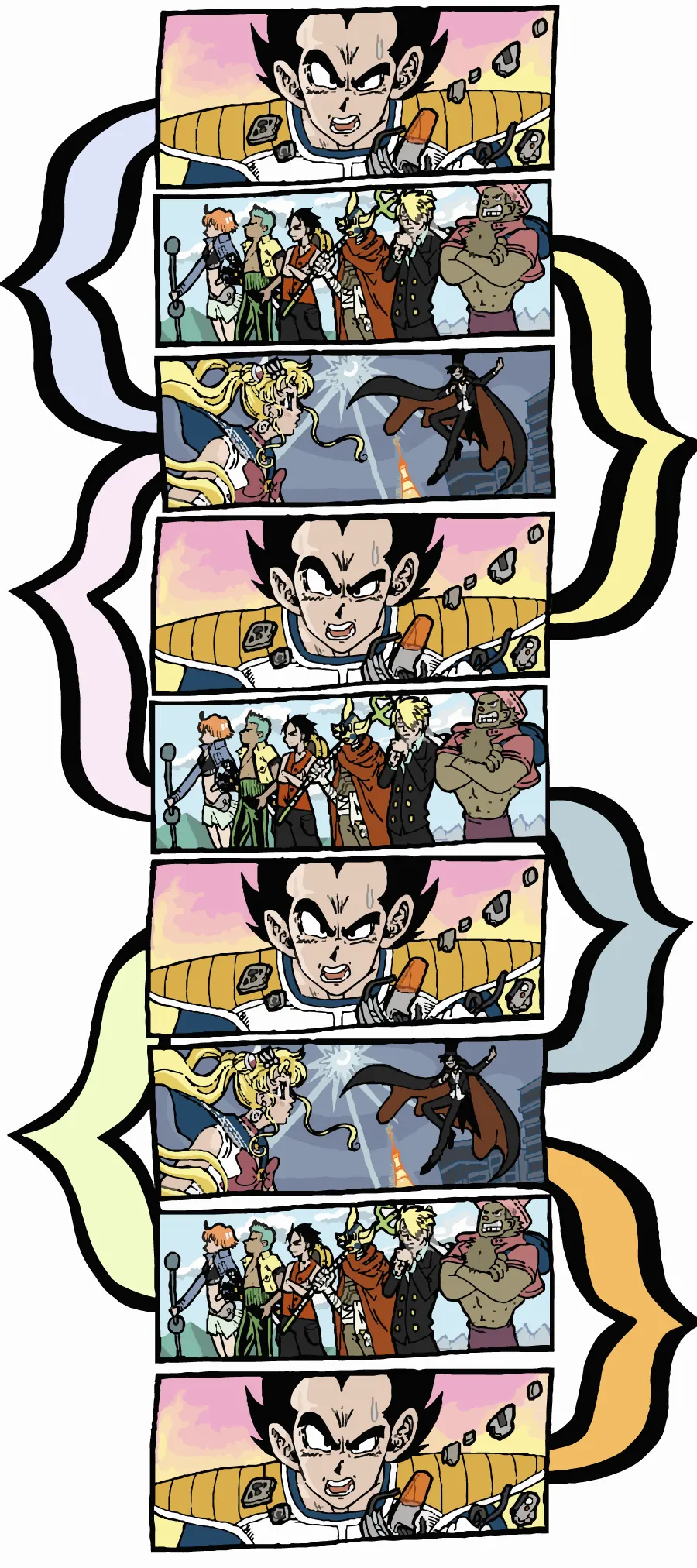
Superpermutation over Anime Orders: The sequence 1,2,3,1,2,1,3,2,1 visits all six permutations of as contiguous subsequences: 123, 231, 312, 213, 132, 321. Here, episode “1” is Dragon Ball Z (Vegeta), “2” is One Piece (Straw Hat Crew), and “3” is Sailor Moon. This is a minimal superpermutation for : the shortest possible viewing order that guarantees every order of watching (back-to-back) all three shows appears.