Chapter 40 of 50
Slices of Life
“Would I have invented PCR if I hadn’t taken LSD? I seriously doubt it.I could sit on a DNA molecule and watch the polymers go by.I learned that partly on psychedelic drugs.”
DNA sequencing has evolved from Sanger’s chain-termination method through the next-generation revolution of 454 pyrosequencing, Ion Torrent, and Illumina platforms to modern nanopore technologies. The computational challenge of genome assembly uses sophisticated algorithms such as de Bruijn graphs to reconstruct complete genomes from millions of short fragments, while paired-end chemistry and long-read technologies help resolve repetitive regions that have long frustrated genomic reconstruction efforts.
Topics
- DNA Sequencing Evolution
- Sanger ddNTP Method
- Illumina Reversible Terminators
- Bridge Amplification
- PacBio SMRT Technology
- Oxford Nanopore
- De Bruijn Graph Assembly
- K-mer Overlap
- Contigs vs Scaffolds
- N50 Statistic
- Long-Read Revolution
Sidenote
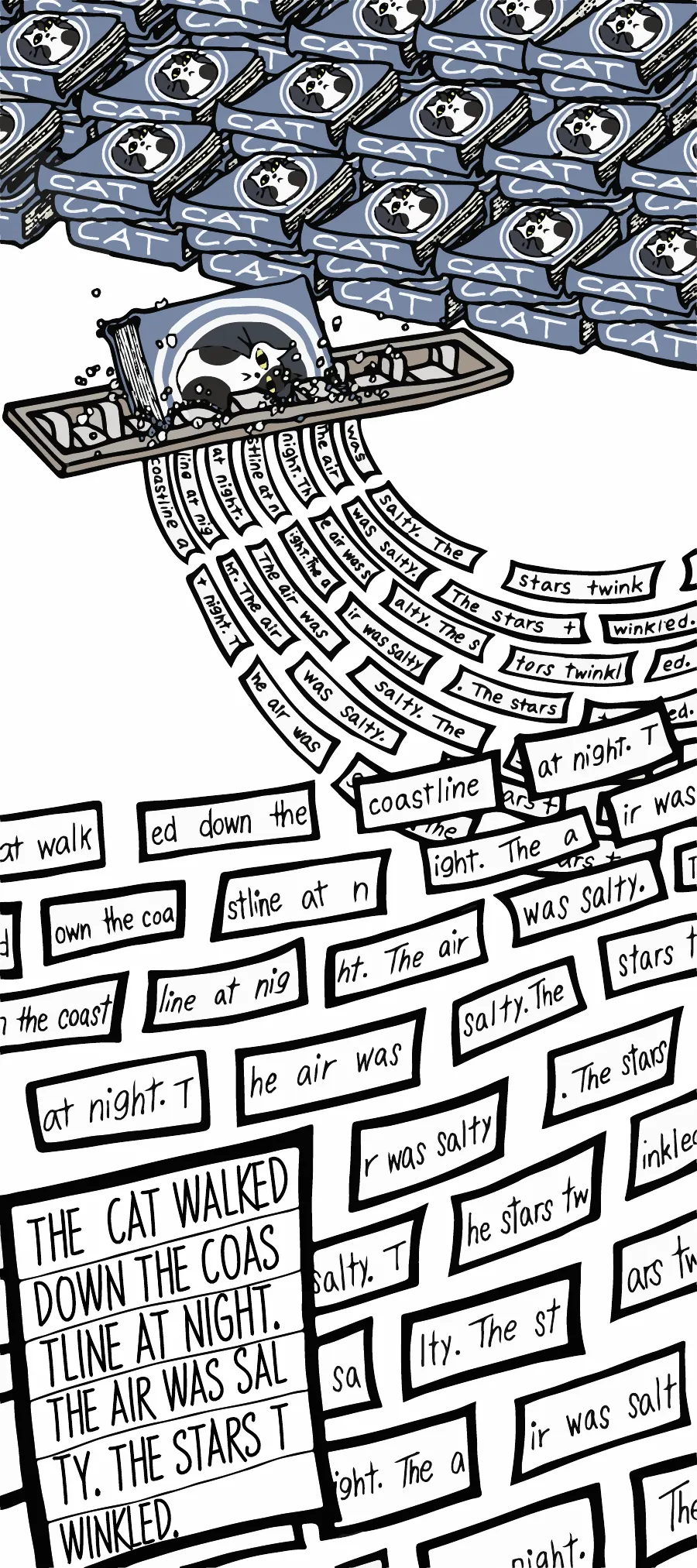
Sequencing as Text Reconstruction: The image parallels DNA sequencing to reassembling a book from shredded fragments from hundreds of identical copies. The books are pulverized into overlapping sentence fragments — analogous to sequencing short reads from long DNA strands. By aligning overlapping sequences, the original string is reconstructed. As with genome assembly, redundancy, overlaps, and statistical inference allow one to piece together each chromosome from fragmented reads.