Chapter 41 of 50
It Is Just a Phase
“With four parameters I can fit an elephant,and with five I can make him wiggle his trunk.”
A curve found in 2010 as shown above.The curve can be fitted with four parameters.A fifth point can be added to form the elephant’s eyeand allows the trunk to move.
The Hough transform detects geometric shapes in images by converting the problem from image space to parameter space. Images undergo edge detection to identify significant brightness transitions. Each edge pixel then “votes” for all possible geometric structures that could contain it. For line detection, edge points generate constraints in parameter space through the relation . Points lying on the same line create intersecting lines in parameter space, forming accumulator peaks.
Topics
- Hough Transform
- Edge Detection
- Parameter Space Voting
- Rho-Theta Parametrization
- Accumulator Arrays
- Global Feature Detection
- Line Finding Algorithm
- Gradient Operators
- Circle Detection
- Computer Vision
- Duality Transform
Sidenote
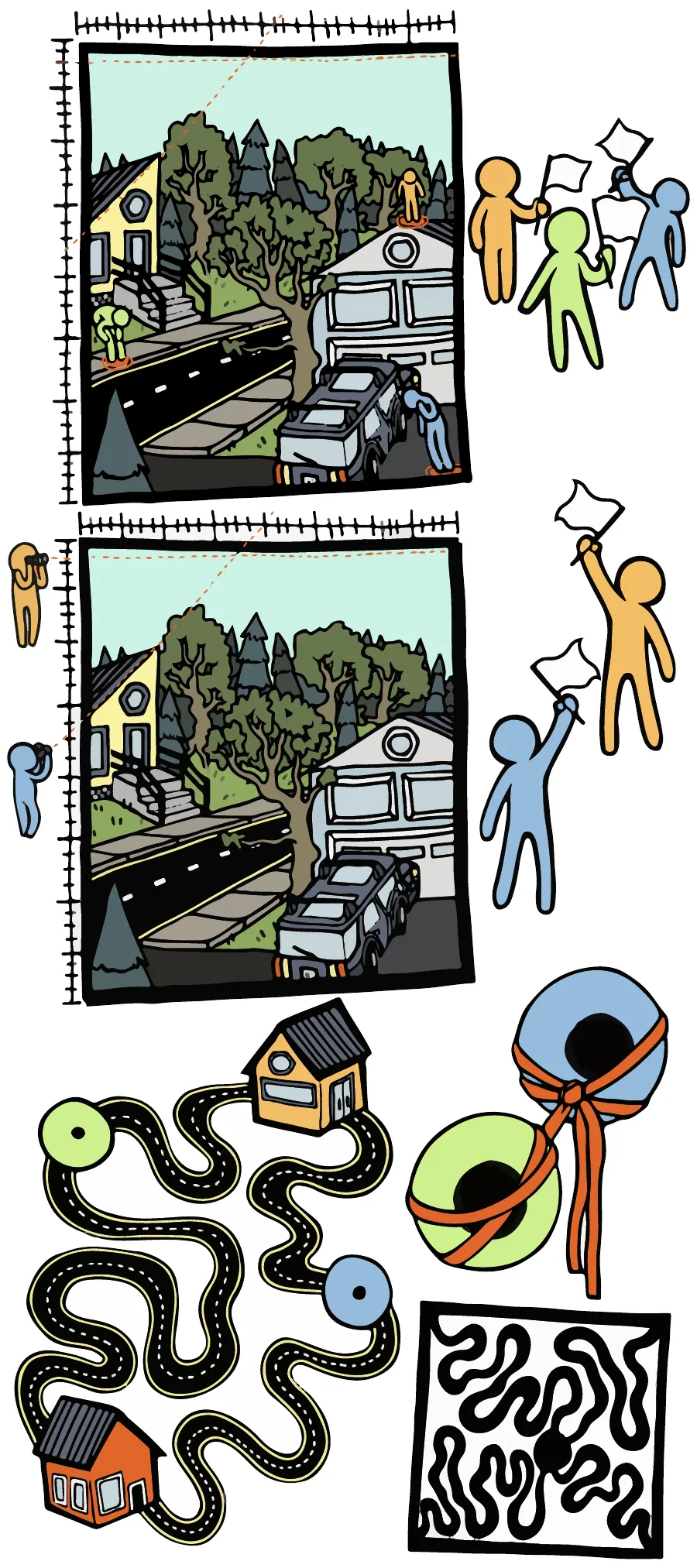
Top (Pixel-Level Edge Detection): Each observer inspects a single pixel and flags whether it looks like part of an edge. This approach produces isolated detections without context — assembling a full line requires comparing scattered responses after the fact. It’s data-rich but structure-poor: the system sees points, not lines.
Middle (Line-Level Hough Detection): Observers instead scan the whole image through virtual rulers at specific angles and offsets. Each one votes if their ruler aligns with edge evidence. The same number of detectors now deliver global outputs: lines directly. This is the core idea behind the Hough Transform — accumulating evidence in a parameter space where lines become peaks.
Bottom (Phase Space Riddle): Two roads connect cities A and B without crossing. A pair of cars, tied by a rope of length < , can travel side by side on these roads from A to B. Now consider two circular wagons of radius , each centered on its own path — one going A to B, the other B to A. Let track their positions along the two roads, forming a trajectory in the unit square . The cars’ path goes from to ; the wagons’ from to . By topology, these curves must intersect. At the intersection, the wagons occupy the same positions as the cars once did, yet their centers are < apart, and each wagon has radius , so a collision is unavoidable. A fact that is difficult to prove directly. (After Konstantinov, in Arnold’s ODEs.)