Chapter 42 of 50
Wet, Cold, Slippery Slope
“Oh, you know what I want? Ice cream.Do you guys have that here? Ice cream?Oh, it’s so good, you have to get it.It’s like scoops and it comes on a cone.Do you have that here?”
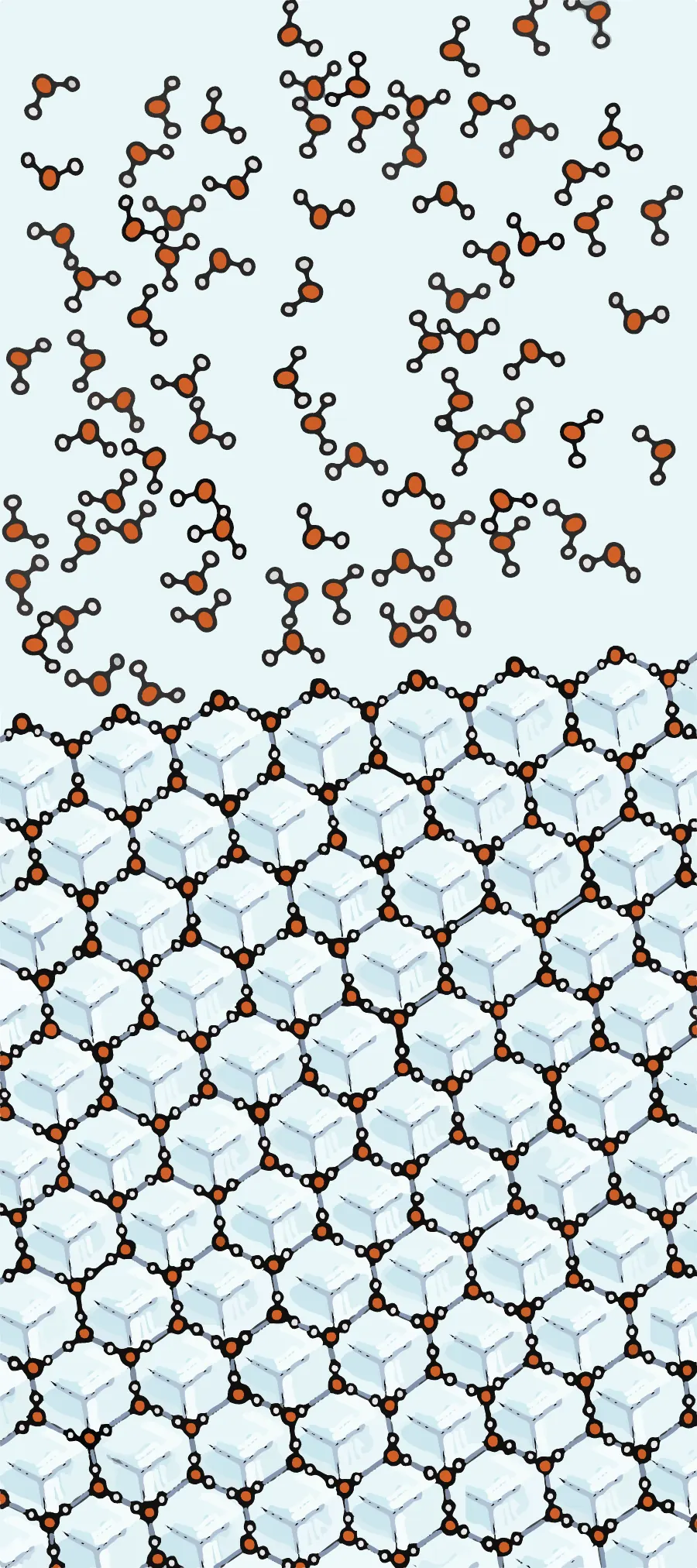
Ice’s exceptional slipperiness results primarily from a quasi-liquid layer (QLL) of disordered water molecules at its surface rather than from commonly assumed mechanisms. While pressure melting and frictional heating contribute under specific conditions, neither explains ice’s slickness at rest nor across wide temperature ranges. Surface molecules, having fewer hydrogen bonds than those in the interior crystal lattice, form a nanometer-thick disordered layer that functions as a molecular lubricant even well below freezing. Counterintuitively, ice is most slippery around -7°C rather than at 0°C, as the QLL is sufficiently mobile at this temperature while the underlying ice remains hard enough to resist deformation.
Topics
- Ice Slipperiness
- Quasi-Liquid Layer
- Surface Undercoordination
- Hydrogen Bond Network
- Ice Ih Structure
- Pressure Melting Myth
- Frictional Heating Limits
- Optimal Temperature -7°C
- Molecular Dynamics
- Sea Level & Land Ice
- Phase Transitions
Sidenote
Quasi-Liquid Layer on Ice: Ice surfaces are coated with a thin, disordered layer of mobile water molecules — called the quasi-liquid layer. Even below freezing, this layer behaves like a liquid: molecules at the surface are less tightly bound than those in the bulk lattice, enabling them to rearrange and flow. This surface mobility reduces friction and is a primary reason ice feels slippery, even without pressure or frictional heating.