Chapter 43 of 50
Flat Universers
“The truth is like salt.Men want to taste a little, but too much makes everyone sick.”
The universe appears flat to within 0.4% precision according to cosmic microwave background measurements. This flatness, described by the Lambda-CDM model, indicates that space follows Euclidean geometry even across vast cosmological distances. The universe may be spatially infinite while having a finite age of 13.8 billion years. This implication comes from the Big Bang model: an expansion of intergalactic space rather than an explosion within pre-existing space. If space was already infinite at the beginning, it expanded uniformly from every point. No center to the universe!
Topics
- Flat Universe Observations
- Cosmic Curvature
- CMB Acoustic Peaks
- Angular Size Test
- ΛCDM Model
- Metric Expansion
- Infinite Spatial Extent
- Particle Horizon
- Big Bang Geometry
- Planck Satellite Data
- Observable vs Total Universe
Sidenote
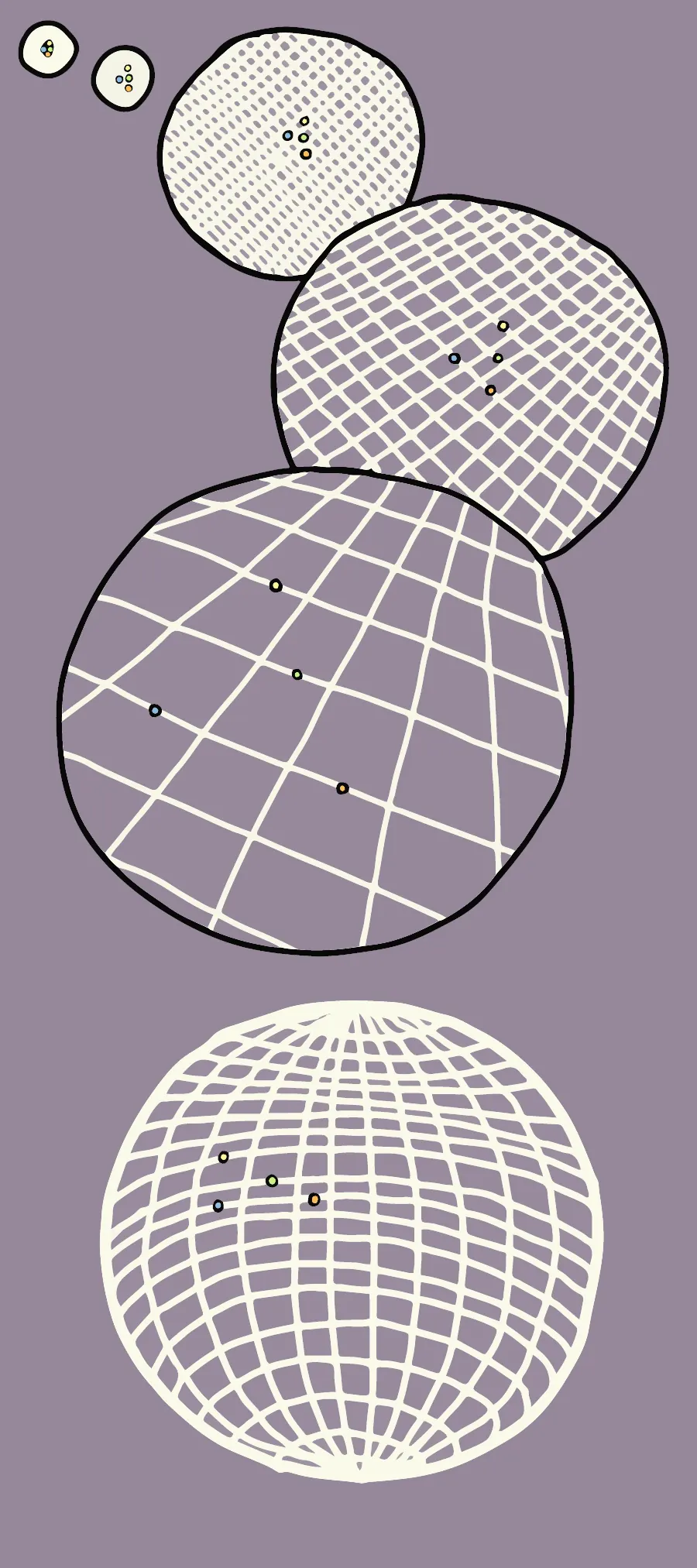
Top (ΛCDM Infinite Flat Universe): In the standard cosmological model, ΛCDM, space is spatially flat and infinite. Galaxies drift apart as distances expand — there is no center, no edge, and every point sees the same large-scale dynamics.
Bottom (Compact Finite Universe): If space is compact — like a 3-torus or a hypersphere — then the universe can be finite in volume without having a boundary. Expansion still occurs, but the global topology loops back on itself. Light could, in principle, circle the cosmos. The grid warps around, indicating periodicity or curvature that reconnects spatial locations.