Chapter 46 of 50
Orbital Affairs
“Coming back to where you startedis not the same as never leaving.”
The Woodward-Hoffmann rules establish how mathematical symmetry conservation governs chemical reaction pathways at the quantum level. In pericyclic reactions, the symmetry properties of molecular orbitals — represented by wave functions with specific nodal patterns analogous to trigonometric functions — must be conserved throughout the reaction coordinate. This conservation requirement creates selection rules that determine allowed stereochemical outcomes. The symmetry constraints differ fundamentally between thermal and photochemical conditions, as light excitation inverts the orbital symmetry relationships, thereby enabling reaction pathways forbidden under thermal conditions and vice versa.
Topics
- Woodward-Hoffmann Rules
- Orbital Symmetry
- Pericyclic Reactions
- Molecular Orbitals
- Thermal vs Photochemical
- Electrocyclic Reactions
- Cycloadditions
- Diels-Alder Reaction
- Retinal Photoisomerization
- Quantum Chemistry
- Symmetry Conservation
Sidenote
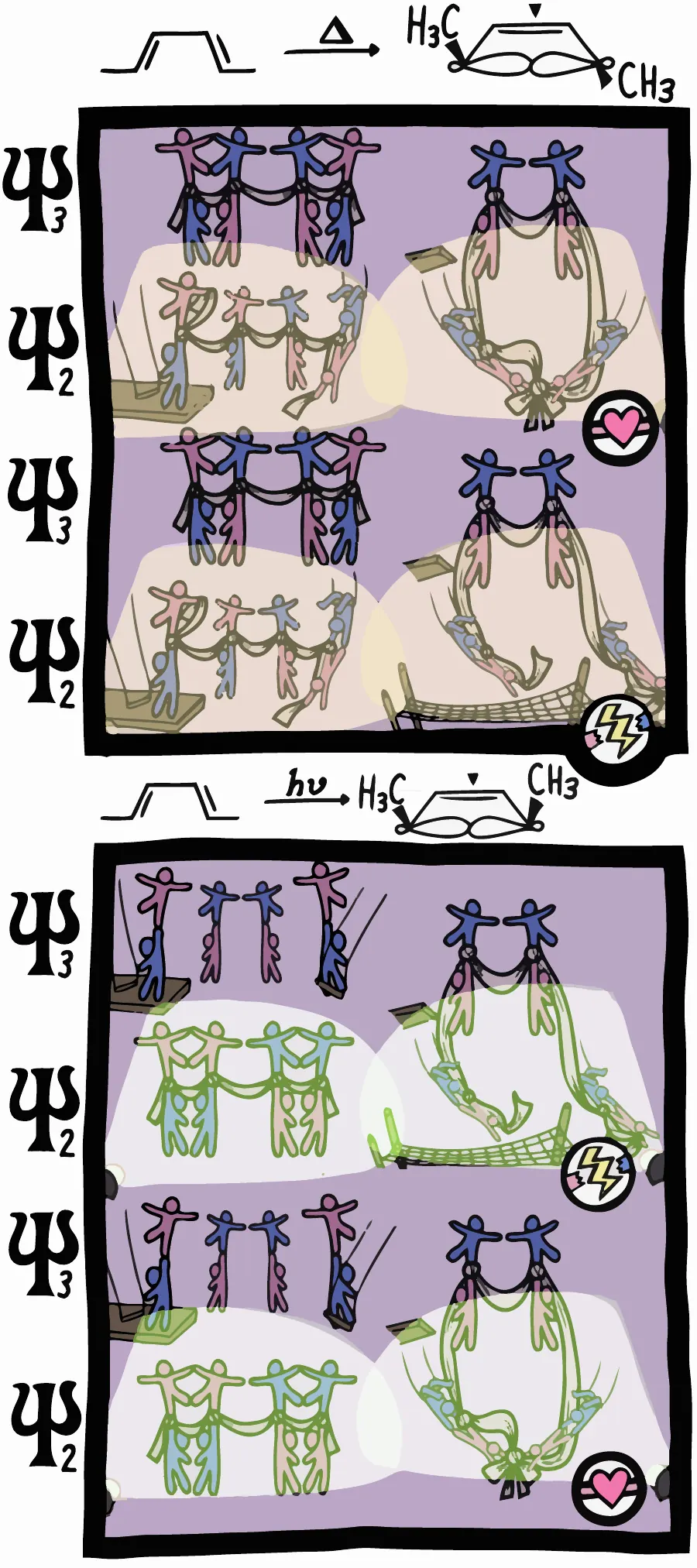
Top (Thermal Electrocyclic Reaction): The ring closure proceeds under heat via disrotatory motion. The HOMO is , antisymmetric, so disrotation preserves bonding overlap. Constructive phase alignment yields product — shown by successful hand-holding of upper dancers.
Second (Forbidden Thermal Reaction): Conrotatory motion under thermal conditions disrupts orbital overlap. Despite symmetrical movement, bonding fails — dancers miss connection.
Third (Photochemical Electrocyclic Reaction): After photoexcitation, the HOMO becomes , symmetric. Now conrotatory motion preserves phase alignment. The dancers execute a stable hand-linked ring — reaction proceeds.
Bottom (Forbidden Photochemical Reaction): Disrotatory motion with breaks symmetry — bonding fails. The dancers’ hands miss again. Only one mode is symmetry-allowed per excitation condition.