Chapter 45 of 50
The Demon is in the Details
« Seul un être aux sens infiniment subtils,tel que le démon de Maxwell,pourrait démêler cet écheveau embrouilléet remonter le cours de l’univers. »
“Oh, ye seekers after perpetual motion,how many vain chimeras have you pursued?Go and take your place with the alchemists!”
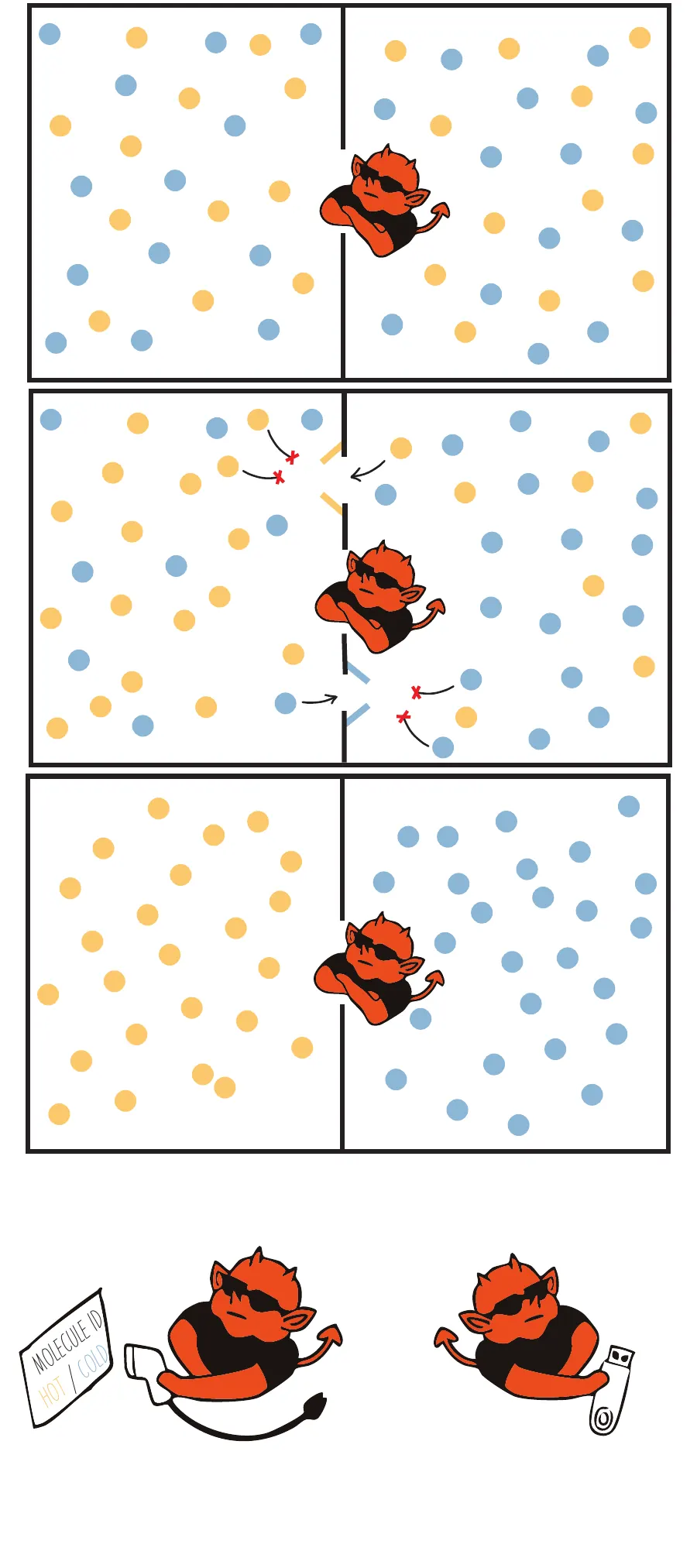
Maxwell’s Demon, proposed in 1867, describes a thought experiment where a tiny being controls a door between two gas chambers, selectively allowing fast molecules into one chamber and slow ones into another. This sorting creates a temperature gradient from uniformity, seemingly decreasing entropy and violating the second law of thermodynamics. The resolutions are through work costs of measurement and the information-theoretic cost of manipulating information.
Topics
- Maxwell’s Demon
- Second Law Challenge
- Entropy & Information
- Boltzmann Statistics
- Molecular Sorting
- Landauer’s Principle
- Bennett’s Resolution
- Information Erasure Cost
- Thermodynamic Computing
- Information is Physical
- Memory Cycle Limits
Sidenote
Top (Maxwell’s Demon): The classic Maxwell’s Demon thought experiment. A demon monitors molecules in a gas and selectively opens a door to let fast-moving (hot) molecules through in one direction and slow-moving (cold) molecules through the other. Over time, this creates a temperature gradient without performing mechanical work, seemingly violating the second law of thermodynamics. Bottom Left (Work Cost): First resolution — work-based measurement cost (Szilard 1929, Brillouin 1951). Determining each molecule’s speed and deciding whether to open the door requires physical measurement processes that generate entropy or consume work, preventing a net decrease in total entropy. Bottom Right (Memory Erasure): Second resolution — memory erasure cost (Landauer 1961, Bennett 1982). Even if measurement and control were performed reversibly with no work cost, the demon’s finite memory would eventually fill. Erasing past measurement records to store new data increases entropy by at least per bit erased (Landauer’s Principle), ensuring the second law remains intact. Either way, the apparent paradox dissolves when information-processing steps are properly accounted for.