Chapter 47 of 50
Matter of Perspective
«Vacuum voco locum omnemin quo corpora sine resistentia movetur.»
«Repugnare ut detur vacuum,sive in quo nulla plane sit res.»
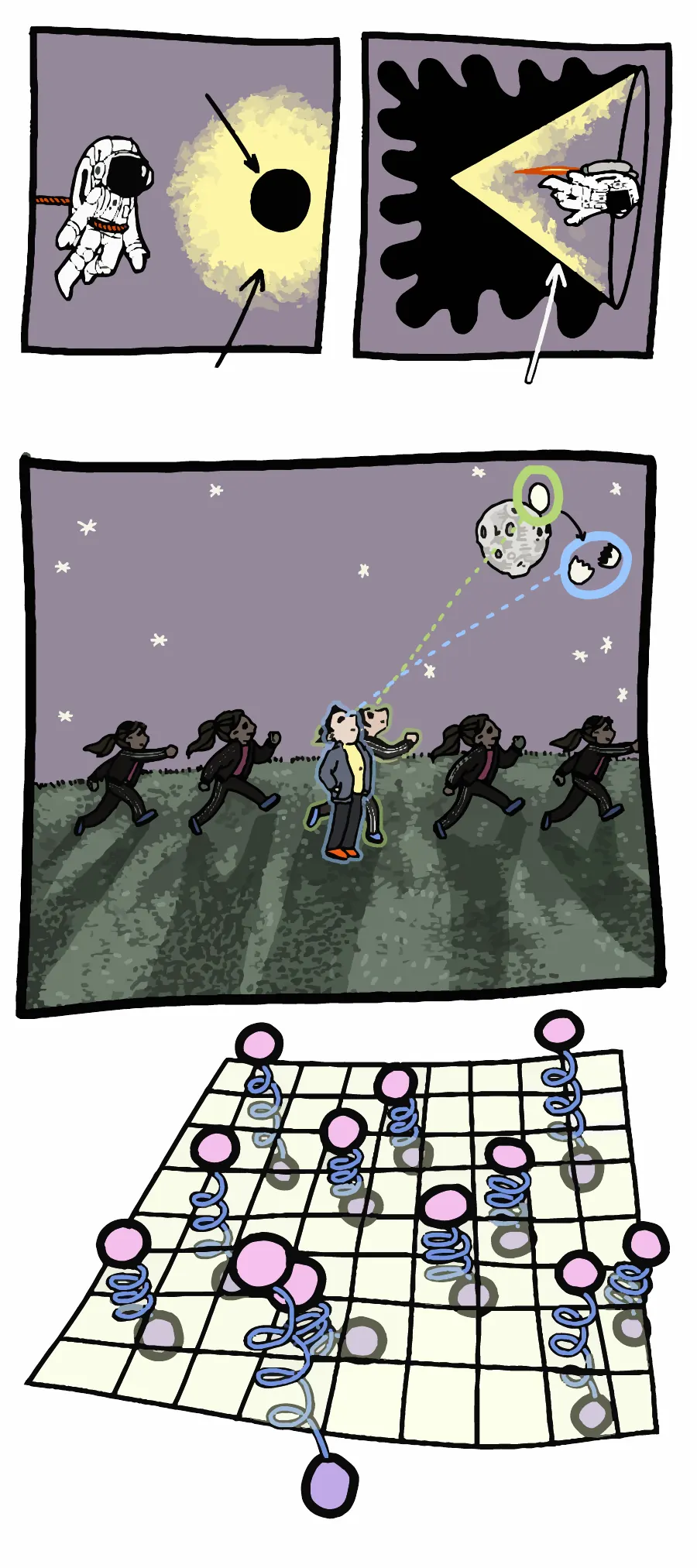
Empty space isn’t empty — and even that depends on who’s looking. The quantum vacuum teems with field fluctuations, but two observers can fundamentally disagree about whether particles exist. An astronaut floating peacefully sees perfect vacuum. Her twin, accelerating through the same region, is bombarded by thermal radiation at temperature — the Unruh effect. Particle content becomes relative, like simultaneity in Einstein’s relativity.
Topics
- Observer-Dependent Vacuum
- Quantum Field Theory
- Curved Spacetime Effects
- Bogoliubov Transformations
- Unruh Effect
- Hawking Radiation
- Cosmological Particle Production
- Dynamical Casimir Effect
- Relative Particle Number
- Killing Vector Fields
- Vacuum State Ambiguity
Sidenote
Top (Unruh effect): Even in vacuum, observers may disagree on particle content. An accelerating observer detects a warm bath of particles where an inertial observer sees none.
Middle (The Andromeda Paradox and Relativity of Simultaneity): Two observers at the same point on Earth — one stationary, one walking — will disagree on what is happening right now (as seen from right here) in distant galaxies. A moon event (such as an egg breaking) can be “now” for the stationary, and “not yet” for the runner.
Bottom (Quantum Fields and Observer-Dependent Particles): What counts as a particle depends on the observer. Each pink sphere represents a local quantum field mode, vibrating against the vacuum. But acceleration or curvature shifts the vacuum state, so an observer may see particles where another sees none — like Unruh radiation or Hawking emission.