Chapter 48 of 50
Chaotic Neutrality
« Pourquoi les chutes de pluie, les tempêtes elles-mêmes nous semblent-ellesarriver au hasard, de sorte que bien des gens trouvent tout naturel de prierpour avoir la pluie ou le beau temps, alors qu’ils jugeraient ridiculesde demander une éclipse par une prière? »
“Let the Lord of Chaos rule.”
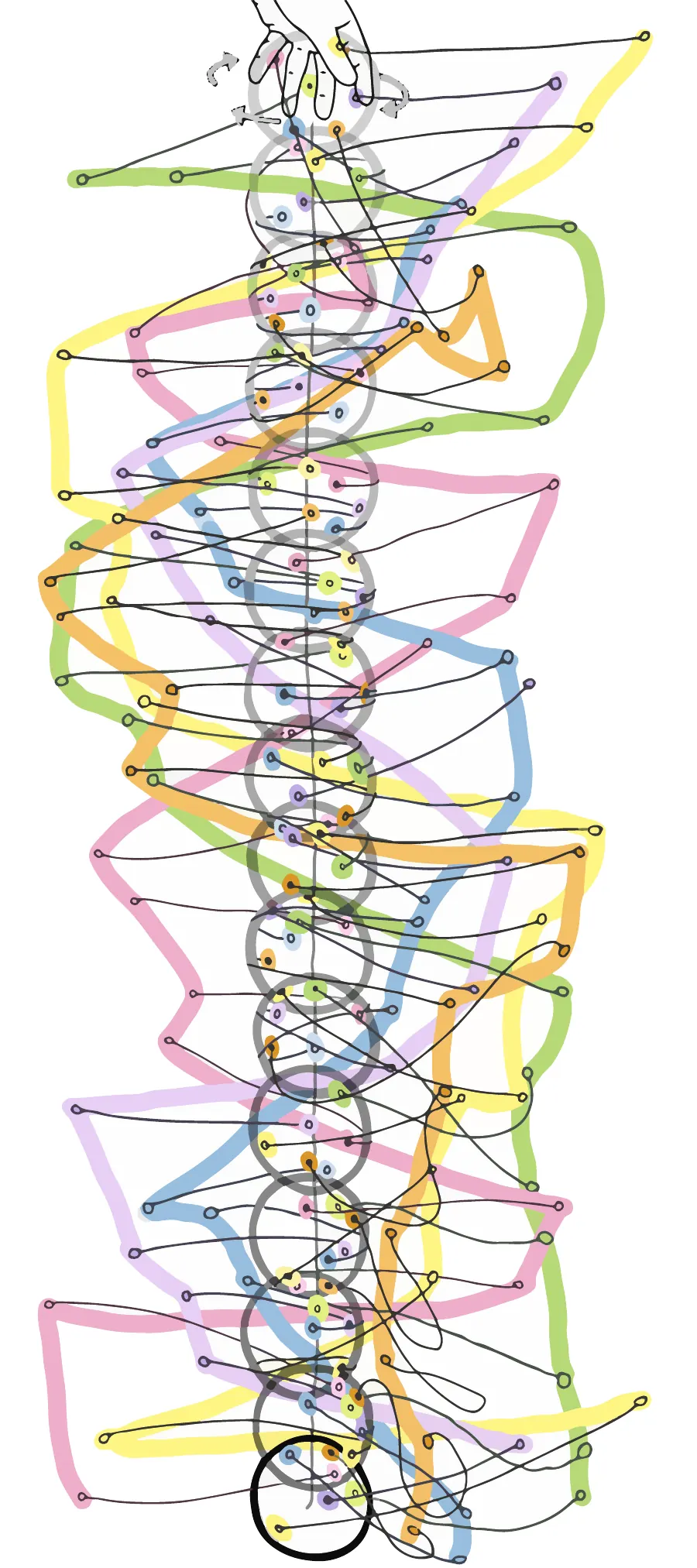
Deterministic systems can exhibit chaotic behavior, where minuscule differences in initial conditions lead to drastically different outcomes. The double pendulum and three-body gravitational problem exemplify this despite having few components and simple equations. Counterintuitively, far more complex systems such as falling objects often behave predictably because dissipative effects continuously suppress perturbations.
Topics
- Three-Body Problem
- Poincaré’s Chaos Discovery
- Deterministic Unpredictability
- Sensitive Initial Conditions
- Double Pendulum
- Butterfly Effect
- Complex System Stability
- Dissipation vs Amplification
- Falling Apple Paradox
- Prediction Horizons
- Chaos Theory
Sidenote
Chaotic Parts, Predictable Whole: Deterministic systems can be chaotic — where tiny changes snowball into wildly different results. Each dot on this falling object traces a unique, tangled trajectory, sensitive to initial conditions. Yet the object as a whole falls smoothly. Dissipative forces such as friction and internal damping suppress chaos, causing the center of mass to follow a clean, Newtonian arc.