Chapter 49 of 50
The Three Genome Problem
“Who in the world am I? Ah, that’s the great puzzle!”
“It has not escaped our notice that the specific pairing we have postulatedimmediately suggests a possible copying mechanism for the genetic material.”
Every human inherits two distinct genomes: nuclear DNA from both parents and mitochondrial DNA almost exclusively from the oocyte. This second genome — 37 genes controlling cellular energy production — mutates 10–100 times faster than nuclear DNA, causing devastating diseases when defective. Traditional IVF cannot prevent mothers from passing faulty mitochondria to children. Enter mitochondrial replacement therapy: scientists transfer nuclear DNA from an affected mother’s egg into a donor egg with healthy mitochondria. From single-base edits to chromosome transfers — many ethical questions arise to be discussed.
Topics
- In Vitro Fertilization
- Mitochondrial DNA Inheritance
- Maternal mtDNA Transmission
- Mitochondrial Disease
- Mitochondrial Replacement
- Three-Parent Baby
- NUMTs Confusion
- Genetic Parentage Redefined
- He Jiankui CRISPR Case
- Oxidative Phosphorylation
- Heteroplasmy
Sidenote
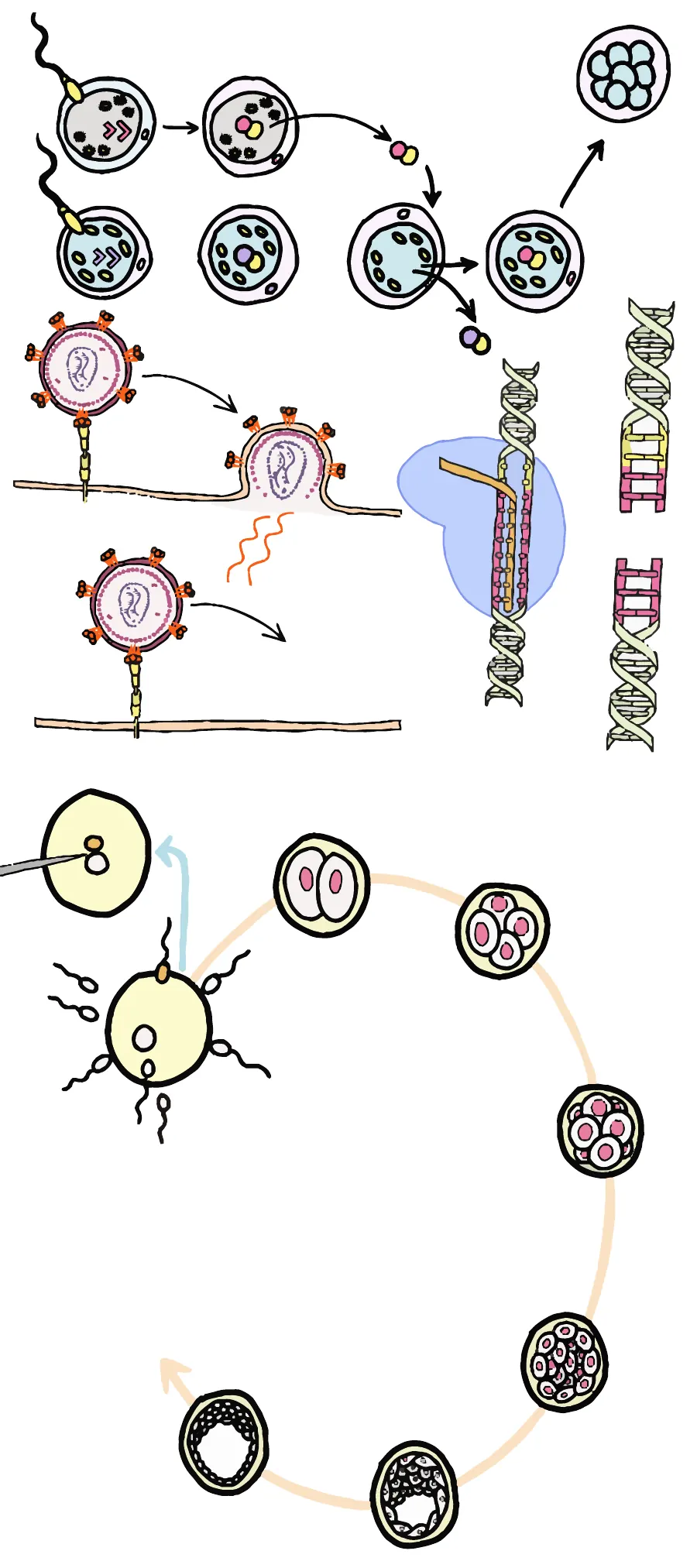
Top (Mitochondrial Replacement Therapy): A fertilized nucleus is inserted into a donor egg with healthy mitochondria, creating an embryo with parental nuclear DNA and donor mtDNA — preventing transmission of mitochondrial disorders.
Middle Left (CCR5 and HIV Resistance): HIV entry requires CCR5. Individuals with the CCR5-Δ32 mutation lack a functional receptor, blocking viral entry. This natural resistance underpins CCR5-targeted therapies.
Middle Right (CRISPR-Cas9 Genome Editing): Cas9 cuts DNA at a targeted site guided by RNA. This enables correction or knockout of specific genes, forming the basis of precise gene therapy.
Bottom Left (Embryonic Germline Editing): CRISPR introduced at the zygote stage edits all descendant cells, including germline — causing permanent, heritable changes. Ethically and legally restricted.
Bottom Right (Embryo Development): Post-fertilization, the embryo progresses through cleavage stages to blastocyst.