Chapter 50 of 50
A Freely Willful Ignorance
«الاعتقاد ليس هو المعنى المقصود، بل المعنى المتصور في النفس»(“Belief is not the utterance, but the conception in the soul.”)
“Reason will prevail.”
Milligrams of propofol erase consciousness in seconds. Fatal familial insomnia prevents its cessation for months until death. While we can reliably toggle awareness, no unified mechanism explains why subjectivity vanishes. Consciousness cannot be reduced to neural correlates or fit by classifiers. Any attempt to locate its origin in physical mechanisms presupposes the very phenomenon under study. Free will and physics appear incompatible, but the standoff is asymmetric: agency is the lived fact that makes physics construction possible. Consciousness occupies the apex of a revision hierarchy where, in any conflict with lower-level descriptions, the knower must prevail.
Topics
- Consciousness & Anesthesia
- General Anesthetic Mystery
- Multiple Molecular Mechanisms
- Fatal Familial Insomnia
- Free Will vs Physics
- First-Person Experience
- Libet Readiness Potential
- Revision Cost Hierarchy
- Cogito Ergo Sum
- Direct Self-Knowledge
- Hard Problem
Sidenote
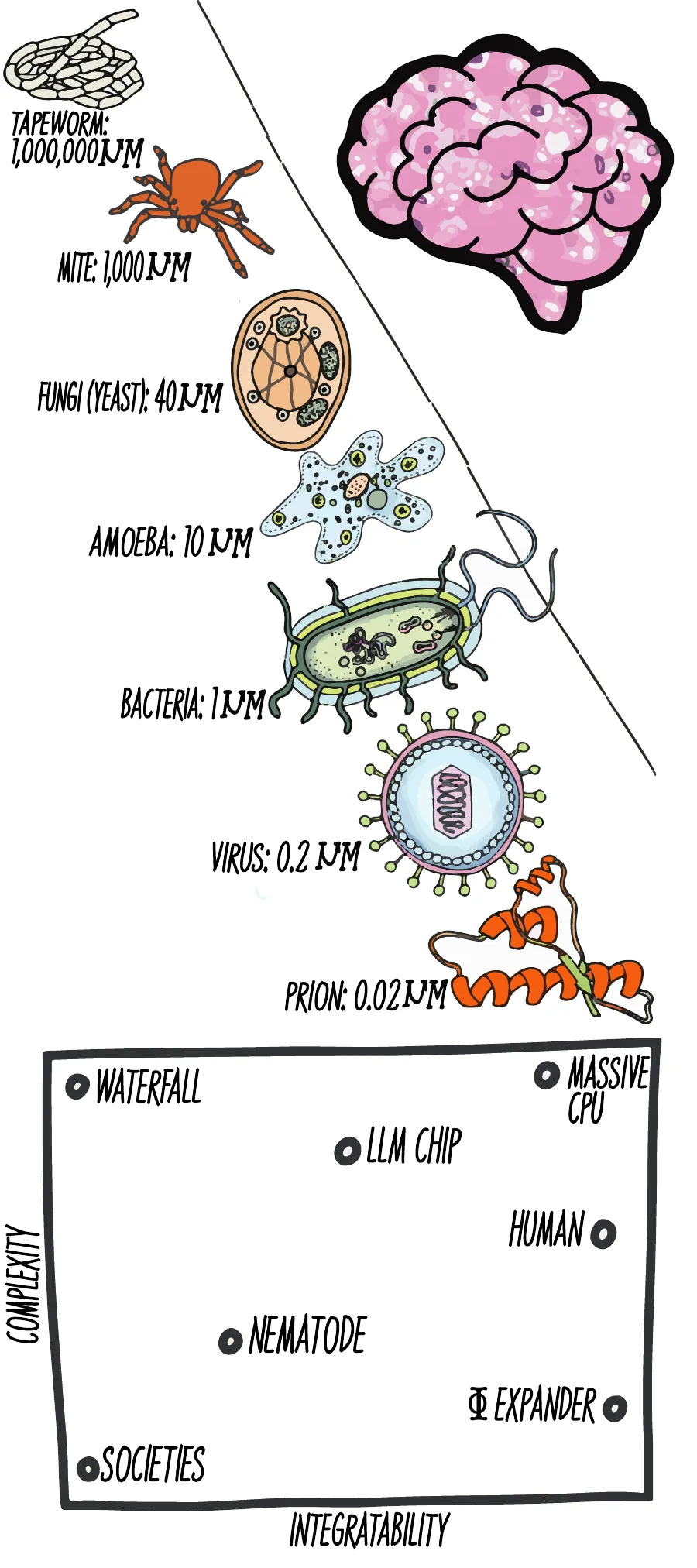
Top (Scales of Infection and Pathogenic Agents): Infectious agents span eight orders of magnitude — from macroscopic parasites such as tapeworms to sub-viral prions. Each has its own transmission pathway, lifecycle, and interaction mode with the host. Top-right: a brain, target of prion neurodegeneration.
Bottom (Post-Hoc Theories of Consciousness): Proposed mechanisms for consciousness map along a complexity–integrability plane: waterfall-like chaos, chip design, nematode circuits, human brains, and societal behavior. But all are descriptive, not explanatory. No theory derives subjective experience from first principles — only correlates it post hoc to system properties, and for each example we can find synthetic constructs as a counter-example. For instance, if we make a chip composed of massively parallel XOR gates arranged in feedback loops to maximize cross-dependence, it can be tuned to produce an arbitrarily high φ value — far exceeding estimates for the human brain — yet the device is nothing more than a repetitive logical expander.